
Claire Jeong, Hanwon Kim, Carrie Wang, and Sophie Xu, Concordia International School Shanghai, Shanghai, China
Reviewed on 9 May 2026; Accepted on 22 June 2026; Published on 26 October 2026
With help from the 2026 BioTreks Production Team.
Bacterial cellulose (BC) is a high-performance, sustainable biomaterial whose exceptional purity, crystallinity, and water retention make it attractive for biomedical devices and flexible electronics. Native producers such as Komagataeibacter spp. are limited by slow growth, genetic instability, and poor scalability, restricting large-scale BC manufacture. E. coli offers a well-characterized, rapid growth chassis, yet recombinant BC yields are constrained by insufficient intracellular UDP-glucose, the direct precursor for cellulose synthase. Our design addresses this bottleneck by co-expressing native E. coli phosphoglucomutase and UDP-glucose pyrophosphorylase, enzymes that together convert glucose-6-phosphate to UDP-glucose, thereby raising the intracellular pool of the essential substrate and enabling higher cellulose synthase activity. To characterize this two-plasmid system, we systematically vary inducer concentration and incubation temperature, assaying growth and fluorescence to identify conditions that maximize UDP-glucose production while maintaining cell viability. These optimized parameters establish a metabolic foundation for scalable, recombinant BC production in E. coli. [possible missing text — see comment] operon, paving the way toward scalable, recombinant BC production in E. coli and broader industrial adoption of this sustainable biomaterial.
Keywords: Bacterial cellulose, phosphoglucomutase, UDP-glucose pyrophosphorylase
Authors are listed in alphabetical order. David Doyle mentored the group. Please direct all correspondence to mailto:david.doyle@concordiashanghai.org.
Background
Cellulose, a structural polysaccharide found in plant cell walls and produced by certain bacteria, is one of Earth’s most common organic materials. Compared to plant-based cellulose, bacterial cellulose (BC) distinguishes itself by its exceptional physicochemical and biological properties: it is highly pure (lacking lignin and hemicellulose) with a crystallinity of up to 90% (Ul-Islam et al., 2019; Popa et al., 2022). Its structure comprises bundles of 2-4 nm cellulose nanofibrils that confer high porosity, water retention, elasticity, and stability under humid conditions. These properties, combined with biocompatibility and non-toxicity, make BC valuable for biomedical applications, including wound dressings, bone repair, drug delivery, and tissue engineering (Abeer et al., 2014; Tronser et al., 2018; Pang et al., 2020), as well as sustainable packaging and flexible electronics (Trigona et al., 2019; Sid et al., 2021). Despite this potential, industrial-scale BC production is constrained by the slow growth, genetic instability, and low productivity of native producers like Komagataeibacter xylinus (Buldum et al., 2018). Consequently, there is a critical need to engineer robust, high-yield production systems in more tractable chassis organisms.
BC biosynthesis in host producers relies on the catalysis of UDP-glucose (UDP-Glc) by the bcsABCD operon (Singhania et al., 2021). In K. xylinus, glucose is phosphorylated to glucose-6-phosphate, converted to glucose-1-phosphate (G1P), and finally reacted with UTP—a precursor of UDP-Glc—by UDP-glucose pyrophosphorylase (UGPase) to form UDP-Glc. This process is demonstrated in Figure 1. While the bcs operon is essential for polymerization, the intracellular availability of UDP-Glc is hypothesized to be a rate-limiting factor. Metabolic modeling of K. xylinus by Zhang et al. (2017) identified that overexpression of galU (encoding UGPase), pgm, and Glucose 6-phosphate isomerase (G6PIS), an enzyme that catalyzes the conversion of glucose-6-phosphate to fructose-6-phosphate, yields the highest predicted BC flux. However, empirical validation of this hypothesis in a non-native host, such as K. xylinus, remains limited.
| Figure 1: Metabolic pathway of Bacterial Cellulose synthesis in K. xylinus, with key enzymes highlighted in blue, (based on Raghavendran et al., 2020) | 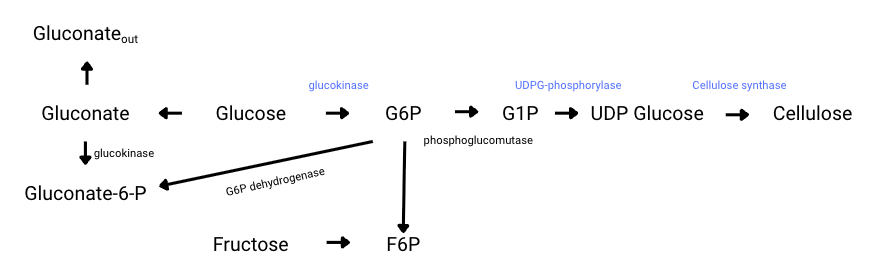 |
|---|
Previous efforts to produce BC in E. coli have demonstrated feasibility but face significant obstacles. Early attempts that expressed only bcsAB failed to achieve proper crystallization. While subsequent studies using the full bcsABCD operon plus accessory genes achieved yields comparable to Komagataeibacter, they encountered toxicity and plasmid instability issues (Buldum et al., 2018), and although strains engineered for toxic protein expression, such as E. coli C41(DE3), have shown promise, systematic optimization of the metabolic precursors driving synthesis is still lacking. Most research has focused on optimizing growth conditions or the synthase complex itself, rather than explicitly testing the impact of precursor concentration on yield.
To address this gap, our project investigates the impact of overexpressing pgm and galU on bacterial cellulose (BC) production in E. coli C41(DE3). We hypothesize that elevating intracellular UDP-Glc concentrations will bypass metabolic bottlenecks and directly enhance the yield of BC mass. Since galU encodes the enzyme that generates the direct substrate for cellulose polymerization, and pgm supplies its necessary precursor, glucose-1-phosphate, their combined overexpression aims to maximize substrate availability for the cellulose synthase complex. Our experimental design focuses on characterizing inducer concentrations and various temperatures in order to maximize BC cellulose by implementing a two-plasmid system in E. coli to coexpress cellulose synthase and the pgm/galU device.
Systems level
Our system examines the effect of pgm and galU on bacterial cellulose yield in E. coli with a two-plasmid system. The first plasmid includes genes pgm and galU; pgm codes for phosphoglucomutase, the enzyme responsible for converting glucose-6-phosphate into glucose-1-phosphate, and galU codes for UDP-glucose pyrophosphorylase, the enzyme that catalyzes the conversion of glucose-1-phosphate and UTP (Uridine triphosphate) into UDP-Glc. The second plasmid contains bcsABCD, an operon isolated from K. xylinus that synthesizes and excretes cellulose from UDP glucose. The introduction of upstream genes pgm and galU aims to maximize yield by enhancing substrate availability. This design considers that recombinant BC synthesis has the highest yield under low induction with isopropyl β-d-1-thiogalactopyranoside (IPTG), a chemical inducer that activates the T7 promoter, that balances the host's metabolic burden, (Buldum et al., 2018), ruling out higher induction as a potential way to improve yield. Noting that the literature conflicts on whether accessory genes ccpax and cmcax are necessary for BC synthesis, the exclusion of these genes was a deliberate choice to reduce the genetic payload of the system and improve construct stability.
Device level
| Figure 2. The genetic construct of promoter-GalU-pgm-GFP, which was constructed using Kernel. Asimov, Inc. (2026). Kernel [Version 3.239.3] [Web-based software]. https://www.asimov.com/kernel (Accessed January 15, 2026) | 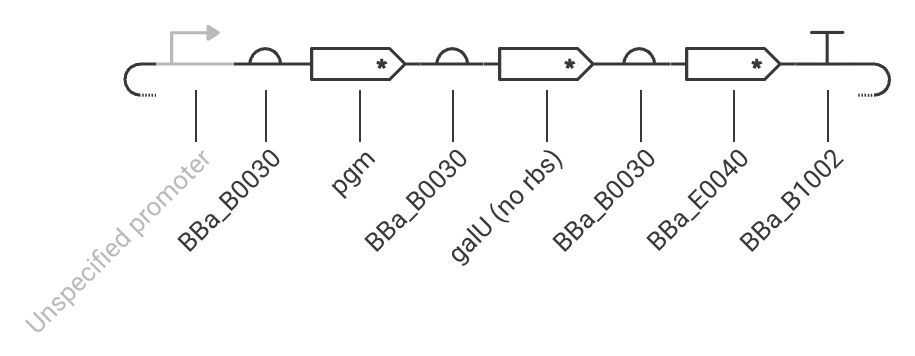 |
|---|
The dual plasmid system involves two distinct pathways: the first plasmid includes the UDP-Glc precursor pathway (Figure 2), and the second plasmid contains the bacterial cellulose synthase pathway (Figure 3). Plasmid one includes pgm, which encodes phosphoglucomutase, an enzyme that catalyzes the reversible interconversion of glucose-1-phosphate into glucose-6-phosphate via the enzyme-bound intermediate glucose-1,6-bisphosphate (Lu & Kleckner, 1994); under conditions where downstream enzymes such as galU actively consume glucose-1-phosphate to produce UDP-Glc, overexpression of pgm is expected to increase carbon flux toward the UDP-Glc pool required for bacterial cellulose synthesis. Metabolic flux is pulled toward UDP-Glc synthesis by the high availability of glucose-6-phosphate from glycolysis and the subsequent consumption of glucose-1-phosphate by galU, which drives the equilibrium forward. Because pgm is native and highly conserved in both E. coli and K. xylinus, and because galU utilizes glucose-1-phosphate as its substrate, co-overexpression of pgm ensures sufficient precursor availability to support increased UDP-Glc synthesis. galU lies downstream of pgm, coding for UGPase. UGPase catalyzes the conversion of glucose-1-phosphate and UTP into UDP-Glc, the direct metabolic precursor for bacterial cellulose synthesis. Both pgm and galU are native to E. coli, and their overexpression aims to increase intracellular UDP-Glc levels and thereby enhance substrate availability for downstream cellulose polymerization by the bcs operon.
| Figure 3. Schematic representation of the engineered plasmids used. The left construct carries pgm and galU under the T7lac promoter, while the right construct contains the bcsABCD operon, with each gene regulated by a T7lac promoter. Both plasmids include an origin of replication (Ori) and antibiotic resistance markers, which are shown as placeholders rather than specific genes. | 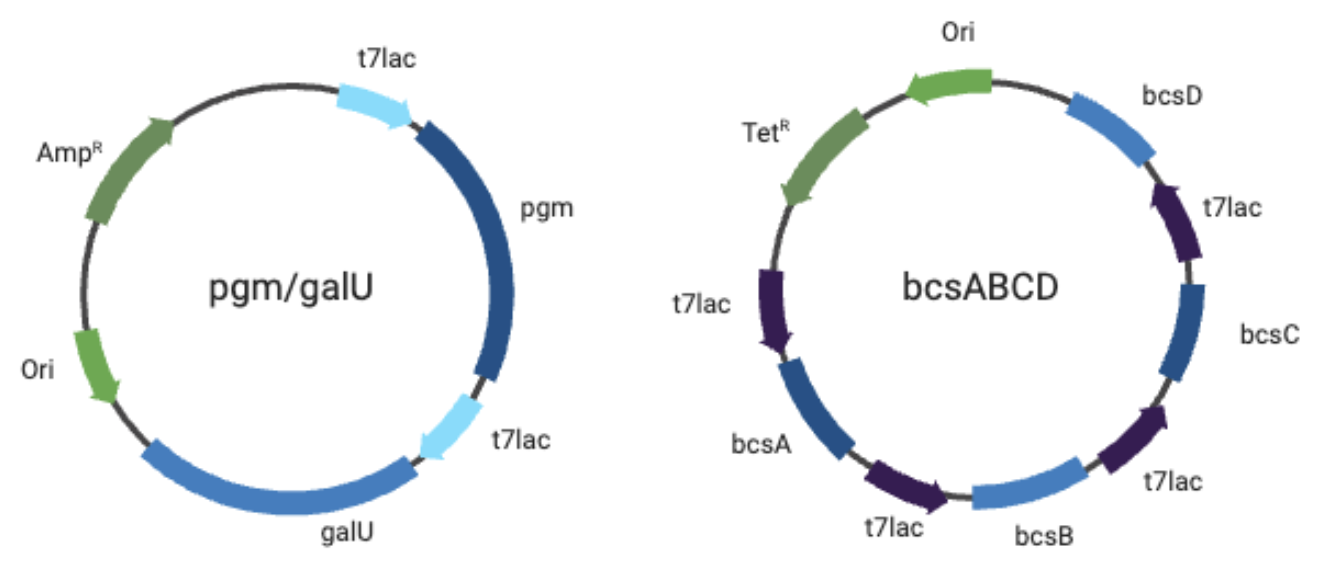 |
|---|
Plasmid two includes the bcsABCD operon, first identified in K. xylinus. While the four-gene bcsABCD operon is essential for BC production in vivo, the bcsA and bcsB pair alone is sufficient to synthesize BC in vitro (Römling & Galperin, 2015). bcsA and bcsB code for the membrane protein bacterial cellulose synthase, while bcsC and bcsD are essential for the secretion and assembly of bacterial cellulose (Kondo et al., 2022). All plasmids will utilize the T7lac promoter before each gene; inducible expression is valuable given the metabolic burden these plasmids will likely place on the host cell. Thus, dual expression with bcsABCD and pgm/galU will be controlled under IPTG induction, and success will be measured in the weight of BC.
Several bacterial strains have been shown to successfully express BC synthase; among them, E. coli C41 (DE3) was a natural choice of chassis (Buldum et al., 2018). Its enhanced plasmid stability and tolerance to toxic recombinant protein expression, as well as its higher transformation efficiency compared to strains such as E. coli BL21(DE3) (Dumon-Seignovert et al., 2004) moderated the misfolding of recombinant membrane proteins and limited their toxicity. The broader decision to focus on recombinant BC production in E. coli had two reasons. First, E. coli’s well-characterized genetics, extensive molecular biology toolkit, and ease of manipulation are well-suited for testing plasmid systems such as the pgm/galU device. Second, K. xylinus’s slow growth and instability render large-scale BC synthesis difficult (Buldum et al., 2020). E. coli as an alternative host offers an optimistic solution.
Parts level
The RBS (BBa_B0030) is a standard ribosome binding site characterized by many past iGEM teams, including the 2022 William & Mary iGEM Team’s chassEASE project, where it was used to drive translation upstream of a GFP coding sequence (Experiments | William_and_Mary – IGEM 2022, 2022). and is also widely utilized for its strong protein expression, making it a clear choice for overexpressing key genes in the bacterial cellulose pathway.
The T7lac promoter (BBa_J435350) chosen is a standard promoter that enables tightly controlled, high levels of transcription that are induced under IPTG. Considering its well-characterized kinetics and strong expression, this would be a standard choice to establish a baseline for expression levels.
The pgm/galU device will be inserted into the vector pBR322, which was selected for its medium copy number and lack of an internal promoter, allowing for quicker ligation by dividing the digested vector into aliquots for different promoter groups without additional steps to remove an internal promoter. The primary antibiotic marker for this plasmid is ampicillin, and this was a clear choice because of its reliability and accessibility. The pgm/galU device, promoters, and backbone will be ligated together in a one-pot procedure using modified 3A assembly. Each of these parts is sourced from the Registry of Standard Biological Parts and is fittingly designed to have specific, complementary restriction sites with BioBrick suffixes and prefixes to ensure ligation. Following this, the plasmids would be transformed into the C41(DE3) cells, which are optimized for high-level expression of recombinant proteins and tolerance to toxic products.
The pACYCDuet-1 vector was chosen for the bcsABCD device. Its ori is p15A, which is compatible with the pMB1 origin found in pBR322. The origin is also for a medium copy number of plasmid, which is suitable given the metabolic burden bcsABCD expression exerts on its host (Buldum et al., 2018). The vector confers resistance to chloramphenicol, which is suitable for selective antibiotic resistance to ensure plasmid uptake. This vector also has T7/lac, meaning it is compatible with our genetic design.
After heat shock of competent cells at 42°C with both plasmids, the cells are to be plated on both ampicillin and chloramphenicol markers.
Safety
This project utilizes E. coli C41(DE3), a non-pathogenic derivative of the K-12 lineage classified as Biosafety Level 1 (BSL-1). This strain was selected for its enhanced tolerance to recombinant protein expression and lack of virulence factors, minimizing risks to researchers and the environment. All molecular cloning and culture work will be performed in a certified biosafety cabinet following Good Microbiological Practices, including the use of appropriate personal protective equipment.
To prevent environmental release, all liquid and solid waste containing genetically modified organisms will be autoclaved at 121°C for at least 1 hour prior to disposal. The experimental design prioritizes safety by avoiding antibiotic resistance markers where possible and relying on metabolic selection or low-copy plasmids to reduce the risk of horizontal gene transfer. Additionally, the project uses a phased approach that initially focuses on optimizing precursor pathways (pgm and galU) before further steps. This strategy allows for the identification and management of metabolic burdens within a controlled setting, ensuring the system remains stable and safe before scaling toward industrial material production.
Discussions
This dual plasmid system presents a promising approach to precursor limitations in large-scale BC production. It addresses the lack of research conducted on heterogeneous BC synthesis and addresses yield concerns. Although K. xylinus naturally produces BC, introducing the pgm/galU device could further enhance UDP-Glc availability, potentially increase cellulose yield, and improve production efficiency. Efficient BC production allows for a wide range of industrial and biomedical applications, such as electronics and wound dressings (Klemm et al., 2005).
While E. coli is not naturally adapted for cellulose secretion, the use of E. coli as a chassis addresses several limitations in native BC producers. K. xylinus grows slowly and has lower productivity relative to other bacteria, and spontaneous mutation of cellulose-producing strains to non-cellulose-producing strains hinders BC production from scaling up (Buldum et al., 2018; Al-Janabi et al., 2022). However, E. coli’s superior growth kinetics and developed genetic toolkit offer a heterogeneous solution to complications found in native producers. Nonetheless, a heterogeneous system presents its own challenges. The introduction of the bcs operon in E. coli BL21 was met with the formation of inclusion bodies and plasmid instability (Buldum et al., 2018; Al-Janabi et al., 2022). Although using the E. coli strain C41 (DE3) addresses this concern, the instability of the bcsABCD operon in heterogeneous hosts is a potential problem. Additionally, the metabolic burden of maintaining two plasmids simultaneously imposes a fitness cost on the host. To monitor this, we will track optical density at 600 nm (OD600) alongside induction to detect early signs of growth suppression before yield data becomes uninterpretable.
Furthermore, a dual plasmid system is prone to loss of plasmid due to plasmid segregation. Constitutive gene expression negatively impacts segregational plasmid instability (Popov et al., 2011). Thus, IPTG induction and the T7/lac promoter are used for all genes in this project. The metabolic burden imposed on the cell by these plasmids can be addressed in the future by using alternative promoters (Silva et al., 2012). Cell growth may also be inhibited due to changes in metabolic flux, potentially compromising yield to ensure the health of cell cultures.
In the design, we will determine success by comparing the dry weight of BC between the different experimental groups. By screening the impacts of inducer concentrations of IPTG and incubation temperatures, we will determine which set of variables will maximize BC growth. The controls will contain an empty pBR322 vector with the bcsABCD plasmid, illustrating how the genes pgm/galU are needed for BC synthesis.
Next steps
First, we will integrate these experimental results into a mathematical model to predict system behavior under untested conditions. This modeling phase will refine our selection of the optimal inducer-temperature combination, providing a data-driven rationale for the final configuration. Next, we will move to constructing and testing a two-plasmid co-expression system. This final step involves introducing the cellulose synthase operon (bcsABCD) alongside our pgm/galU pathway to verify that the increased precursor pool successfully drives bacterial cellulose production in E. coli C41(DE3).
Author contributions
The Shanghai Crocodiles BioBuilder team collaborated throughout all project phases. CJ led mentorship communication and scheduled meetings, working with HK to finalize the experimental design and purchasing logistics. HK supported planning and led dry lab computations. CW led task delegation and project timeline while executing wet lab procedures alongside SX, who coordinated wet lab protocols and tracked experimental progress.
Acknowledgements
We would like to express our sincere gratitude to Dr. Rick Roy of Genome Surfer, Inc. for his invaluable guidance and support throughout our research process. His assistance in helping us refine our research topic and providing constructive feedback on our drafts greatly enhanced the feasibility of our project. We also wish to thank the Biobuilder Education Foundation for offering a platform that enabled us to develop and present our research. Finally, we are deeply grateful to Mr. David Doyle, our synthetic biology instructor, for his unwavering support throughout the entire research and experimental process.
References
Abeer, M. M., Mohd Amin, M. C. I., & Martin, C. (2014). A review of bacterial cellulose-based drug delivery systems: their biochemistry, current approaches and future prospects. Journal of Pharmacy and Pharmacology, 66(8), 1047–1061. https://doi.org/10.1111/jphp.12234
Al-Janabi, S. S., et al. (2022). Stable, efficient, and cost-effective system for the biosynthesis of recombinant bacterial cellulose in Escherichia coli DH5α platform. Journal of Genetic Engineering and Biotechnology, 20(1). https://doi.org/10.1186/s43141-022-00384-7
Asimov, Inc. (2026). Kernel (Version 3.239.3) [Web-based software]. https://www.asimov.com/kernel (Accessed January 15, 2026)
Buldum, G., Bismarck, A., & Mantalaris, A. (2018). Recombinant biosynthesis of bacterial cellulose in genetically modified Escherichia coli. Bioprocess and biosystems engineering, 41(2), 265–279. https://doi.org/10.1007/s00449-017-1864-1
Buldum, G., Tsipa, A., & Mantalaris, A. (2020). Linking engineered gene circuit kinetic modeling to cellulose biosynthesis prediction in Escherichia coli: Toward bioprocessing of microbial cell factories. Industrial & Engineering Chemistry Research, 59(10), 4659-4669. https://doi.org/10.1021/acs.iecr.9b05847
Dumon-Seignovert, L., Cariot, G., & Vuillard, L. (2004). The toxicity of recombinant proteins in Escherichia coli: a comparison of overexpression in BL21(DE3), C41(DE3), and C43(DE3). Protein Expression and Purification, 37(1), 203–206. https://doi.org/10.1016/j.pep.2004.04.025
Experiments | William_and_Mary – iGEM 2022. (2022). Igem.wiki. https://2022.igem.wiki/william-and-mary/experiments
Klemm, D., Heublein, B., Fink, H. P., & Bohn, A. (2005). Cellulose: fascinating biopolymer and sustainable raw material. Angewandte Chemie (International ed. in English), 44(22), 3358–3393. https://doi.org/10.1002/anie.200460587
Kondo, T., Nakamura, Y., Nojima, S., Yao, M., & Imai, T. (2022). The BcsD subunit of type I bacterial cellulose synthase interacts dynamically with the BcsAB catalytic core complex. FEBS Letters, 596. https://doi.org/10.1002/1873-3468.14495
Lu, M., & Kleckner, N. (1994). Molecular cloning and characterization of the pgm gene encoding phosphoglucomutase of Escherichia coli. Journal of Bacteriology, 176(18), 5847–5851. https://doi.org/10.1128/jb.176.18.5847-5851.1994
Pang, M., Huang, Y., Meng, F., Zhuang, Y., Liu, H., Du, M., Ma, Q., Wang, Q., Chen, Z., Chen, L., Cai, T., & Cai, Y. (2020). Application of bacterial cellulose in skin and bone tissue engineering. European Polymer Journal, 122, 109365. https://doi.org/10.1016/j.eurpolymj.2019.109365
Popa, L., Ghica, M. V., Tudoroiu, E.-E., Ionescu, D.-G., & Dinu-Pîrvu, C.-E. (2022). Bacterial Cellulose—A Remarkable Polymer as a Source for Biomaterials Tailoring. Materials, 15(3), 1054. https://doi.org/10.3390/ma15031054
Popov, M., Petrov, S., Nacheva, G., Ivanov, I., & Reichl, U. (2011). Effects of a recombinant gene expression on ColE1-like plasmid segregation in Escherichia coli. BMC biotechnology, 11, 18. https://doi.org/10.1186/1472-6750-11-18
Raghavendran, V., Asare, E., & Roy, I. (2020). Bacterial cellulose: Biosynthesis, production, and applications. Advances in Microbial Physiology, 89–138. https://doi.org/10.1016/bs.ampbs.2020.07.002
Römling, U., & Galperin, M. Y. (2015). Bacterial cellulose biosynthesis: Diversity of operons, subunits, products, and functions. Trends in Microbiology, 23(9), 545-557. https://doi.org/10.1016/j.tim.2015.05.005
Sid, S., Mor, R. S., Kishore, A., & Sharanagat, V. S. (2021). Bio-sourced polymers as alternatives to conventional food packaging materials: A review. Trends in Food Science & Technology, 115, 87–104. https://doi.org/10.1016/j.tifs.2021.06.026
Silva, F., Queiroz, J., & Domingues, F. (2012). Evaluating metabolic stress and plasmid stability in plasmid DNA production by Escherichia coli, Biotechnology Advances, 30(3), 691-708. https://doi.org/10.1016/j.biotechadv.2011.12.005
Singhania, R. R., et al. (2021). Genetic modification for enhancing bacterial cellulose production and its applications. Bioengineered, 12(1), 6793-6807. https://doi.org/10.1080/21655979.2021.1968989
Trigona, C., Graziani, S., Di Pasquale, G., Pollicino, A., Nisi, R., & Licciulli, A. (2019). Green Energy Harvester from Vibrations Based on Bacterial Cellulose. Sensors, 20(1), 136. https://doi.org/10.3390/s20010136
Tronser, T., Laromaine, A., Roig, A., & Levkin, P. A. (2018). Bacterial Cellulose Promotes Long-Term Stemness of mESC. ACS Applied Materials & Interfaces, 10(19), 16260–16269. https://doi.org/10.1021/acsami.8b01992
Ul-Islam, M., Khan, S., Ullah, M. W., & Park, D. J. (2019). Comparative study of plant and bacterial cellulose pellicles regenerated from dissolved states. International Journal of Biological Macromolecules, 137, 247-252. https://doi.org/10.1016/j.ijbiomac.2019.06.232
Zhang, H., Ye, C., Xu, N., Chen, C., Chen, X., Yuan, F., Xu, Y., Yang, J., & Sun, D. (2017). Reconstruction of a Genome-scale Metabolic Network of Komagataeibacter nataicola RZS01 for Cellulose Production. Scientific Reports, 7(1). https://doi.org/10.1038/s41598-017-06918-1