
Jack Baron, and James Collins, Andover High School, Andover, Massachusetts, United States of America
Reviewed on 9 May 2026; Accepted on 22 June 2026; Published on 26 October 2026
With help from the 2026 BioTreks Production Team.
Pine trees are found throughout the world, and are invaluable to the many ecosystems they inhabit. They stabilize soil, prevent erosion, store carbon, and provide vast economic value in the form of the lumber, paper, and resin industries. As one of the most widespread tree genera, found throughout the world and dominating the forests of the northern hemisphere, their success is deeply linked with their ecosystems (Hu, 2024). Pine Wilt Disease (PWD) is the most destructive disease that the Pinus genus faces. It is responsible for environmental devastation around the world, and economic losses of tens of millions of dollars. It is caused by the Pinewood Nematode (PWN), Bursaphelenchus xylophilus, reproducing within the resin canals of a Pinus tree and killing it within weeks. Nematicides are substances which kill and/or disable nematodes, and consist of organic compounds that harm them. In trees, these nematicides are naturally produced as a defense mechanism when an infection is detected, working as part of their immune system. However, their natural defences are often insufficient to defend against infections from B. xylophilus. To prevent this, the system will start with an input of a bacteria (Pseudomonas abietaniphila) engineered to release nematicides within the trees. As the nematicide spreads throughout the trees, it will prevent the B. xylophilus infection from spreading. Then, the bacteria will spread to other susceptible tree species, such as pines, until all of the trees are immunized. This is the simplest way to get rid of B. xylophilus without harming the trees. This nematicide will be in the form of the enzyme chitinase, with the engineered bacteria producing large quantities of it. This chitinase breaks down chitin, the main substance in B. xylophilus eggshells. The chitinase will break down the eggshells, causing them to rupture or hatch early. Chitinase production at a large scale can occur within the tree without causing adverse effects on it, as trees produce and use chitinase naturally in defense against infections.
Keywords: Pine Wilt Disease, Pinewood Nematode, Bursaphelenchus xylophilus, Pinus, Pseudomonas abietaniphila, Chitinase
Authors are listed in alphabetical order. Lindsey L'Ecuyer. Andover High School mentored the group. Please direct all correspondence to mailto:lindsey.lecuyer@andoverma.us.



Background
Pine Wilt Disease (PWD) is the most destructive disease that the Pinus genus faces. It is responsible for environmental devastation around the world, and economic losses of tens of millions of dollars (Tóth, 2011). It is caused by the Pinewood Nematode (PWN) Bursaphelenchus xylophilus. Nematodes are microscopic roundworms which inhabit almost every environment on earth. While generally harmless, some like B. xylophilus are parasitic, infecting plants like Pinus trees. Although it causes harm to many species of Pinus and other genera of trees, it is beneficial for many other important organisms, limiting possible solutions for fear of harming other species, such as its vector, or sawyer beetles (Monochamus). These animals facilitate the spread of PWN, but they are also important species in their own right, being vital parts of nutrient cycling and decomposition in forests (Longhorned Beetles (Borers; Sawyer Beetles), 2024). Some current solutions include removing dead and infected trees, injecting nematicides into trees to kill the PWN, and using microbes to kill the PWN. These solutions are costly and only partially effective, as once a tree is infected, PWN will still spread to other trees. They also run the risk of disrupting other species' life cycles and harming the ecosystem. PWN’s extremely short lifecycle makes certain solutions difficult to implement, as it can finish its life in only four days. It spreads to trees inside of its insect vectors, beetles of the genus Monochamus that carry the nematodes from tree to tree. These beetles rely on dead trees to lay their eggs, so saving more trees could have a compounding effect on the rate at which they are saved (Shi, 2022). After it is infected with the nematode, the infected adult sawyer beetle flies to a healthy tree and feeds on young shoots. The nematode senses chemicals released by the tree, exits the beetle and enters the tree. If the tree is not of the Pinus genus PWN will simply die, as shown in Figure 1. If it is a tree in the Pinus genus, however, the nematodes will feed and multiply inside of the tree within weeks, killing it in months (Gleason, 2000). Around 30,000 or more individual nematodes are needed to kill a tree (Kiyohara, 1971). This is known as the Plant-feeding phase. Scolytinae take advantage of the dead tree, boring into it as a part of their life cycle. These beetles are vectors for a fungus called the Blue-Stain fungus, which fills a dead tree with blue fungus. The nematodes now begin to feed on the fungus inside the tree. This part of the life cycle is called the Fungus-feeding phase. The sawyer beetles lay eggs in the dead tree, and once they become pupae the nematode is attracted to them and infects them. The sawyer beetle grows and becomes an adult, it carries the nematodes to another tree, and the cycle repeats.
| Figure 1. (Life cycle of B. xylophilus nematode) The life cycle of the pinewood nematode starts by eating blue stain fungus and infecting the larvae of Sawyer Beetles. The beetle hatches carrying the nematode and the infected adult feeds on young pine chutes. Nematode leaves the beetle and infects the pine tree, reproducing in the resin canals and killing the tree. Bark Beetle transmits blue stain fungus to the dead tree, and Sawyer Beetle lays eggs in the dead tree bark. The cycle then repeats. | 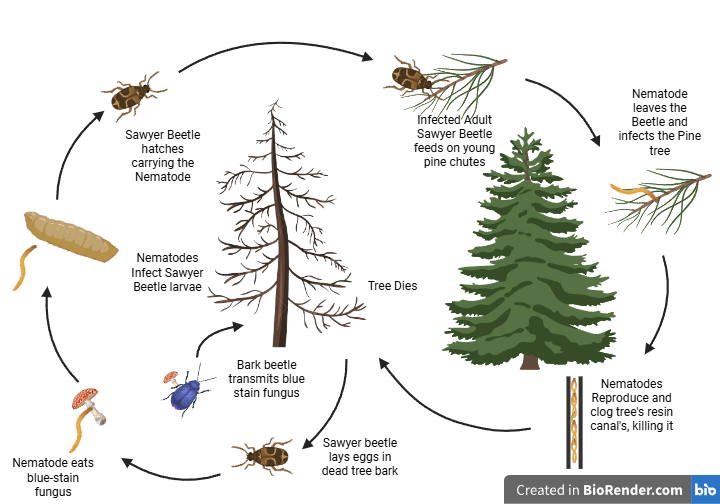 |
|---|
This paper attempts to find a solution to this problem by utilizing a modified strain of the bacteria Pseudomonas abietaniphila.
Systems level
This project proposes a modified version of the bacterium Pseudomonas abietaniphila, which would carry modifications causing a large increase in the production of the enzyme chitinase. Chitinase is an enzyme that is naturally found within the trees of the Pinus genus, and can assist in stopping the reproduction of Bursaphelenchus xylophilus by destroying their eggs so they are unable to hatch, as shown in Figure 2. Chitinase is generally used by trees as a defense mechanism against fungi cell walls and insect exoskeletons, both containing chitin. As an enzyme, chitinase acts as a catalyst for the hydrolysis of chitin, breaking down the bonds and destroying the larger structures. P. abietaniphila has been shown to be actively beneficial for trees in the Pinus genus, promoting growth of branches and roots (Peng et al., 2024). The modified bacteria would be injected into trees, where they would reproduce while producing elevated levels of chitinase. P. abietaniphila naturally inhabits the resin canals of Pinus trees, which would bring them in contact with B. xylophilus. It has a variety of specialized adaptations to allow this, including having specialized gene clusters and enzymes that catabolize the normally toxic tricyclic diterpenoids (resin acids) and convert them into usable energy, as well as heightened stress response genes for counteracting the osmotic pressure of the resin. The nematode causes the majority of its damage in those areas, so the ease of access P. abietaniphila has to it allows easier access in mitigating the damage. As they spread throughout the trees, they eventually make it through to the roots and leaves, where they are then able to travel to nearby trees, spreading the “infection” of the bacteria, and allowing it to defend nearby trees. Eventually, it would spread throughout the region and stop the ability of B. xylophilus to spread entirely.
| Figure 2. (Life cycle of proposed P. abietaniphila) The cycle of modified P. abietaniphila begins with infecting a tree susceptible to PWN. Bacteria spread throughout the tree, colonizing it, and releasing more bacteria into the environment to go to different trees. The bacteria release chitinase, which kills any B. xylophilus that it encounters. | 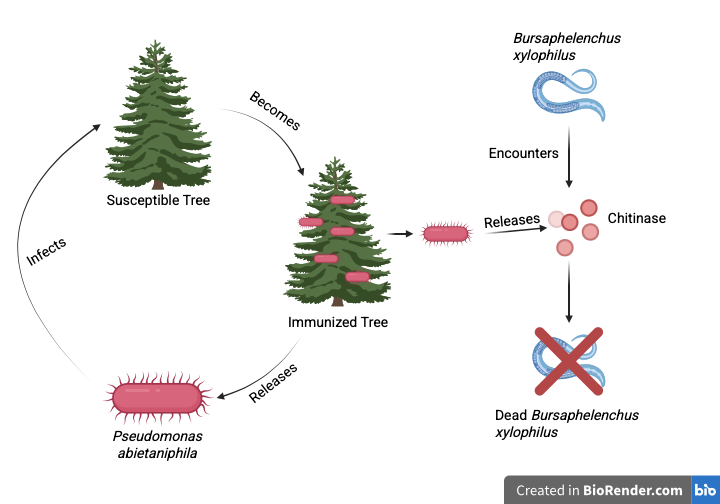 |
|---|
Device level
For our chassis, we selected Pseudomonas abietaniphila, a bacterium that naturally inhabits coniferous trees, and is especially resistant to the resin found within the vascular channels of the trees, which can be difficult for other species of bacteria to inhabit (Martin & Mohn, 1999). P. abietaniphila is a prolific secreter, which indicates its ability to spread enzymes and other substances throughout its environment, as opposed to keeping it within its own range. This allows it to spread the enzyme at an effective rate throughout the tree, and efficiently prevents B. xylophilus reproduction. As shown in Figure 3, due to the fact that the primary location within the trees that B. xylophilus inhabits during infection is the resin channels the process of targeting the eggs will be simplified, as P. abietaniphila is a natural inhabitant of these channels. Additionally, this chassis, even before editing, already has a variety of beneficial effects towards the trees it colonizes, including stimulating the growth of the plant’s roots, and increasing the natural expression of the chitinase production gene within the tree, which is vital for protection against pathogens such as B. xylophilus. (Peng et al., 2024). Specific strains of P. abietaniphila such as BHJO4 have been shown to cause significant activation of Pinus defense mechanisms against nematodes, including dehydration-responsive protein, chitinase, PR-2 (β-1,3-glucanase), and PR-5 (thaumatin-like protein) genes (Li et al., 2026). This provides a clear precedent for the effectiveness of P. abietaniphila as a mechanism for fighting against nematode infections. With the DNA alterations our paper is suggesting, this effectiveness will be increased further.
| Figure 3. (Modified P. abietaniphila mechanism) Inside the resin channels of Pinus trees, the modified P. abietaniphila excretes chitinase, which ruptures PWN eggs, stopping them from hatching and bringing more nematodes. The modified gene sequence is turned into chitinase protein through transcription and translation. | 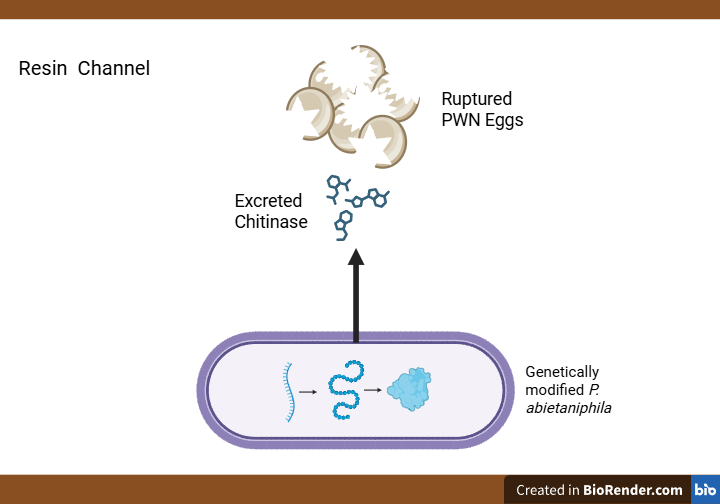 |
|---|
Parts level
All of the parts for our new gene are compatible with BioBrick RFC[10], the most commonly used assembly standard as shown in Table 1 and Figure 4. It is a standardized system of parts that are all compatible with each other, making gene assembly more efficient. It has a large set of tested and documented parts we will use to make our gene. It also makes all of our parts easily accessible for us and others to use. Our promoter, ribosome binding site, and terminator are all designed for E. coli bacteria, however they will still work when using P. abietaniphila as a chassis. They are both bacteria, and therefore can share many of these parts with only minor modifications at the time of construction.
| Figure 4. Synthetic Biology Open Language visualization of our gene. The promoter is constitutive for the constant production of chitinase. The RBS is strong to attach more ribosomes and produce more chitinase. The chitinase producing sequence is the longest and most crucial part of the gene. The double terminator reliably stops transcription. All of our parts are picked to maximize chitinase production for the greatest chance at destroying PWN eggs. | 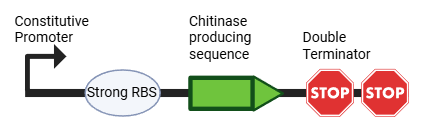 |
|---|
Table 1.
| Part | Function |
|---|---|
| Promoter: Part:BBa_J23100 | The promoter of our gene would be a constitutive promoter, meaning that it is constantly transcribing the DNA and producing chitinase. This would allow for the chitinase to spread throughout the entire tree quickly, leaving no room for B. xylophilus to reproduce effectively. P. abietaniphila is not affected by chitinase due to lacking chitin in its body. The excess chitinase within the tree would not harm the Pinus as it is a natural enzyme produced for defense against pathogens (Shobade et al., 2024). The amount of excess chitinase in the tree may also provide additional resilience to fungal and bacterial infections. (Modesto et al., 2022) |
| RBS: Part:BBa_B0030 | The ribosome binding site, or RBS, of our gene would be strong-medium strength. The strength of a RBS controls the rate of translation by assigning differing amounts of ribosomes to produce a protein, meaning a strong RBS will produce more chitinase. The strong RBS is a type of RBS that allows the mRNA of our gene to be transcribed by more ribosomes at once, increasing the rate at which chitinase is produced within our organism. |
| Coding Sequence: Part:BBa_K3686011 | Our coding sequence is a simple gene that codes to produce chitinase. It is compatible with the rest of our gene within the BioBrick RFC[10] assembly standard. It codes for the chitinase to be produced in the first place. |
| Terminator: Part:BBa_B0015 | In order to regulate gene expression, a terminator must be added to stop the RNA polymerase. The terminator we will use is a double terminator. It is formed from two terminators combined together, and is the most commonly used terminator on the iGEM Registry of Parts. It is the most reliable and most common terminator. Having a reliable terminator is necessary to regulate gene expression properly in order to not create an unnecessary excess of chitinase. |
Table 2.
| Part |
|---|
| Promoter: Part:BBa_J23100 |
| RBS: Part:BBa_B0030 |
| Coding Sequence: Part:BBa_K3686011 |
| Terminator: Part:BBa_B0015 |
The full sequence of these parts can be found on the iGEM parts registry under these identifications.
Safety
P. abietaniphila is defined as BSL-1 (Biosafety Level 1), meaning that its impact and potential to infect and harm humans is minimal, and there is very low hazard in using it (BacDive, 2019). This allows it to be utilized by those of varying levels of experience, from high school students to professionals. Due to the fact that the chassis is a bacteria which is already found in significant quantities within the trees in which they would be implanted, there is minimal risk for adverse effects stemming from that. The modified P. abietaniphila does not have modifications that allow it to outcompete other bacteria that are naturally present within the trees, as its modifications focus heavily on the production of chitinase, rather than something that would allow it to spread at an increased rate or overconsume nutrients. Chitinase does not harm bacteria, as their cells lack Chitin which is the target of the enzyme. However, the production of excess chitinase could potentially adversely harm insect/fungi species which are affected by chitinase production.
Discussions
Benefits to this project have been discussed throughout, but in general indicate the cost effectiveness, if successful, as well as the minimal ecological impact on the trees themselves allowing them to defend themselves against the damage of the nematodes while boosting their natural defenses and utilizing natural enzymes that they produce by themselves, but in greater quantities. Some challenges of the project would be in keeping the bacterial colonies within the trees self-sustaining, without necessitating the reintroduction of the bacteria from other trees. Though the regular strain of P. abietaniphila lives within the trees and survives without issue, the alterations to produce more chitinase could decrease its competitiveness against the regular strains, as it takes energy and resources to divert towards the production that could be used for increasing fitness. The hope is that the trees would be able to use the boost in chitinase production to leave a long standing impact in the microbial community within them, creating a more hostile environment towards the nematodes, and allowing helpful bacteria to thrive.
Next steps
Next steps to the project would entail how it would actually be put into practice, as this paper is mostly hypothetical in nature. We would need to see if the selected chassis is able to properly adapt to the modifications, as well as researching more about codon optimization using tools for P. abietaniphila. Such tools were not found to work with P. abietaniphila specifically, but there may be less well-known ones which would function properly for it. Once an optimized sequence is established, the next focus could be towards the physical construction of the system by assembling the plasmid. The method of transformation for the gene sequence could also be solved by another research team, using techniques such as CCMB80 or calcium chloride heat shock, methods to allow the absorption of new DNA by organisms through the process of translation. Teams could also work on the ways the gene will be expressed, involving transcription and translation, as well as characterizing the protein structure and its function.
Author contributions
JB contributed primarily to the Systems level, Device level, safety, discussions, and next steps. JC contributed to the Parts level, as well as the Background and the original idea of stopping the spread of PWN.
Acknowledgements
We would like to thank the mentor of the BioBuilder club, Dr. L’ecuyer, for all of her work and support with this project and allowing it to come to fruition. Her ability to explain all the necessary steps and their importance, and how we were to accomplish them, was invaluable in working on and completing this project and research.
References
BacDive. (2019). Pseudomonas abietaniphila (DSM 17554, ATCC 700689, CIP 106708).
Dsmz.de. https://bacdive.dsmz.de/strain/13122
Hu, B., Huang, W., Hao, Z., Guo, J., Huang, Y., Cheng, X., Zhao, J., Jiao, Q., & Zhang, B. (2024). Invasion of pine wilt disease: A threat to forest carbon storage in china. Ecological Indicators, 169, 112819. https://doi.org/10.1016/j.ecolind.2024.112819
Inoculation Experiments of a Nematode, Bursaphelenchus sp., onto Pine Trees. (1971). JOURNAL OF THE JAPANESE FORESTRY SOCIETY, 53(7), 210-218. https://doi.org/10.11519/jjfs1953.53.7_210
Li, D., Yu, M., Huang, L., Ye, J., & Wu, X. (2026). Engineered bacterium pseudomonas abietaniphila bhj04-blg4 controls pine wilt disease via nematocidal activity and induction of host systemic resistance. Pesticide Biochemistry and Physiology, 216, 106729. https://doi.org/10.1016/j.pestbp.2025.106729
Longhorned Beetles (Borers; Sawyer Beetles). (2024). Missouri Department of Conservation. https://mdc.mo.gov/discover-nature/field-guide/longhorned-beetles-borers-sawyer-beetles
Martin, V. J. J., & Mohn, W. W. (1999). A novel aromatic-ring-hydroxylating dioxygenase from the diterpenoid-degrading bacterium Pseudomonas abietaniphila bkme-9. Journal of Bacteriology, 181(9), 2675-2682. https://doi.org/10.1128/jb.181.9.2675-2682.1999
Modesto, I., Mendes, A., Carrasquinho, I., & Miguel, C. M. (2022). Molecular
defense response of pine trees (Pinus spp.) to the parasitic nematode
bursaphelenchus xylophilus. Cells, 11(20), 3208. https://doi.org/10.3390/cells11203208
Part:BBa J23100 – parts.igem.org. (2006). Parts.igem.org. https://parts.igem.org/wiki/index.php?title=Part:BBa_J23100
Part:BBa_B0030 – parts.igem.org. (2021). Parts.igem.org. https://parts.igem.org/wiki/index.php?title=Part:BBa_BBBa_B0030
Part:BBa_K3686011 – parts.igem.org. (2020). Parts.igem.org. https://parts.igem.org/Part:BBa_KBBa_K3686011
Part:BBa_B0015 – parts.igem.org. (2003). Parts.igem.org. https://parts.igem.org/wiki/index.php?title=Part:BBa_BBBa_B0015
Peng, Y., Tang, Y., Li, D., & Ye, J. (2024). The Growth-Promoting and Colonization of the Pine Endophytic Pseudomonas abietaniphila for Pine Wilt Disease Control. Microorganisms, 12(6), 1089. https://doi.org/10.3390/microorganisms12061089
Pine Wilt: A Fatal Disease of Exotic Pines in the Midwest. (n.d.). Missouri. https://extension.missouri.edu/media/wysiwyg/Extensiondata/Pub/pdf/miscpubs/mx0858.pdf
Shi, L.-N., Wang, L., Shi, X.-F., Luo, L., & Ye, J.-R. (2022). Negative effects of free-living nematodes on the populations of bursaphelenchus xylophilus in dead pine trees. Biological Control, 168, 104858. https://doi.org/10.1016/j.biocontrol.2022.104858
Shobade, S. O., Zabotina, O. A., & Nilsen-Hamilton, M. (2024). Plant root associated chitinases: Structures and functions. Frontiers in Plant Science, 15. https://doi.org/10.3389/fpls.2024.1344142
Tóth, Ágnes (2011) "Bursaphelenchus xylophilus, the pinewood nematode: its significance and a historical review", Acta Biologica Szegediensis, 55(2), pp. 213–217. Available at: https://abs.ek.szte.hu/index.php/abs/article/view/2749 (Accessed: 30 March 2026).
UC Riverside. (2025). What are Nematodes? Department of Nematology. https://nematology.ucr.edu/about/what-are-nematodes