
Eric Du, Stephen Jing, Adam Mei, and Ethan Wu, Concordia International School Shanghai, Shanghai, China
Reviewed on 9 May 2026; Accepted on 22 June 2026; Published on 26 October 2026
With help from the 2026 BioTreks Production Team.
In drylands, wind-driven soil erosion is a major driver of desertification. Desertification is characterized by reduced soil stability and accelerated land degradation, both of which damage local infrastructure and ecosystems. Conventional soil stabilization methods, such as those that rely on cement, polymers, or mechanical vibration, are often energy-intensive and environmentally unfriendly. Microbially induced calcium carbonate precipitation (MICP) offers a bio-mediated alternative by binding soil particles with calcite. Unfortunately, urease-mediated MICP generates ammonia as a byproduct, conferring phytotoxic risks that limit its large-scale application. Thus, this project proposes a low-cost engineered biocrust based on carbonic anhydrase-mediated MICP that mitigates ammonia release. Together, the co-culture is intended to be deployed in dryland regions and to independently form a biocrust in designated areas. However, our design has limitations. Although the carbonic anhydrase in our system is highly efficient, it can only conduct MICP under basic, calcium-rich conditions. By inducing carbonic anhydrase expression in wild soil bacteria, this system achieves regulated, enhanced calcite precipitation, thereby forming a thin, erosion-resistant surface crust. Further development of this project may yield a scalable, programmable, carbon-sequestering method to sustainably mitigate desertification.
Keywords: Desertification, bioconversion, soil-stabilization, MICP, synthetic biocrust
Authors are listed in alphabetical order. David Doyle mentored the group. Please direct all correspondence to mailto:david.doyle@concordiashanghai.org.

Background
Drylands make up a vast portion of the Earth’s terrestrial surface: roughly 52 million square kilometers, making up almost half of all non-ice-covered land. As shown in Figure 1, soil degradation is a widespread global phenomenon that affects extensive regions across Africa, Asia, Europe, the Americas, and Australia, with many areas experiencing moderate to severe damage (Middleton et al., 1997). According to the United Nations Convention to Combat Desertification (UNCCD), about 36 million km² of land is already affected by desertification, and 250 million people are directly impacted. If current trends persist, as many as 135 million people could be displaced by 2045 due to land degradation (United Nations, 2019).
| Figure 1 – Global soil degradation map (Source: UNEP, International Soil Reference and Information Centre, World Atlas of Desertification, 1997) | 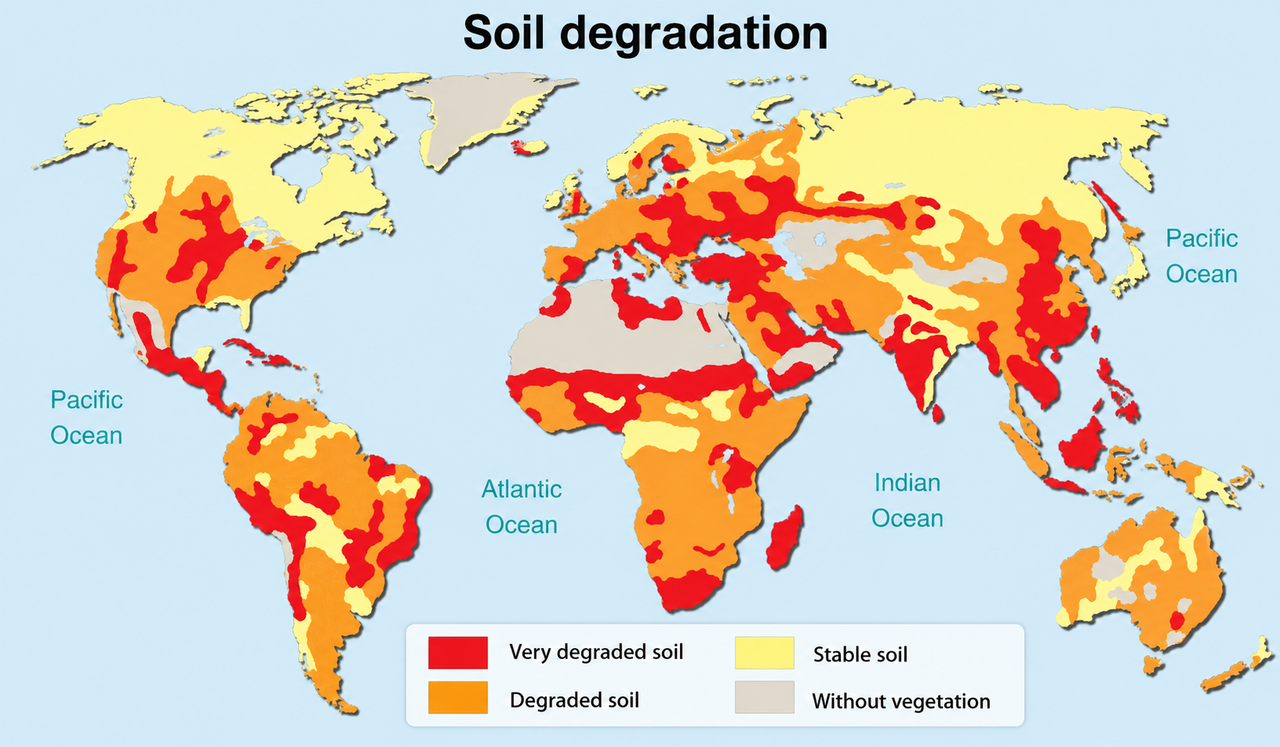 |
|---|
Figure 1 – Global soil degradation map (Source: UNEP, International Soil Reference and Information Centre, World Atlas of Desertification, 1997)
Unfortunately, in many parts of the world, soil with poor engineering and technological development is unsuitable for large-scale construction, primarily due to its unstable structure and low mechanical strength. Moreover, specific environmental factors, such as extreme temperatures, freeze-thaw cycles, and localized seismic activity, will increase soil susceptibility to desertification and hinder industrial efforts to combat it (Patil et al., 2021).
This global crisis significantly affects local agricultural progress, slowing the national economies. In China, for example, the Loess Plateau, covering an area of about 640,000 square kilometers, is important to the ecological, economic, and social development of China. However, due to its unique geological and topographic characteristics, it faces serious soil erosion. According to a survey from researcher XuanShuo Zhang in 2024, numerous various-sized reservoirs were constructed in the loess hilly region for the purpose of water storage and soil conservation, which utilizes local soil as a base material to improve the ecological environment. However, heavy rains and floods have resulted in numerous landslides due to destabilized soil, posing serious threats not only to the safety of residents in the vicinity, but also exerting a severe impact on the local economy, infrastructure, and ecological environment. Thus, improving engineering technology to stabilize soil structure and prevent erosion through human intervention and reinforcement technology is crucial, meaningful, and necessary (Zhang et al., 2024).
Microbial induced carbonate precipitation (MICP) & efficiency optimization
Various soil improvement techniques have been commercially developed to enhance soil mechanical strength. Techniques such as preload, synthetic polymers, and mechanical vibration have been widely used. However, the widespread use of material pathways requires significant energy and artificial materials, resulting in high engineering costs and various post-effects. Meanwhile, engineering polymer materials through chemical pathways will also lead to long-term soil and groundwater contamination, adversely affecting the project's purpose. Nowadays, injecting fine cement slurry into soil's empty space to form a cemented soil is the most common method(Dubey et al., 2023).
Most notably, mixing and “one-phase” injection procedures delay nucleation, spreading reagents more evenly. According to the results, this procedure added approximately 3% polycarboxylic acid, postponed the onset of CaCO₃ by more than 2 hours, and achieved complete Ca²⁺ conversion within 24 h, yielding about 2.76 MPa after five treatment cycles (Dubey et al., 2023).
Meanwhile, active nanomaterials have also been applied to improve the efficiency of many engineering processes due to their high specific surface area and well-known pozzolanic activity. Nano-MgO has been proven effective in improving soil strength, cohesion, and durability, thereby resisting soil erosion. Unfortunately, this methodology poses alarming toxic risks to human health and issues related to chronic health problems due to long-term exposure, which does not apply to most agricultural sites and communities. Thus, there is an obvious and urgent need to investigate an eco-friendly, applicable, and efficient soil structure stabilization method. (Chen et al., 2022)
Among the methods of preventing desertification, the formation of a biocrust through calcium carbonate precipitation is one of the most promising, effective, and sustainable solutions. Calcium carbonate precipitation can be achieved through a biological process called Microbial Induced Carbonate Precipitation (MICP). This technique is essential for sand fixation by stabilizing the loose and silty sand in the surface layer. The end product of MICP, calcite crystals, can bridge loose sand in the crustal sand layer, forming a tough crust through cohesion and improving its mechanical strength to prevent soil erosion. (Cao et al., 2024)
Two pathways of MICP have been explored: the decomposition of urea by urease and the conversion of carbon dioxide and water into calcium carbonate by carbonic anhydrase. Figure 2 accurately portrays the pathways of two conversions. In urease-mediated MICP, urea hydrolysis generates both carbonate ions and ammonium as byproducts, increasing local pH. In contrast, carbonic anhydrase accelerates the hydration of free carbon dioxide into bicarbonate and carbonate ions, increasing mineral precipitation while limiting environmental impact (Castro-Alonso et al., 2019). Both methods offer unique benefits and tradeoffs.
| Figure 2 – Schematic diagram of MICP formation mediated by urease and carbonic anhydrase (Source: Castro-Alonso et al., 2019, used under the Creative Commons CC BY license) | 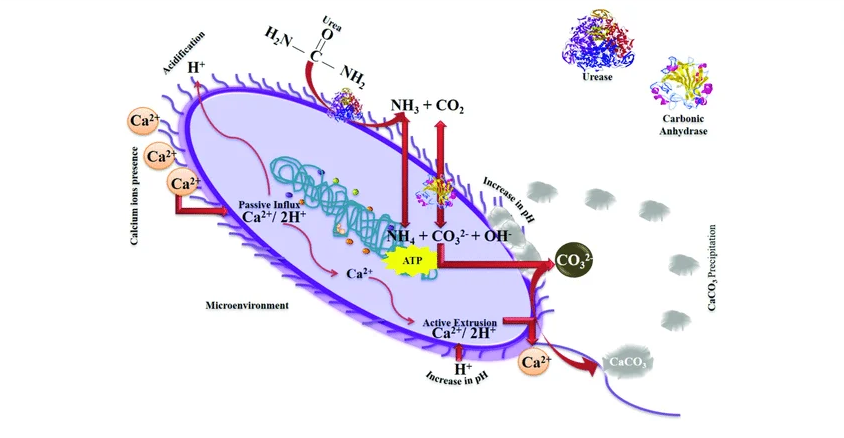 |
|---|
Figure 2 – Schematic diagram of MICP formation mediated by urease and carbonic anhydrase (Source: Castro-Alonso et al., 2019, used under the Creative Commons CC BY license)
Most research papers present designs advancing urease engineering technology. This process utilizes urease-producing bacteria, such as Bacillus and Sporosarcina pasteurii, to hydrolyze urea into ammonium (NH4+) and carbonate ions (CO32–). Then, the generated carbonate ions from ureolysis react with free calcium ions (Ca2+) to form calcium carbonate. The optimal pH of these reactions is at 7-9, which also highly depends on bacterial mineralization capacity and the geochemical and environmental conditions of a specific site.
The chemical equation of ureolysis follows:
The chemical equation of calcium carbonate precipitation follows:
(Source: Liu et al., 2025)
The CaCO3 crystals nucleate heterogeneously on microbial cell walls or soil sediment particles, progressively cementing soil grains, filling pore spaces, and strengthening soil particles overall (Wu et al., 2022). Meanwhile, compared to the spontaneous reaction occurring in nature, enzyme-facilitated hydrolysis of urea is approximately 1014 times faster, increasing the shear strength and conversion efficiency of treated soil (Jabri et al., 1995). After the urea hydrolysis pathway of MICP, the wind erosion was reduced between 63.9–97.7% in the wind tunnel experiment (Han et al., 2020). Therefore, this lab outcome serves as crucial evidence of MICP's anti-erodibility in aeolian soils and its leading-edge technology role in combating desertification.
Figure 3 – Diagram of calcium carbonate precipitation induced by urease-producing bacteria (Source: Tang et al., 2020, used under the Creative Commons CC BY license)
| Figure 3 – Diagram of calcium carbonate precipitation induced by urease-producing bacteria (Source: Tang et al., 2020, used under the Creative Commons CC BY license) | 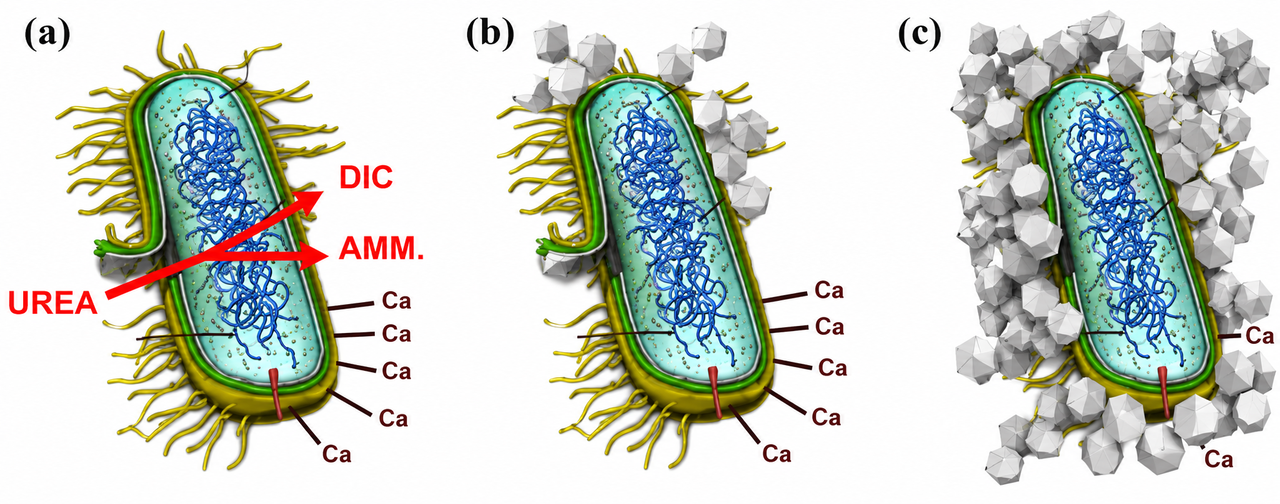 |
|---|
A recent paper shows ureolysis MICP transitioning from lab scenario to field application with progress in uniformity, strength, and erosion control. Field validations in Ahoskie (USA) and Sanya (China) demonstrated the efficacy of MICP in coastal erosion control through tailored delivery systems and environmental adaptations. Sanya’s studies highlighted seawater-compatible MICP solutions, achieving a maximum 1743 kPa penetration resistance in the atmospheric zone and layered “M-shaped” CaCO3 precipitation in tidal regions. (Liu et al., 2025)
Figure 3 presents the mechanism of conventional urease-driven MICP. Urea hydrolysis by urease-producing bacteria first generates carbonate ions and ammonium, then leads to calcium carbonate nucleation and CaCO3 crystal growth on the bacterial cell surface. However, high NH4+ concentrations often have negative effects on ecosystems. In particular, the accumulating toxicity can result in leaf chlorosis and suppressed root growth despite it being an inorganic N source for plant species. Furthermore, ammonium triggers deeper physiological and morphological responses, including changes in cytosolic pH, gene expression, protein modification, ion transport, redox and phytohormone status, as well as root system architecture, which may ultimately have the opposite effect of the goal of MICP. (Yang et al., 2023)
Especially at the expense of higher cost and difficulty in urea availability, this introduces the research to a more natural, sustainable, and efficient pathway: microbial induced calcite precipitation facilitated by carbonic anhydrases. Carbonic anhydrases achieve MICP by hydrating carbon dioxide, forming carbonic acid, losing two protons to become carbonate ions, and binding to calcium ions to form calcium carbonate.
Recent laboratory studies have shown a significant increase in the reaction rate of carbon dioxide hydration (108 times faster), which facilitates a rapid hydration to form a substantial amount of carbonate calcium compared to urease-facilitated MICP (Liu et al., 2024).
Other benefits of carbonic anhydrase on MICP’s performance on sandy soil were also systematically examined through a series of macroscopic and microfabrication tests. The results mainly show that: 1) During microbial consolidation of sandy soils, carbonic anhydrase (CA) significantly increases the production of cement by 105.3% compared with conventional MICP with an optimum dose of carbonic anhydrase-producing bacteria reaching approximately 4%. 2) By incorporating CA, the compressive strength and resistance of the cured soil showed obvious improvements. Based on experiments, the unconfined compressive strength of solidified soil increases with the increase in CA bacteria content, reaching 1.915 MPa at a content of 4%. (8.54 times strength of cured sample via conventional MICP). 3) The grain size of the calcite is larger after changing the enzyme to CA, the shape of the hexahedron is more uniformed, and the overall mechanical properties are improved. 4) When both urease and CA are present to co-precipitate calcium carbonate to cure sandy soil, CA enormously accelerates the rate of urea-generated carbon dioxide hydrate to form the end product. This eventually provides a more favorable condition for mineralization (Liu et al., 2024).
MICP & engineered biocrust restrictions & advancement
The wide application of MICP to restore degraded dryland is still not fully developed. The knowledge gaps have hindered advances in soil solidification technology and possibilities in MICP, with different factors being manipulated and maximized.
Research has shown that bacteria, soil conditions (soil content, temperature, salinity, pH, etc.), and cementation material (type and concentration) all directly affect microbial and enzyme activity, thereby influencing the efficiency of MICP. (Song et al., 2022) In addition to engineered bacteria, soil bacteria that are sites for nucleation during calcium carbonate precipitation will also impact crystal growth, affecting its size, durability, and effectiveness. (Gao et al., 2014) Furthermore, soil conditions directly determine cementation sites and reaction space. It is shown by research that soil particles with more open spaces for free movement of bacteria achieve optimal crust hardness, stiffness, compressibility, and permeability. (Liang et al., 2022) Among all, the presence of salt helps provide more nucleation sites for MICP and weave calcium carbonate networks through bacteria. (Dhami et al., 2016)
Although MICP through CA doesn’t produce high concentrations of ammonium, nor do they require increased cost due to the addition of a calcium source (calcium chloride), the process still reveals many limitations. Large-scale application of calcium chloride may contribute to soil salinization and calcium chloride runoff, potentially affecting vegetation, microbial communities, and groundwater quality (Szklarek et al., 2022). Meanwhile, CA is highly dependent on the availability and optimization of inorganic carbon, Ca²⁺, pH, and nucleation environment, which can be inconsistent without specifically controlled delivery substrates and local pH. Its activities and kinetics vary greatly across ecosystems and communities, and it often becomes immobilized due to harsh environmental conditions. Without an optimistic setting, carbonic anhydrase is not efficient enough to match the speed of desertification, which cannot be widely applied. Ultimately, it is clear that CA’s role in MICP has been less studied than urease, leaving room for deeper investigation and the possibility to maximize its capability (Tang et al., 2020).
A successful MICP biocrust will save O&M costs and water, recover lost energy, and offer a simple recipe for land surface management on-site for renewables. The same technique can stabilize road shoulders, construction sites, and other drylands where dust is a health and climate problem.
The 2025 iGEM team meduCA presented a similar project, inducing bio-cementation with carbonic anhydrase, which includes the process of MICP. meduCA conducted a phylogenetic analysis, characterizing many types of carbonic anhydrases (CAs). One of the categories describes Periplasmic alpha CAs, which catalyze rapid hydration of carbon dioxide for extracellular pH regulation and carbonate equilibrium (Supuran & Capasso, 2017). Periplasmic alpha CAs match the desired function of our group, so a specific coding sequence (CDS) for a Periplasmic alpha CA is selected.
Materials and methods
Design
We designed an expression device that encodes Sulfurihydrogenibium azorense (Saz) (Aguiar et al., 2004) α-carbonic anhydrase (Saz αCA) tagged with a signal peptide. TorA encodes a signal peptide that transports Saz αCA to the periplasmic space. TorA is linked to Saz αCA via a flexible peptide linker, BBa_K416001. Upstream of TorA are a medium-strength ribosome binding site (RBS), RBS B0032, and inducible promoter araC. Downstream of Saz αCA is terminator B0015. 6 bp spacers were added between the promoter and RBS, RBS and TorA, and Saz αCA and terminator. Two BsaI recognition sites flank the entire device and will create sticky ends during Golden Gate Assembly (GGA). This device was ordered online and synthesized by Genscript (Figure 4).
| Figure 4 – Diagram of custom Saz αCA expression device synthesized by Genescript (BioRender) | 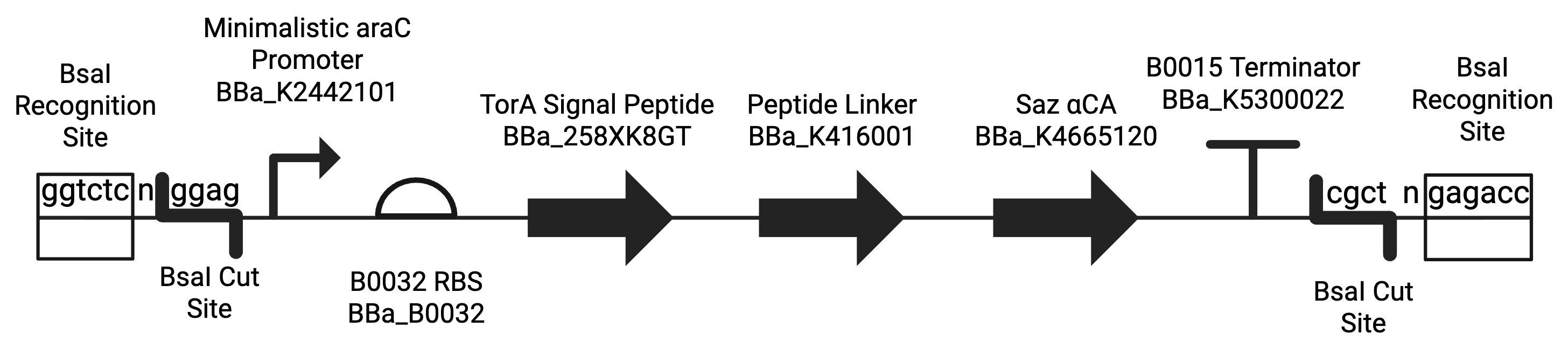 |
|---|
Figure 4 – Diagram of custom Saz αCA expression device synthesized by Genescript (BioRender)
Our device will be inserted into the plasmid backbone pJUMP23-1A(sfGFP) (Valenzuela-Ortega & French, 2021) using GGA with the BsaI restriction enzyme (Figure 5).
| Figure 5 – Overview diagram of pJUMP23-1A(sfGFP) (Addgene). pJUMP23-1A(sfGFP) was a gift from Chris French (Addgene plasmid # 126970; RRID:Addgene_126970) | 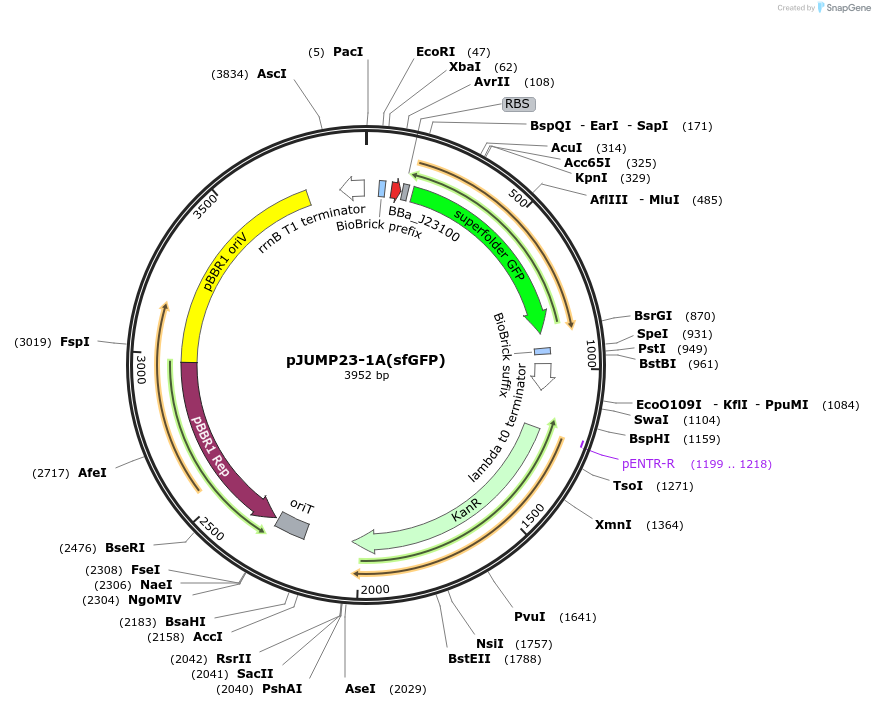 |
|---|
Figure 5 – Overview diagram of pJUMP23-1A(sfGFP) (Addgene). pJUMP23-1A(sfGFP) was a gift from Chris French (Addgene plasmid # 126970; http://n2t.net/addgene:126970; RRID:Addgene_126970)
Figure 6 – Diagram of BsaI cut sites on pJUMP23-1A(sfGFP) (Benchling).
| Figure 6 – Diagram of BsaI cut sites on pJUMP23-1A(sfGFP) (Benchling). | 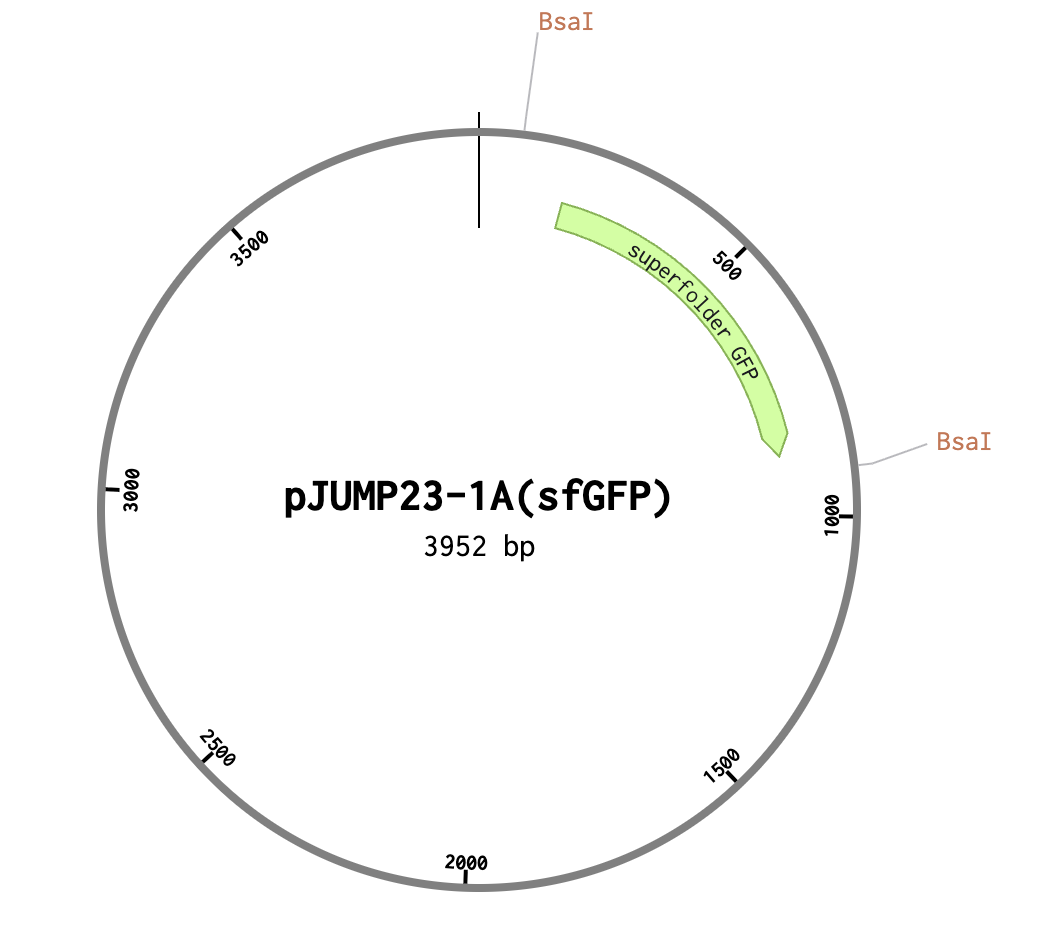 |
|---|
Figure 7 – Benchling GGA simulation (Benchling)
| Figure 7 – Benchling GGA simulation (Benchling) |  |
|---|
Initially, we selected the gram-negative, non-pathogenic, and resilient soil bacterium Pseudomonas putida KT2440 to be the chassis for our design (Martin-Pascual et al., 2021; Yunus et al., 2024). However, we do not have access to P. putida KT2440 in our lab. P. putida KT2440 is typically transformed via electroporation and does not respond well to heat shock, which is the preferred transformation method in our lab. Because of these accessibility and technical challenges, we chose to work with Escherichia coli TOP10 and E. coli DH5α as proof-of-concept chassis. E. coli TOP10 was used to propagate and amplify pJUMP23-1A(sfGFP) because of its high plasmid yield. E. coli DH5α was selected to host the recombinant plasmid because of its high transformation efficiency and genetic stability.
Amplifying plasmid vector pJUMP23-1A(sfGFP)
Transform E. coli TOP10 cells with heat shock
Start by resuspending pJUMP23-1A(sfGFP) DNA powder included in the 2025 iGEM distribution kit (iGEM) in nuclease-free water. Then, thaw a tube of competent E. coli TOP10 cells on ice. Set up an experimental group by adding both DNA and cells to a tube, and set up a negative control by only adding cells. After keeping both tubes on ice for 30 min, transfer them to a dry bath set to 42°C for 30 seconds, then return them to ice. After 5 min, add LB broth and incubate in a shaker for an hour.
Selection using the selection marker kanamycin
Obtain two agar plates and two 50 µg/mL kanamycin agar plates. Label and plate a “+” and “-” on each type of plate. Incubate overnight and observe for fluorescent colonies in the +DNA kanamycin plate. Collect a colony with a loop and inoculate a fresh tube of kanamycin LB broth. Incubate the tube in the shaker.
Extract vector with miniprep
Using DiaSpin Plasmid Mini-Preps Kit (Sangon Biotech), precipitate cell debris, bacterial proteins, and bacterial genomic DNA, and elute the amplified plasmid.
Run a gel and Nanodrop to confirm DNA length and concentration
Validate the mini-prep products on a Nanodrop. Record key values such as DNA concentration, A260/A280, and A260/A230 readings. Next, confirm the size of the DNA in the miniprep products with gel electrophoresis.
Assembling the plasmid via GGA
Using GGA, insert Saz αCA expression device into pJUMP23-1A(sfGFP)
Add Saz αCA expression device, mini-prep product, type II endonuclease BsaI, T4 DNA ligase, T4 DNA ligase buffer, BSA, and nuclease-free water into a PCR tube on ice according to Table 1. After adding the last component, mix reaction by pipetting or by flicking and centrifuging tubes to recollect liquid at bottom. Place the reaction mixture in the thermocycler and run the program shown in Table 2.
Table 1 – GGA reaction mixture. Enzymes must be added after buffer and water are mixed: combine and mix water, buffer, and enhancers before adding endonuclease and ligase.
| Component | Volume | Notes |
|---|---|---|
| BsaI endonuclease | 0.2 µL | 1U for each DNA part. Dilute if necessary to reach desired volume |
| T4 DNA Ligase | 0.2 µL | 10 CEU per DNA part. Higher concentrations of ligase are directly related to misligation. |
| 10x T4 Ligase Buffer | 10% of total reaction volume = 1 µL | |
| BSA, 1mg/mL concentration | 10% of total reaction volume = 1 µL | |
| Coding sequence | 30 fmol in 0.6 uL | |
| Plasmid backbone | 15 fmol in 0.75 µL | Vector quantity (not concentration) should be half the DNA part(s)’ quantity. Ideal concentration is 50 nM. |
| Deionized water | 6.25 µL | |
| Total reaction volume | 10 µL |
Table 2 – Thermocycler program for basic GGA (suitable for 2-3 parts)
| Lid Temperature 75 °C | Temp. (°C) | Time (min) |
|---|---|---|
| 37 | 20 | |
| Repeat 10x | 37 | 1.5 |
| 16 | 3 | |
| 50 | 5 | |
| 80 | 5 |
Immediately after thermocycling, transform E. coli DH5α with the recombinant plasmid and verify success by plating.
Follow the same procedures as transforming E. coli TOP10 with the vector. This time, colonies that appear non-fluorescent on the kanamycin + plate have been transformed with the recombinant plasmid. Collect one with a loop and grow in kanamycin LB broth.
Quantifying the size and function of Saz αCA
Grow and induce expression
Grow the recombinant cells to mid-log phase, and then induce Saz αCA expression with isopropyl β-D-1-thiogalactopyranoside (IPTG). Add increasing amounts of IPTG to separate samples for SDS-PAGE.
Run transformed cells through sodium dodecyl sulfate-polyacrylamide gel electrophoresis (SDS-PAGE)
Lyse cells with lysis buffer and freeze-thaw cycle. Separate soluble and insoluble substances, and finally prepare the soluble mixture into a loading sample and run an SDS-PAGE gel to confirm the size of Saz αCA.
Be aware that the band corresponding to Saz αCA may be faint. In our design, Saz αCA is an efficient enzyme, so strong expression is unnecessary and may cause excessive burden on the chassis. Instead, a medium-strength promoter and RBS were chosen.
Wilbur-Anderson Assay
Confirm enzyme functionality by conducting the Wilbur-Anderson assay. Prepare recombinant cells and add them to Tris buffer with bromothymol blue indicator. Set up another negative control with no cells added. Rapidly add CO2-saturated water into the sample, record the time, and observe for the color change from blue to yellow. Repeat for the negative control and determine if Saz αCA is functional.
pNPA Assay
In principle, the pNPA works similarly to the Wilbur-Anderson Assay. However, pNPA is now the substrate for Saz αCA, and absorbance changes from pNPA are more accurate and responsive than those of Bromothymol blue. This assay can be conducted in cuvettes, and absorbance can be recorded with a spectrophotometer, yielding more accurate data to quantify the efficiency of Saz αCA.
Safety
All bacterial strains used in these experiments are non-pathogenic. All the above experiments have been conducted in a Biosafety Level 1 (BSL-1) lab. All members wore personal protective equipment during labs.
Both E. coli DH5α and TOP10 are laboratory-domesticated strains that are widely used in molecular biology and synthetic biology research. These strains are classified as BSL-1 organisms and are considered non-pathogenic to healthy humans. They have been extensively engineered for laboratory use and lack the virulence factors associated with pathogenic E. coli strains.
All culture media were sterilized prior to use to prevent microbial contamination. LB broth and other growth media were autoclaved at 121°C before inoculation and incubation of bacterial cultures. Following experimentation, all liquid cultures, agar plates, disposable consumables, and other materials that came into contact with genetically modified bacteria were sterilized by autoclaving at 121°C for a minimum of 30 minutes prior to disposal. No genetically modified organisms were intentionally released into natural environments, and all experimental work was performed under supervised laboratory conditions
Figure 8 – Diagram of kill switch repressible by the presence of cumate (Biorender)
| Figure 8 – Diagram of kill switch repressible by the presence of cumate (BioRender) | 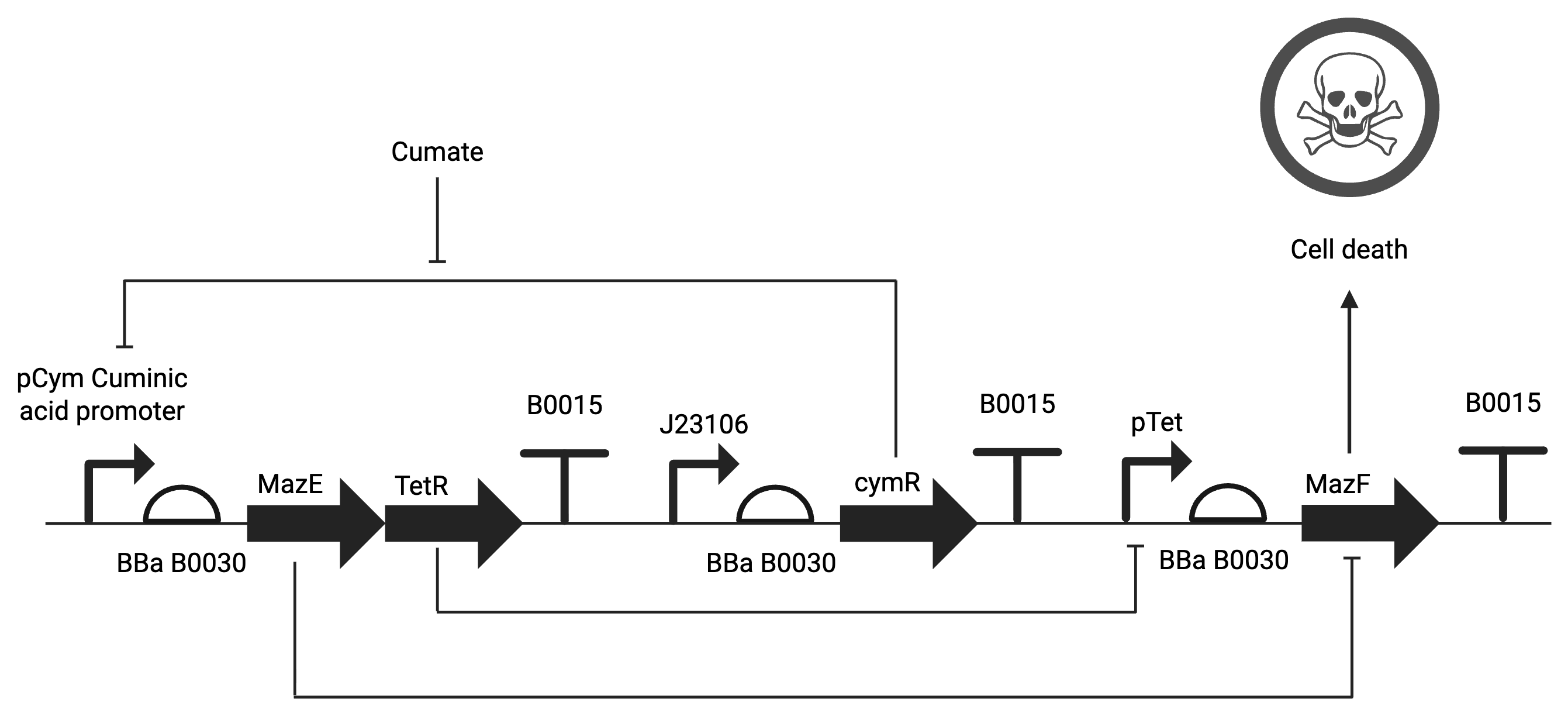 |
|---|
As an additional biosafety measure, we designed, but did not implement or experimentally test, a genetic kill-switch intended to limit the survival of our system outside designated areas, shown in Figure 8. The proposed design is a double-repressor cascade kill switch repressed by cumate, an inexpensive and biodegradable chemical inducer. Under this design, the engineered bacteria would only survive and produce biocrusts in environments containing cumate. In the absence of cumate, the kill switch would express MazF and inhibit bacterial survival, thereby reducing the risk of unintended environmental consequences.
The design was inspired by the containment strategy developed by the 2024 iGEM team CAAPI, which engineered a cumate-dependent survival system for an environmental strain of Bacillus subtilis intended for agricultural applications (CAAPI, 2024). However, CAAPI were able to engineer the bacterial chromosome so that cumate induced an essential gene, without which the cell would die. Since we do not possess the techniques to do so, we instead opted for the lack of cumate inducing a toxin.
While this approach is theoretically capable of restricting bacterial survival to designated treatment zones, it was not constructed or tested during the course of this project. As we will discuss in the Next steps section, future work on this project will involve experimentally validating this kill switch.
Results
E. coli TOP10 transformation is a verified success
The first step in our methods was to transform our selected plasmid backbone into E. coli TOP10 strain for replication. As described in the Methods section, the backbone was extracted from the iGEM distribution kit and transformed into E. coli TOP10 cells by heat shock. 4 total plates were set up:
| Figure 9 – Qualitative data of transformation. (A) and (B): Kanamycin was added to both plates. (A) is labelled with (+), indicating bacteria with the transformed plasmid, and (B) is labelled with (-), indicating bacteria without the transformed plasmid. (C) and (D): Kanamycin was not added to either plate. (C) is labelled with (+), indicating bacteria with the transformed plasmid, and (D) is labelled with (-), indicating bacteria without the transformed plasmid. | 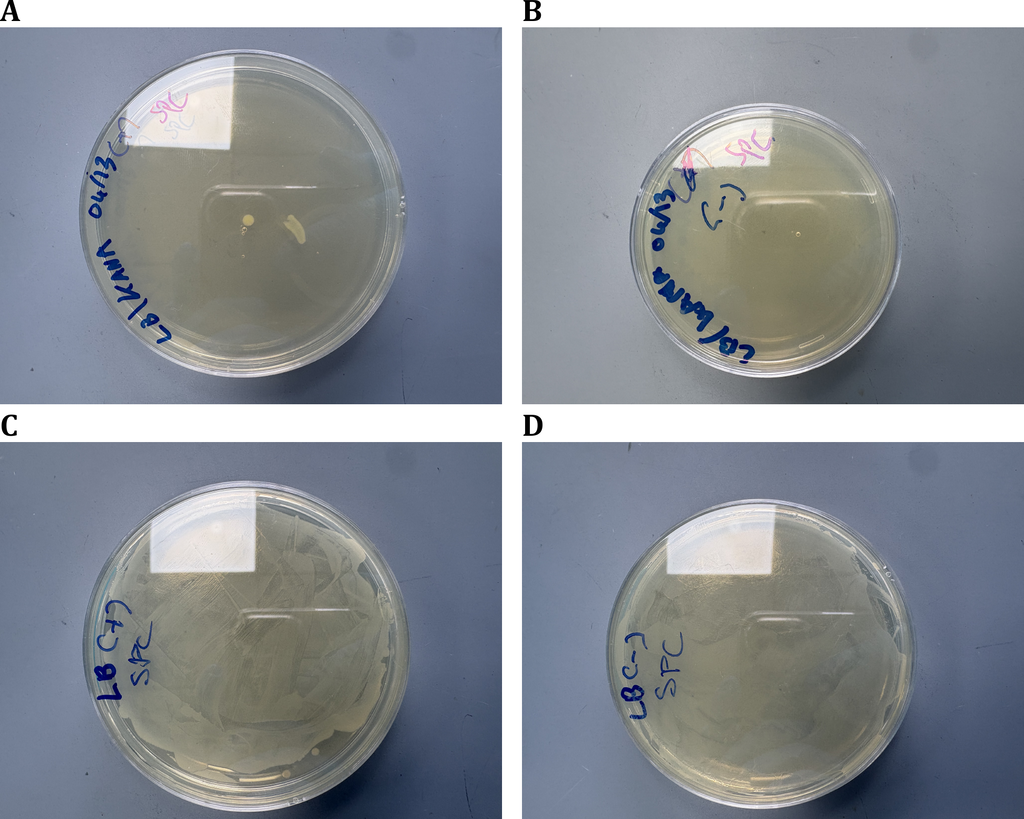 |
|---|
Two control groups were present in this experiment to ensure the validity of the results from the experimental groups. The LB (-) plate, containing only LB nutrient broth, serves as a positive control group, or the baseline level of bacterial growth without interference from the plasmid backbone or kanamycin. This can then be compared to our experimental groups to better understand the change from a baseline. The LB/kanamycin (-) serves as a positive control group, providing a baseline of bacterial growth in the absence of genetic modifications when exposed to kanamycin. This would better highlight whether the plasmid backbone affects bacterial growth by comparing bacterial growth in the LB/kanamycin (+) and LB/kanamycin (-) groups.
As seen in Figures 9C and 9D, there is lawn growth on both plates without kanamycin, regardless of whether transformed or untransformed bacteria were used. In the plate with kanamycin, plated with untransformed bacteria, there is evidently no growth. Lastly, on the plate with kanamycin, there are two surviving bacterial colonies.
With the two control groups verifying the effectiveness of kanamycin in killing non-transformed bacteria and the normal growth of E. coli TOP10 without kanamycin, it can safely be concluded that the transformation was successful.
Mini-prep yields contaminated results
Plasmid extraction was performed on the transformed E. coli TOP10 cells. We used a spectrophotometer to measure optical density at 600 nm (OD600) and confirm that our cells were in mid-log phase. The extracted plasmid product was verified with a Nanodrop UV spectrophotometer.
We struggled with low plasmid concentration and high contamination levels, so we had to repeat mini-prep multiple times. In our initial attempts, DNA concentrations were around 60 ng/uL, and A260/A230 values were around 0.5. The extraction kit procedures state that A260/A230 should be greater than 2 for sequencing or GGA. Residual guanidine salts, phenol, EDTA, and ethanol can contribute to a low A260/A230.
In our final attempt, we reduced contamination by washing three times instead of two, centrifuging faster in the final wash step, and leaving the tubes open for 5 min after the final wash step. These changes eliminated more contaminants and gave ethanol time to evaporate out of the column. Our last attempt had a plasmid concentration of 48.8 ng/uL, an A260/A280 value of 2.08, and an A260/A230 value of 1.15. Despite A260/A230 still being below 2, we decided to proceed to GGA due to time constraints.
GGA failed to yield recombinant cells
Following the procedures described above, we had enough reagent to prepare two tubes of reaction mixture. While preparing the reaction mixture, we found it difficult to pipette the small volumes accurately according to the procedure. After finishing GGA and transformation, we plated the cultures and observed for growth. Unfortunately, the results do not support that GGA was successful, and we were not able to obtain the recombinant cell for further testing (Figure 10).
| Figure 10 – Golden Gate Assembly transformation plates | 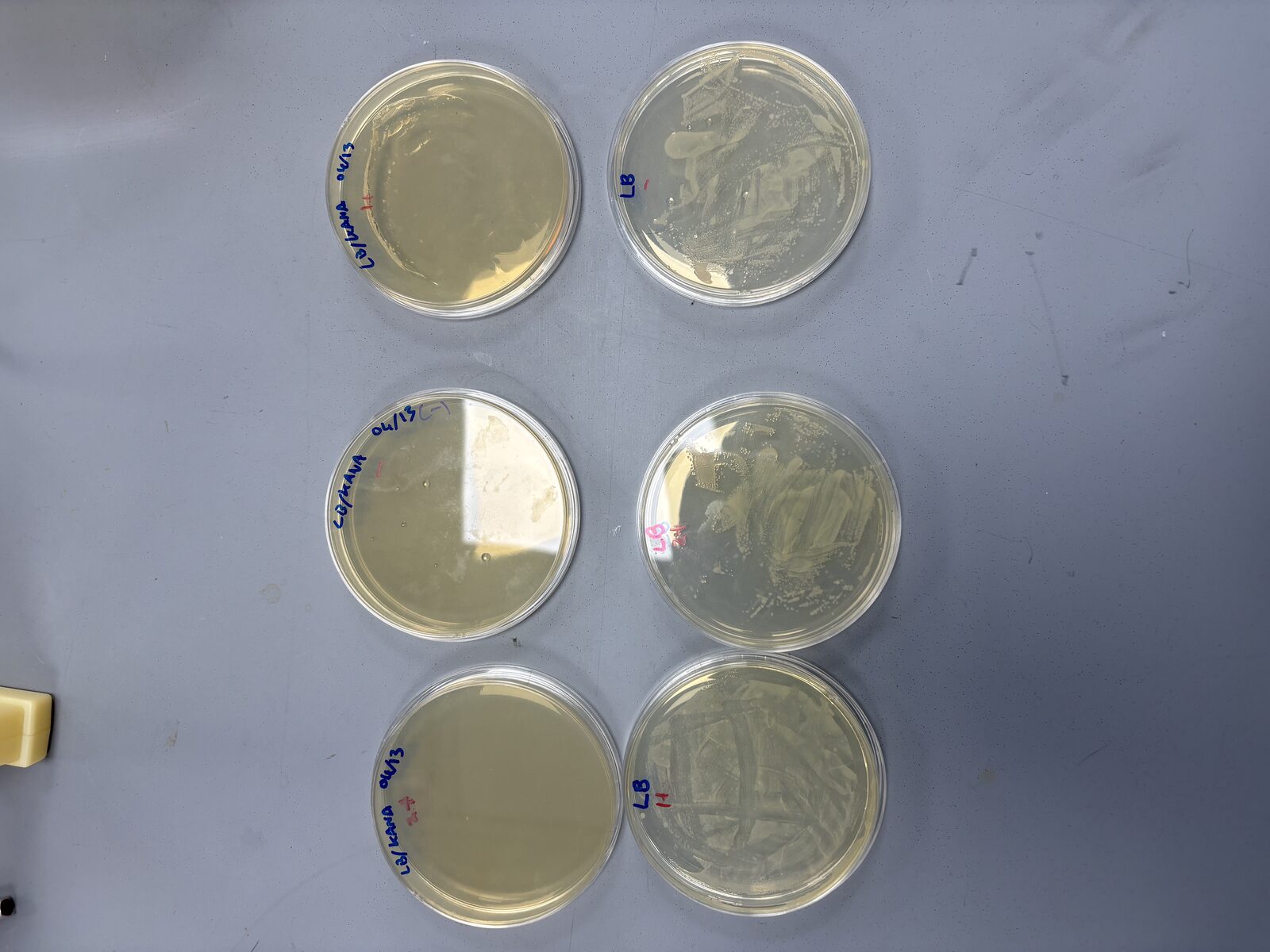 |
|---|
Figure 10 – GGA transformation plates
The observed growth on the LB – plate validates that the E. coli DH5α cells used in this transformation were competent. However, there was no growth on all three plates with kanamycin, suggesting that no cells were transformed with either pJUMP23-1A(sfGFP) or the recombinant plasmid.
Due to limited lab resources and time, we were not able to conduct the remaining experiments detailed in this section. We have discussed in the Next steps section about doing them in the future.
Discussions
In our final mini-prep attempt, the A260/A230 value of 1.15 suggests high levels of contamination. According to the mini-prep instructions manual, some contaminants, such as ethanol, measured by A260/A230 are known to inhibit enzymatic activity and interfere with downstream experiments. Therefore, contamination from the miniprep could be responsible for why GGA did not yield recombinant cells.
Another explanation for the lack of recombinant cells is that bacterial transformation with E. coli DH5α may have failed. E. coli DH5α has a similar heat shock transformation efficiency to E. coli TOP10 (Liu et al., 2018). Since the initial transformation of E. coli TOP10 with pJUMP23-1A(sfGFP) only yielded two colonies, it is possible that transformation with the recombinant plasmid failed because of random chance.
This microbial-induced MICP system is a promising step towards addressing desertification. By using synthetic biology, we replicated a natural phenomenon observed in biocrusts in a controlled, malleable E. coli system, enabling more cost-effective and sustainable solutions than current physical ones, and allowing others to modify and replicate our system.
The additional features in our plasmid, such as the TorA secretion protein, arabinose-induced promoter, and cumate-induced kill switch all work to complement the core Saz αCA enzyme which makes the system more controllable, safe, and cost-effective to maintain.
Aside from desertified soil, our system may also prove to be effective in several other applications. Wastewater, for example, also provides a suitable system for MICP, forming carbonate that can precipitate with calcium or magnesium ions. However, this system cannot be used in acidic environments as calcium carbonate dissolves when reacting with acids.
Our system could also be applied in space biology and extraterrestrial habitat development. Habitats on other planets or moons are also unstable, and frequent storms stir up large amounts of dust that can interfere with equipment, infrastructure, and human health. A layer of biocrust can contribute to stabilizing the soil, reducing dust and supporting the development of livable habitats on other planets.
However, despite the biosafety measures incorporated into this project, there are still potential environmental and safety risks with this system. For instance, horizontal gene transfer remains a potential concern. Although the engineered strain was designed for laboratory use, plasmid-borne genetic material may be transferred to naturally occurring microorganisms through processes such as transformation or conjugation. Although the genome of our selected chassis and our coding sequence will not confer pathogenic traits, the unintended spread of our genetic constructs still could have unintended consequences
The introduction of our engineered bacteria into natural environments may alter existing microbial communities. Our bacteria could potentially compete with native microorganisms for nutrients and space and disrupt their ecosystem.
Several iterations have been planned to improve the system. For instance, the aforementioned kill switch can be added to our system to provide safety measures and limit unintended harm. One of the weaknesses in our system, which is the need for a calcium source and a carbon dioxide source to perform MICP, can be addressed by adding parts that allow our chassis to intake soil calcium and atmospheric CO2 at a faster rate. Another consideration is the stability of our chassis when exposed to desert temperatures and low water levels for extended periods of time.
Next steps
To advance this study, the MICP performance will be quantified under controlled laboratory conditions by measuring carbonate precipitation, calcite formation, and resulting improvements in soil mechanical strength. In addition to repeating the unsuccessful experiments and conducting the ones we didn’t have time for (such as SDS-PAGE and the Wilbur Anderson assay), the following experiment is also planned.
To test the efficiency of this biocrust, a controlled laboratory experiment is designed using treated sandy soil samples subjected to real-life simulated environmental conditions. Thirty 30 cm × 30 cm × 5 cm trays will be prepared using sandy soil and treated by spraying bacterial culture and cementation solution over the surface through three cycles in five to seven days. Three control experiments will be conducted in untreated sand, abiotic cementation solution, and a killed-cell control.
After forming biocrusts, trays will go through accelerated weathering stages. Drying will be accomplished by alternating periods of 8 to 12 hours at 40 to 50°C with 12-hour intervals at room temperature 5 to 10 times. Wet-dry cycles will involve water spraying followed by drying and measurement of weight loss during this process. If equipment allows for it, photodegradation will be estimated by UV-C exposure. For wind erosion testing, the tray samples will be tested with a bench-top fan or homemade PVC wind tunnel at speeds of low (~3 m/s), medium (~6 m/s), and high (~10 m/s); the trays will be weighed before and after ten minutes, along with a downwind collecting pan to capture the eroded sediments to measure the wind erosion rate in grams per meter squared per minute. The soil strength, measured in kPa, is going to be measured from several different angles and locations to show the reduction in soil strength due to the various stresses. Since the only metric tested here is whether the system actually functions, in case standard atmospheric CO2 concentrations are insufficient or if natural calcium concentrations of the soil samples are found to be too low, gas pumps and supplemental calcium could be added to magnify the strength and formation speed of the biocrust.
The results that are to be obtained are the percentage of soil mass lost as a function of wind speed and treatment, penetration resistance after each cycle, the level of crust tamperment (intact, cracked, fragmented, and destroyed), as well as the amount of CaCO₃ in the crust layer compared to the sub-crust soil.
The effectiveness of the theoretical cumate-induced kill switch should also be assessed. This can be achieved by assembling the kill switch into a vector and transforming E. coli with it. Next, grow recombinant cells in a cumate + and cumate – culture tube. We can conclude that the kill switch is effective if there is only growth in the cumate + tube.
Author contributions
AM and ED drafted the initial idea of this research proposal. SJ worked on the background section. EW and AM worked on conducting experiments, collecting data, and analyzing results. EW worked on the discussion and results section. AM worked on the method and material, as well as graphing and designing scientific diagrams.
Acknowledgements
The Concordia Solar Powered Crew acknowledges the support from our advisor, Mr. David Doyle, for his guidance and mentorship throughout this project, as well as Mr. Bhatia, who provided valuable feedback on the experimental design of this project. We would also like to extend our gratitude to Concordia International School of Shanghai, whose facility and funds made this project possible.
References
Aguiar, P., Beveridge, T. J., & Reysenbach, A.-L. (2004). Sulfurihydrogenibium azorense, sp. nov., a thermophilic hydrogen-oxidizing microaerophile from terrestrial hot springs in the Azores. International Journal of Systematic and Evolutionary Microbiology, 54(1), 33–39. https://doi.org/10.1099/ijs.0.02790-0
CAAPI. (2024). biosafety | MIT-MAHE – iGEM 2024. Igem.wiki. https://2024.igem.wiki/mit-mahe/biosafety
Cao, H., Gao, G., Rao, L., Zhang, Y., Sun, Z., Zhang, J., Wang, T., Ding, G., & Zhao, H. (2024). Microbially induced calcium carbonate precipitation to combat desertification: A field application experiment. Journal of Cleaner Production, 468, 143085–143085. https://doi.org/10.1016/j.jclepro.2024.143085
Castro-Alonso, M. J., Montañez-Hernandez, L. E., Sanchez-Muñoz, M. A., Macias Franco, M. R., Narayanasamy, R., & Balagurusamy, N. (2019). Microbially Induced Calcium Carbonate Precipitation (MICP) and Its Potential in Bioconcrete: Microbiological and Molecular Concepts. Frontiers in Materials, 6. https://doi.org/10.3389/fmats.2019.00126
Chen, S., Hou, X., Luo, T., Yu, Y., & Jin, L. (2022). Effects of MgO nanoparticles on dynamic shear modulus of loess subjected to freeze-thaw cycles. Journal of Materials Research and Technology, 18, 5019–5031. https://doi.org/10.1016/j.jmrt.2022.05.013
Dhami, N. K., Mukherjee, A., & Reddy, M. S. (2016). Micrographical, minerological and nano-mechanical characterisation of microbial carbonates from urease and carbonic anhydrase producing bacteria. Ecological Engineering, 94, 443–454. https://doi.org/10.1016/j.ecoleng.2016.06.013
Dubey, A. A., Dhami, N. K., Ravi, K., & Mukherjee, A. (2023). Erosion mitigation with biocementation: a review on applications, challenges, & future perspectives. Reviews in Environmental Science and Bio/Technology, 22(4), 1059–1091. https://doi.org/10.1007/s11157-023-09674-z
Gao, G.-L., Ding, G.-D., Zhao, Y.-Y., Wu, B., Zhang, Y.-Q., Qin, S.-G., Bao, Y.-F., Yu, M.-H., & Liu, Y.-D. (2014). Fractal approach to estimating changes in soil properties following the establishment of Caragana korshinskii shelterbelts in Ningxia, NW China. Ecological Indicators, 43, 236–243. https://doi.org/10.1016/j.ecolind.2014.03.001
Han, L., Li, J., Xue, Q., Chen, Z., Zhou, Y., & Poon, C. S. (2020). Bacterial-induced mineralization (BIM) for soil solidification and heavy metal stabilization: A critical review. Science of the Total Environment, 746, 140967. https://doi.org/10.1016/j.scitotenv.2020.140967
Jabri, E., Carr, M. B., Hausinger, R. P., & Karplus, P. A. (1995). The crystal structure of urease from Klebsiella aerogenes. Science (New York, N.Y.), 268(5213), 998–1004. https://pubmed.ncbi.nlm.nih.gov/7754395/
Liang, H., Liu, Y., Tian, B., Li, Z., & Ou, H. (2022). A sustainable production of biocement via microbially induced calcium carbonate precipitation. International Biodeterioration & Biodegradation, 172, 105422. https://doi.org/10.1016/j.ibiod.2022.105422
Liu, J., Chang, W., Pan, L., Liu, X., Su, L., Zhang, W., Li, Q., & Zheng, Y. (2018). An Improved Method of Preparing High Efficiency Transformation Escherichia coli with Both Plasmids and Larger DNA Fragments. Indian Journal of Microbiology, 58(4), 448–456. https://doi.org/10.1007/s12088-018-0743-z
Liu, P., Cao, Y., Cheng, Y., & Bai, Y. (2024). Experimental study of enhancing the effects of microbial-induced calcite precipitation treated sand using carbonic anhydrase. Rock and Soil Mechanics, 45(9), 2554–2564. https://doi.org/10.26599/rsm.2024.9436594
Liu, S., Dong, C., Zhu, Y., Wang, Z., Li, Y., & Feng, G. (2025). Recent Developments on Biomineralization for Erosion Control. Applied Sciences, 15(12), 6591–6591. https://doi.org/10.3390/app15126591
Martin-Pascual, M., Batianis, C., Bruinsma, L., Asin-Garcia, E., Garcia-Morales, L., Weusthuis, R. A., van Kranenburg, R., & Martins dos Santos, V. A. P. (2021). A navigation guide of synthetic biology tools for Pseudomonas putida. Biotechnology Advances, 49, 107732. https://doi.org/10.1016/j.biotechadv.2021.107732
Middleton, N., Thomas, D. S. G., & Programme Des Nations Unies Pour L'environnement. (1997). World atlas of desertification. Arnold, Cop. https://digitallibrary.un.org/record/245955 (Original work published 2026)
Patil, M., Dalal, P. H., Shreedhar, S., Dave, T. N., & Iyer, K. K. R. (2021). Biostabilization techniques and applications in Civil Engineering: State-of-the-Art. Construction and Building Materials, 309, 125098. https://doi.org/10.1016/j.conbuildmat.2021.125098
Song, M., Ju, T., Meng, Y., Han, S., Lin, L., & Jiang, J. (2022). A review on the applications of microbially induced calcium carbonate precipitation in solid waste treatment and soil remediation. Chemosphere, 290, 133229. https://doi.org/10.1016/j.chemosphere.2021.133229
Supuran, C., & Capasso, C. (2017). An Overview of the Bacterial Carbonic Anhydrases. Metabolites, 7(4), 56. https://doi.org/10.3390/metabo7040056
Szklarek, S., Górecka, A., & Wojtal-Frankiewicz, A. (2022). The effects of road salt on freshwater ecosystems and solutions for mitigating chloride pollution – A review. Science of the Total Environment, 805(0048-9697), 150289. https://doi.org/10.1016/j.scitotenv.2021.150289
Tang, C.-S., Yin, L., Jiang, N., Zhu, C., Zeng, H., Li, H., & Shi, B. (2020). Factors affecting the performance of microbial-induced carbonate precipitation (MICP) treated soil: a review. Environmental Earth Sciences, 79(5). https://doi.org/10.1007/s12665-020-8840-9
United Nations. (2019, June 21). 24 billion tons of fertile land lost every year, warns UN chief on World Day to Combat Desertification. UN News. https://news.un.org/en/story/2019/06/1040561
Valenzuela-Ortega, M., & French, C. (2021). Joint universal modular plasmids (JUMP): A flexible vector platform for synthetic biology. Synthetic Biology, 6(1), ysab003. https://doi.org/10.1093/synbio/ysab003
Wu, H., Wu, W., Liang, W., Dai, F., Liu, H., & Xiao, Y. (2022). 3D DEM modeling of biocemented sand with fines as cementing agents. International Journal for Numerical and Analytical Methods in Geomechanics, 47(2), 212–240. https://doi.org/10.1002/nag.3466
Yang, H., Zhou, J., Fei, J., Ci, K., Li, D., Fan, J., Wei, C., Liang, J., Xia, R., & Zhou, J. (2023). Soil ammonium (NH4+) toxicity thresholds for restoration grass species. Environmental Pollution, 318, 120869. https://doi.org/10.1016/j.envpol.2022.120869
Yunus, I. S., Hudson, G. A., Chen, Y., Gin, J. W., Kim, J., Baidoo, E. E. K., Petzold, C. J., Adams, P. D., Simmons, B. A., Mukhopadhyay, A., Keasling, J. D., & Lee, T. S. (2024). Systematic engineering for production of anti-aging sunscreen compound in Pseudomonas putida. Metabolic Engineering, 84, 69–82. https://doi.org/10.1016/j.ymben.2024.06.001
Zhang, X., Wang, H., Wang, Y., Wang, J., Cao, J., & Zhang, G. (2024). Improved methods, properties, applications and prospects of microbial induced carbonate precipitation (MICP) treated soil: a review. Biogeotechnics, 100123–100123. https://doi.org/10.1016/j.bgtech.2024.100123