
Rose Huang, Jaeyun Lee, Ryo Nakano, Roberts Sartor, and Boran Zhang, Western Reserve Academy, Hudson, Ohio, United States
Reviewed on 9 May 2026; Accepted on 22 June 2026; Published on 26 October 2026
With help from the 2026 BioTreks Production Team.
Industrial activities have driven atmospheric CO2 to 421 ppm, a level not seen in 4 million years of recorded history. In 2024 alone, 34 billion tonnes of CO2 were released into the atmosphere, intensifying global warming and increasing the risk of dangerous environmental hazards such as wildfires, floods, and ocean heat waves. Since 1980, 403 U.S. weather and climate disasters have cost over $2.915 trillion. However, previous solutions like Storage and Bioenergy with Carbon and Sequestration (BECCS) and Direct Air Carbon Capture (DACC) require extremely high costs and energy devotion. Synthetic biology provides a possible solution that bypasses all these pitfalls by utilizing cyanobacteria’s ability to capture CO2. Specifically, the overexpression of bicA, a sodium-dependent bicarbonate transporter, increases inorganic carbon availability and decreases carbon limitation. We will monitor the biosynthesis process with a cellular-stress biosensor that detects cellular stress and bottlenecks, ensuring efficiency and effectiveness. This system aims to capture atmospheric CO2 and convert it into valuable biofuels, offering a dual approach to mitigate climate change.
Keywords: Cyanobacteria, bicA, climate change, carbon fixation
Authors are listed in alphabetical order. Aditya Pandharinath Sarnaik mentored the group. Please direct all correspondence to mailto:marmersteinv@wra.net.


Background
Problem
Atmospheric carbon dioxide concentration has reached record levels in recent years due to increasing industrial activity. In 2022, the National Oceanic and Atmospheric (NOAA) Administration’s Mauna Loa observatory detected a carbon dioxide concentration level of approximately 421 ppm, a value not seen in 4 million years of recorded history. As shown in Figure 1, atmospheric CO2 concentration has increased by over 50% relative to pre-industrial levels, with annual emissions of around 40 billion tons, a consistent figure before the onset of the industrial era (Osborne, 2022). Figure 2 illustrates the shift in global temperature anomalies from predominantly negative values before 1980 to consistently positive values after 2000, indicating a clear upward trend in warming over time. This demonstrates that global warming is an escalating issue with profound environmental and societal impacts.
| Figure 1. Global CO2 emissions from fossil fuels and industry (1750 – 2024), illustrating exponential growth after the Industrial Revolution and accelerating sharply after 1950. | 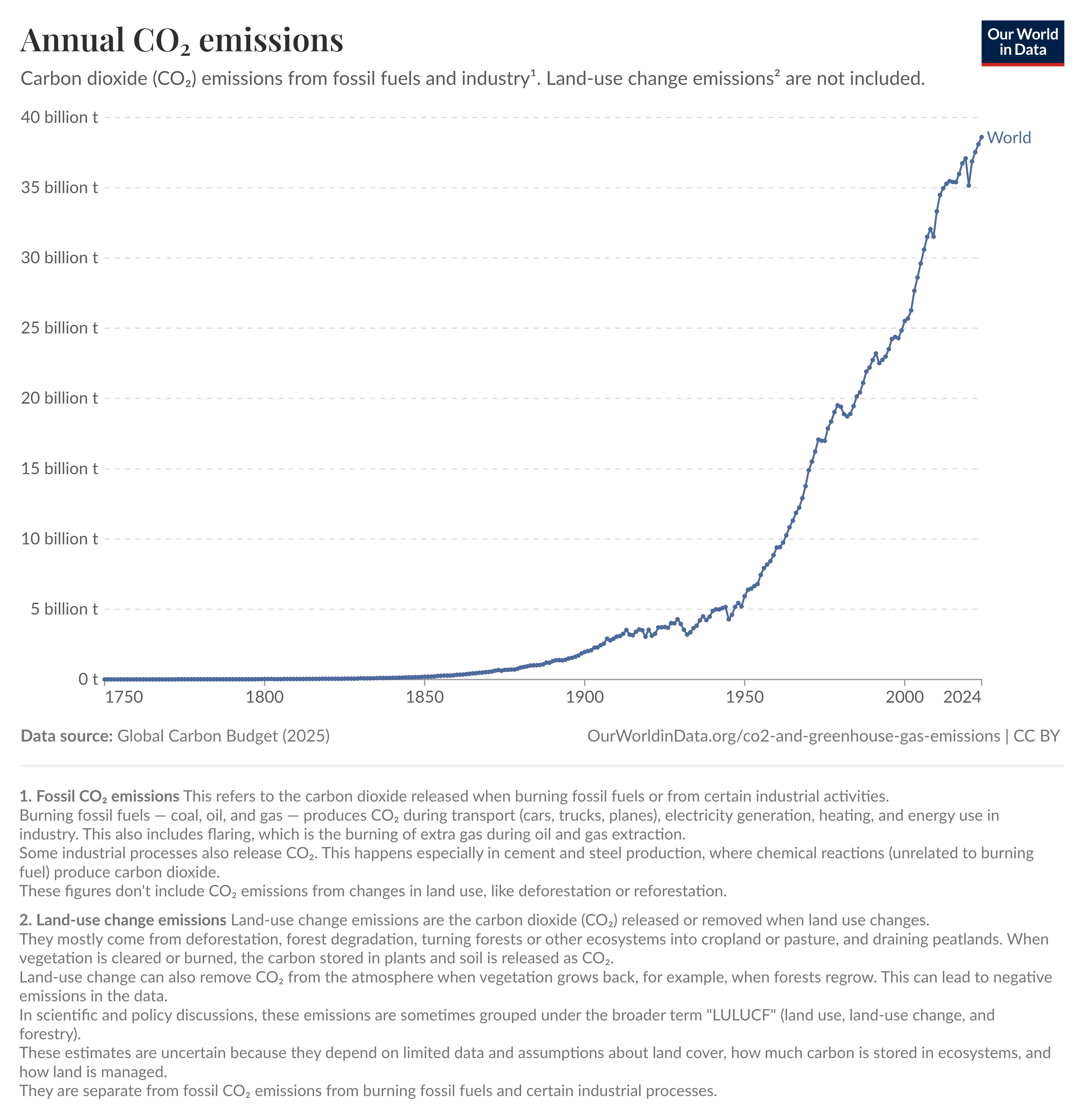 |
|---|
| Figure 2. Monthly global temperature anomalies (1940 – 2025), showing a transition from below-average temperatures to sustained warming after 2000, indicating a long-term climate change trend. | 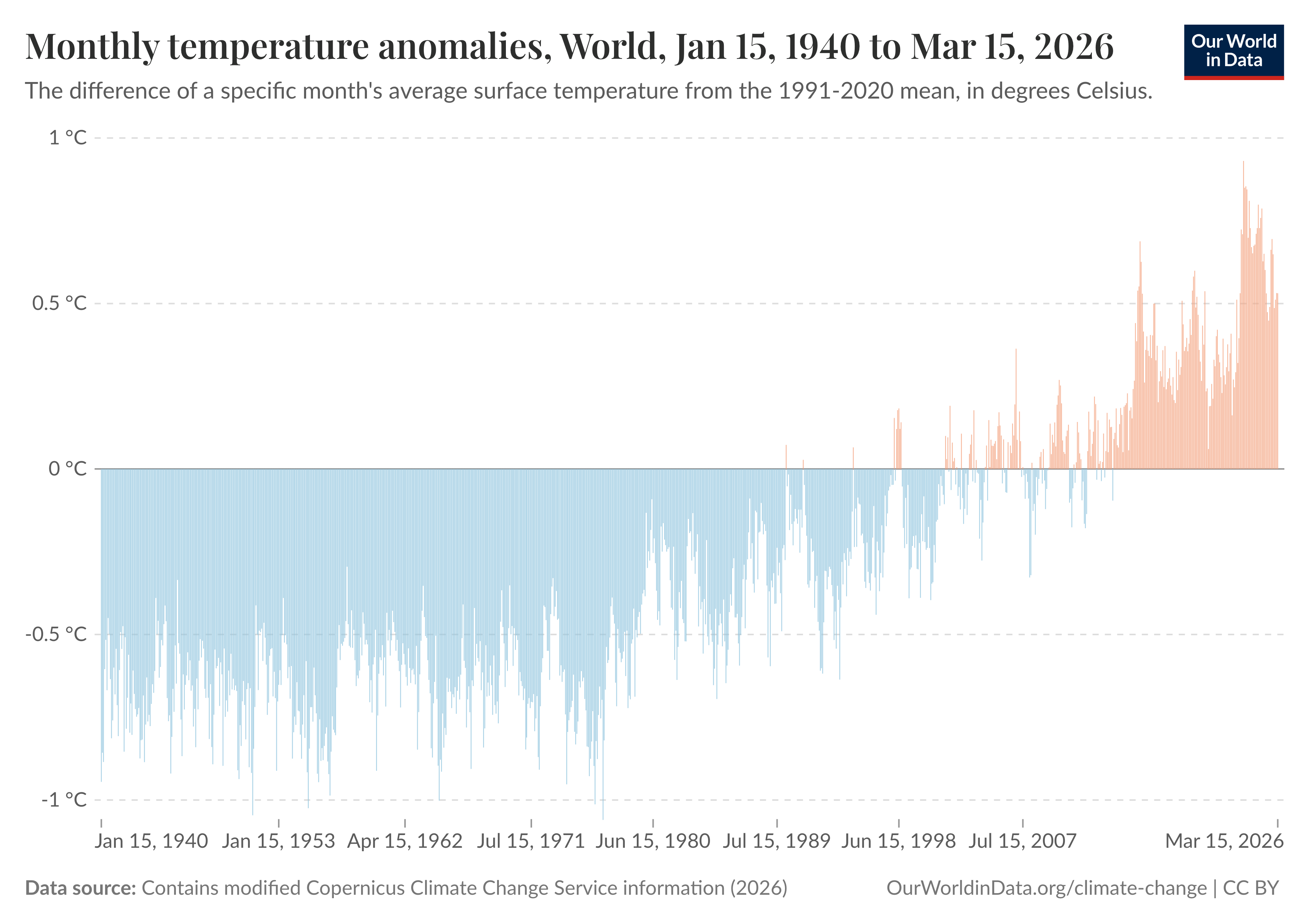 |
|---|
Promoting greenhouse gas emissions directly correlates with extreme weather. Even with only one degree Celsius of warming, humanity is experiencing habitat destruction that was considered rare before the 20th century; destruction includes wildfires, record-breaking floods, and marine heatwaves, affecting millions of people and costing billions in damages (WMO, 2023). The U.S. sustained 403 weather and climate disasters from 1980 to 2024, where overall damages/costs reached or exceeded $1 billion (including CPI adjustment to 2024). The total cost of these events exceeds $2.915 trillion (National Centers for Environmental Information, 2025).
Environmental side effects in the ocean include melting sea ice, rising sea levels, flooding, marine heat waves, and ecosystem stressors, which affect a wide range of aquatic animals. The high atmospheric CO2 concentration is acidifying the ocean; surface ocean pH levels are at their lowest in the last 2 million years (IPCC, 2021). Warmer temperatures can also form excess nutrients in waterways, fueling algae growth and potentially creating harmful heat blooms. This depletes oxygen levels, creating "dead zones" that kill fish and other aquatic species (Aqua Action, n.d.). Additionally, the entire coral reef system is experiencing a die-off due to marine heatwaves (Boehm, 2023).
The consequences of rising global temperatures already influence human society. The 2022 Pakistan floods affected up to a third of the country, and a 2016 drought in Brazil led to empty reservoirs and water rationing across some cities (Turrentine, 2024). The World Health Organization (WHO) warns that climate change is expected to cause an estimated 250,000 extra deaths per year between 2030 and 2050 from malnutrition, malaria, and heat stress (World Health Organization, 2023). The World Bank also estimates that climate change could displace more than 140 million people within their home countries in sub-Saharan Africa, South Asia, and Latin America by 2050.
Global warming is becoming a major existential threat worldwide, affecting everyone who shares this planet (Lindwall, 2022). Scientific evidence from NASA, WHO, UN, NOAA, and IPCC shows that urgent action is needed to tackle greenhouse gas emissions and climate change (IPCC 2023). To address the rapid pace at which humanity is experiencing global warming-related tragedies, we are charting a course to address environmental concerns and support populations worldwide.
Existing solutions
As a significant global issue, scientists have attempted a wide variety of solutions to decrease carbon dioxide emissions. However, CO2 removal (CDR) solutions are struggling to effectively meet climate targets and are hampered by economic and chemical limitations. Existing approaches can broadly be categorized into technological and nature-based solutions.
Two main representative technologies include Direct Air Carbon Capture (DACC) and Storage and Bioenergy with Carbon and Sequestration (BECCS). In recent years, despite the increase in investment in DACC, it remains incredibly energy-intensive, requiring high-quality heat or large amounts of electricity to operate, and its current costs are extremely high, making it economically challenging. Furthermore, BECCS, which is often featured in climate mitigation models, faces severe constraints due to its massive requirement for land, water, and fertilizer. This could potentially contribute to food scarcity and biodiversity loss (Bindl et al., 2025).
On the other hand, nature-based solutions to remove CO2, such as afforestation— adding forests, and reforestation, replanting forests—are more available and affordable. However, forests remain vulnerable to unpredictable dangers such as wildfires, pests, and deforestation, making them susceptible to releasing captured carbon dioxide back into the atmosphere (Helferty et al., 2023). As a result, these approaches often provide temporary carbon storage. Across different removal pathways, research tends to be more concentrated on biochar (carbon-rich charcoal produced by heating biomass in low-oxygen conditions), revealing uneven study efforts (Luck et al., 2025).
Another risk of these climate policies around CDR lies in their potential ethical concerns due to their high risk. Uncertain future removal can cause issues, such as the delay of the rapid phase-out of fossil fuels. If these CDRs fail to materialize at scale, they may lead to an increase in standard fossil fuel assets, jeopardizing the achievement of climate goals (Bindl et al., 2025).
Although synthetic biology approaches to CDR exist, they also face key challenges. Early efforts have largely focused on modifying heterotrophic organisms such as E. coli that consume carbon dioxide; however, these solutions often require costly inputs of organic sugar as an energy source and may not be sustainable at a large scale (Gleizer et al., 2019). Other strategies using natural carbon-fixing organisms, such as cyanobacteria, have primarily focused on native pathways like the Calvin-Benson-Bassham (CBB) cycle. These approaches typically yield improvements in carbon fixation but fail to effectively redirect captured carbon in stable, valuable products, limiting their economic viability.
Rationale
As discussed, biological strategies for carbon capture have gained increasing attention in the face of rapidly rising carbon dioxide (CO2) emissions. Among the candidates, cyanobacteria are uniquely suited to help mitigate global warming. Cyanobacteria are aquatic organisms that, like plants, use photosynthesis to convert carbon dioxide into sugars and other valuable compounds, releasing oxygen as a byproduct. Cyanobacteria were crucial in allowing other organisms to survive in the early atmosphere and in creating the massive carbon-rich deposits that provide us with fossil fuels today. Modern cyanobacteria continue to sustain life on Earth by providing food and oxygen to other species, while also serving as a promising option for bioengineering to produce cleaner alternative fuels (Milo, 2014).
A distinguishing feature of cyanobacteria is their unique CO2-concentrating mechanism (CCM). This system actively transports inorganic carbon into the cell, primarily as bicarbonate, and raises CO2 concentrations locally around the enzyme Ribulose-1,5-bisphosphate carboxylase/oxygenase (RuBisCO). CO2 enrichment occurs within microcompartments known as carboxysomes (Mangan et al., 2014), which spatially organize RuBisCO to enhance its efficiency. These prokaryotes are an ideal platform for biotechnological applications focused on carbon utilization because, as noted earlier, their mechanisms enable them to sustain high rates of photosynthesis even in low-CO2 environments.
Despite their many advantages, the carbon-fixing capacity of cyanobacteria is limited by several factors. Although RuBisCO is necessary for the assimilation of CO2, it possesses slow catalytic activity and has very limited specificity for CO2 relative to O2, which frequently results in energy-wasting photorespiration (Li et al., 2022). Furthermore, a large portion of carbon, even when it is properly fixed by the Calvin cycle, gets diverted from valuable products. To overcome these enzymatic and metabolic limitations, precise alterations in several genetic and biochemical pathways are required, ultimately enhancing cyanobacterial carbon-fixation efficiency.
Our proposal
Our team plans to control the cyanobacterial platform using Synechococcus elongatus PCC 7942, where sunlight, water, CO2, and nutrients serve as inputs, and oxygen, biomass, and biofuel precursors are generated as outputs (Onyeaka & Ekwebelem, 2022). This platform allows enhancement of carbon capture efficiency alongside product formation.
To improve CO2 uptake, we will overexpress the bicA gene, which enhances bicarbonate transport into the cell and increases the intracellular inorganic carbon pool. This would support higher carbon availability for the Calvin-Benson-Bassham (CBB) cycle, which is the main pathway for plants and bacteria to generate energy, without disrupting native cellular functions. (Ruan et al., 2025).
The rbcL gene encodes the large subunit of RuBisCO, the primary enzyme responsible for carbon dioxide fixation into sugars. RuBisCO is extremely prevalent in nature, but it is not highly efficient, as it often reacts with oxygen rather than carbon dioxide, a process known as photorespiration (Ruan et al., 2025). To fix this problem, we plan to create an improved version of the rbcL gene that would help RuBisCO work faster and focus more on carbon dioxide rather than oxygen.
The pentose phosphoketolase (PHK; heterolactic) pathway is a major route of glucose catabolism in heterolactic lactic acid-producing bacteria. This pathway provides a shortcut for redirecting sugars, efficiently transforming fixed carbon molecules into acetyl-CoA and greatly reducing carbon loss. Acetyl-CoA is a prevalent molecule in chemical reactions, known as the universal fuel carrier that enhances biofuel yield. Since most cyanobacteria lack the PHK pathway, it can be introduced into cyanobacteria by extracting phosphoketolase genes from other lactic acid bacteria (such as Bifidobacterium) and using their plasmids to edit the genome.
However, increasing carbon influx alone may create a metabolic imbalance. To address this, we will integrate a biosensor system to monitor intracellular conditions, including oxidative stress, carbon flux bottlenecks, and metabolic overload (Figure 4). This system will allow dynamic assessment of whether the enhanced carbon uptake is effectively processed through the CBB cycle or causes cellular stress that reduces efficiency (Ruan et al., 2025).
| Figure 4: Depiction of the biological circuits used for our project. Device 1 depicts how the bicarbonate is transported from inside the cell to the outside with bicA acting as the coding region. Device 2 contains an inducible promoter that activates only when CO2 is detected, with a fluorescent reporter to indicate its presence. Like Device 2, Device 3 also contains an inducible promoter that activates a fluorescent reporter based on an organic sugar molecule. | 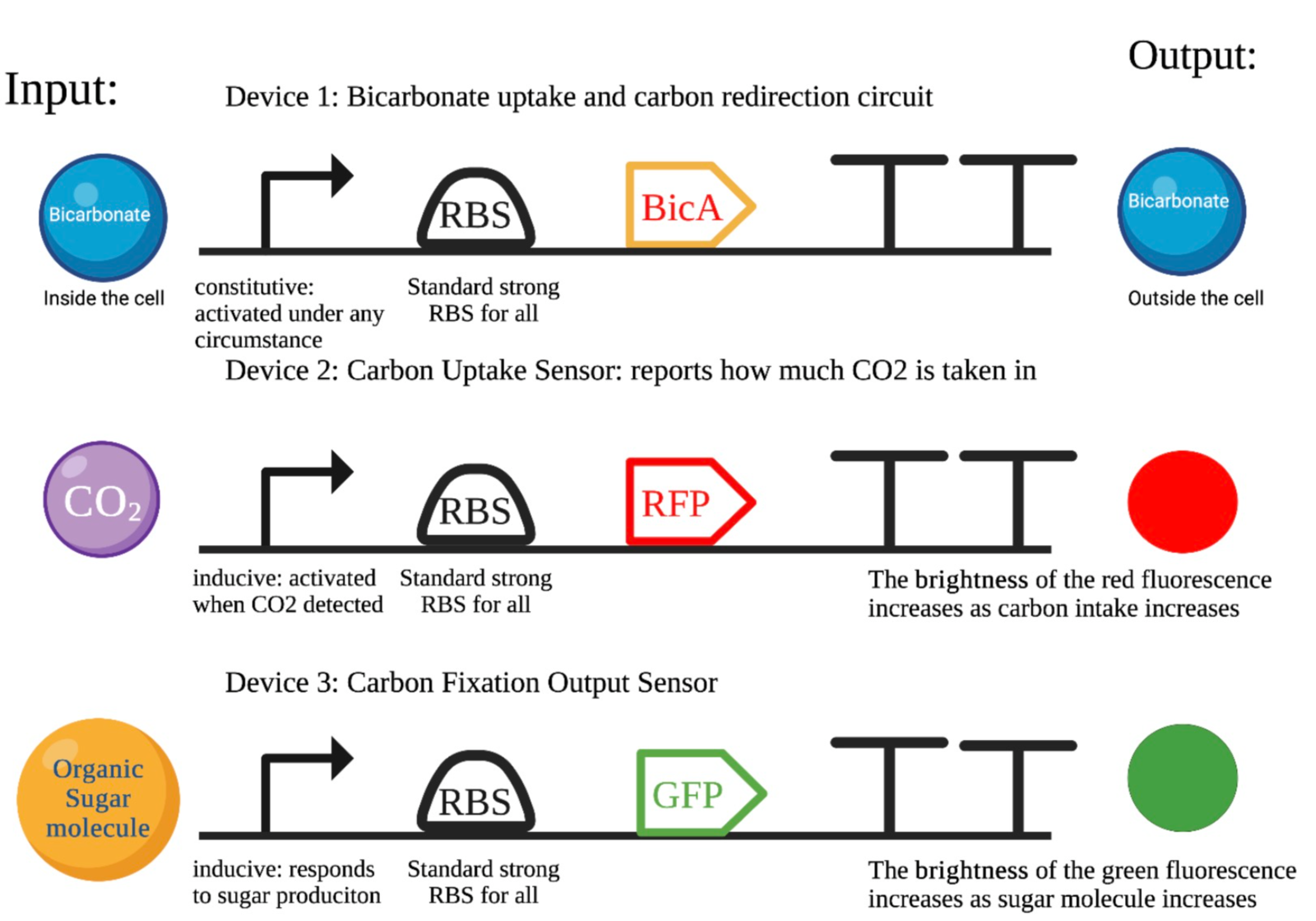 |
|---|
Finally, our team will grow our modified cyanobacteria strain (Synechococcus elongatus) in an enclosed photobioreactor system, which allows precise control of light and CO2 levels. We will measure the amount of CO2 they absorb using an infrared gas analyzer (IRGA) and test the amount of biofuel/byproducts using gas chromatography (GC). We hope that by modifying the key genes/enzymes, we will be able to create a more efficient cyanobacterial strain that can fix carbon at a much higher rate, along with higher biofuel production.
Systems level
The choice of the engineering platform is critical while developing a technology, and our engineering platform promotes a suitable approach to enhance the efficiency of CO2 conversion. Living-organism-based approaches are sustainable and highly stereo-selective. Cyanobacteria capture approximately 200 billion tonnes of CO2 from the atmosphere each year at no cost (Majhi, 2025). Already more efficient than other photosynthetic organisms, they use CO2 as a raw material to generate biomass via oxygenic photosynthesis, releasing oxygen (O2) and producing bio-based chemicals, including biofuels, bioplastics, and sugars (Chan et al., 2025). Moreover, they grow faster, have minimal growth requirements, and can be genetically modified easily.
Therefore, in this design, we focus on improving cyanobacterial CO2 uptake to mitigate atmospheric CO2 while simultaneously deploying the cells to direct fixed CO2 towards the production of biofuel precursors. Our system takes the form of cultivated cyanobacterial cultures, particularly Synechococcus elongatus PCC 7942, a model freshwater cyanobacterium. Sunlight, water, CO2, and nutrients serve as inputs, while oxygen, biomass, and biofuel precursors are the products of the process (Majhi, 2025). Figure 3 provides a system-level overview of this process, showing how cyanobacteria use atmospheric CO₂ and convert it into oxygen, glucose, biomass, and biofuel-related products.
| Figure 3: A demonstration of how cyanobacteria interact with the environment in the ecosystem. The growing population leads to expanding industrialization and increased vehicle usage, resulting in large amounts of CO2 in the atmosphere. The cyanobacteria in the ecosystem can convert CO2 via the CBB cycle to produce oxygen, glucose, and biofuel. | 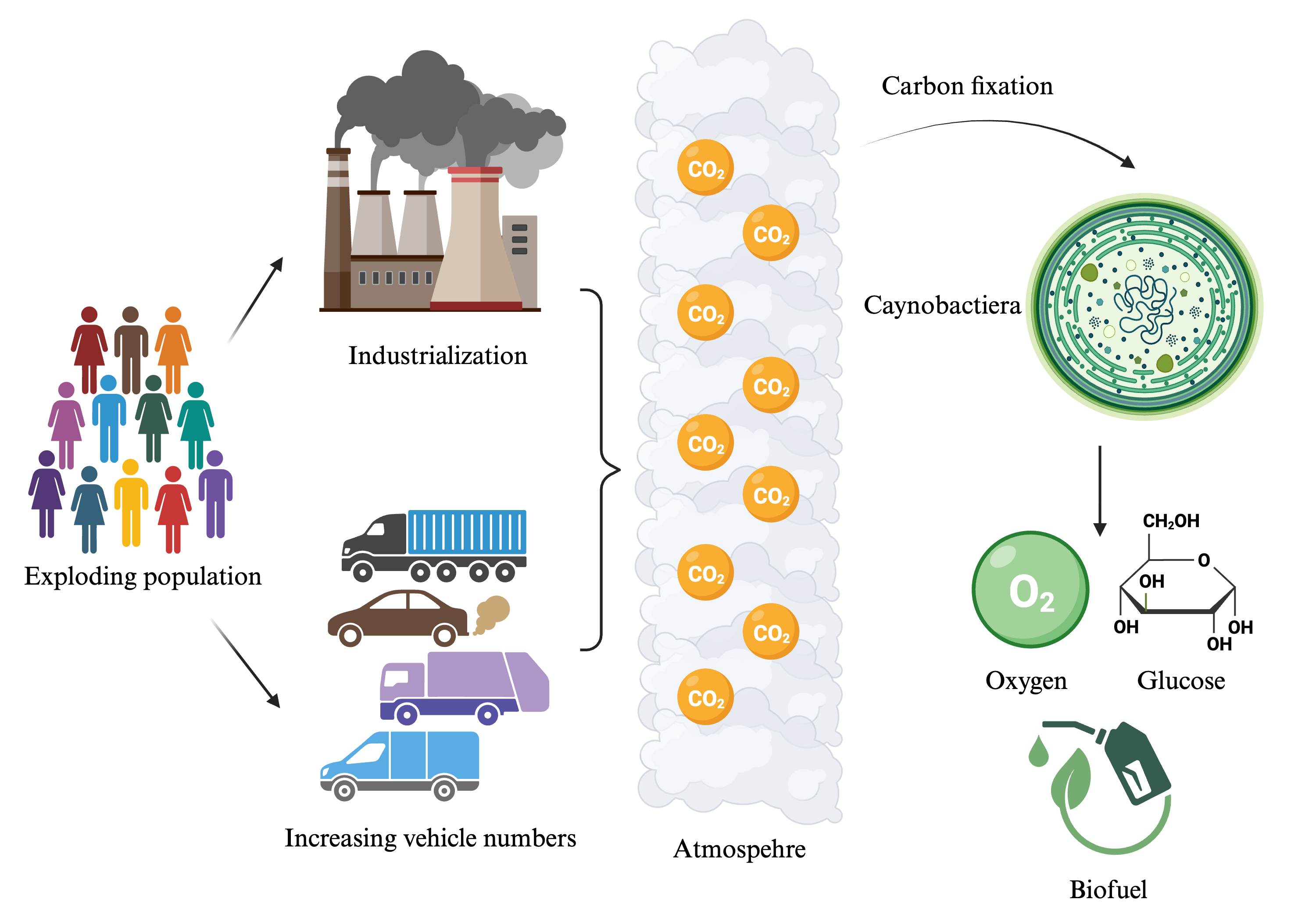 |
|---|
This design builds upon the natural photosynthetic machinery in cyanobacteria by overexpressing the bicA gene, which increases bicarbonate uptake in the cell, thereby raising the available inorganic carbon supply that supports downstream carbon fixation. This is a critical C-assimilating gene involved in carbon assimilation, the process by which organisms convert inorganic carbon into organic compounds like glucose and biomass, and it would function harmoniously without disrupting the original function of cyanobacteria (Chan et al., 2025). This envisioned system builds directly on native mechanisms rather than replacing essential biological pathways, ensuring compatibility and scalability.
To ensure that the increased inorganic carbon supply is efficiently processed, we also aim to enhance Calvin cycle throughputs by increasing RuBisCO enzyme abundance. We also focus on overexpressing other key CBB enzymes, including phosphoglycerate kinase (PGK), fructose-1,6-bisphosphatase (FBPase), and sedoheptulose-1,7-bisphosphatase (SBPase), which help reduce the bottlenecks and improve the carbon flux. In addition, we aim to incorporate the PHK pathway as a downstream carbon utilization module to redirect fixed carbon toward acetyl-CoA production, improving the conversion efficiency into biofuel precursor molecules. Together, these additional modules form an integrated carbon pipeline that creates a more effective carbon uptake and improves fixation capacity and the extent of carbon utilization.
Increased carbon uptake must be matched by sufficient Calvin cycle processing capacity to avoid metabolic stress. By incorporating a biosensor, we detect oxidative stress, carbon bottlenecks, and metabolic overload. This monitoring system helps ensure the increased carbon uptake does not reduce growth or disrupt cellular homeostasis.
This project will generate a proof-of-concept in an enclosed laboratory setting, with broader future potential for carbon sequestration and valorization. The enclosed photobioreactor will serve as an initial approach, preventing environmental release while controlling light and CO2 levels to support practical experiments at a manageable cost.
Device level
We aim to integrate carbon uptake, fixation, and conservation into a streamlined metabolic machine. We first overexpress the bicA bicarbonate transporter to begin the process. Unlike unedited systems, our design is not carbon-limited; bicA uses a sodium electrochemical gradient to import inorganic carbon against its concentration gradient (Chan et al., 2025). This transitions the cell from a state of carbon limitation to one that is now only inhibited by enzyme performance, an enzymatic limitation. In effect, the cell’s environment becomes ‘supercharged,’ to ensure downstream machinery always has substrate available (Ruan et al., 2025).
To ensure carbon influx, the bicA gene is placed under a constitutive promoter, enabling continuous bicarbonate transport (Figure 4). Because of said carbon influx, it’s necessary for the cell to overexpress the rbcL gene, which encodes a large subunit of the RuBisCO enzyme. Because RuBisCO has been evolutionarily conserved for over two billion years, our device simply aims to expand the total enzyme count rather than overhaul its catalytic site (Li et al., 2022). The increase in RuBisCO activity, along with increased CO₂ uptake, enables our device to maximize the carboxylation of RuBP to 3-phosphoglycerate (3-PGA), directly addressing a potential bottleneck step in the CBB cycle (Ruan et al., 2025).
To address metabolic ‘stalling’ caused by a potentially sudden surge of fixed carbon, our design employs PGK (phosphoglycerate kinase) as a reduction-phase pulling mechanism. PGK moves the flow of fixed carbon forward, which prevents the accumulation of upstream metabolites that could contribute to blockage or feedback compromise. At the same time, the overexpression of FBPase and SBPase aids the regeneration step of the CBB cycle. These enzymes also remove sugar bottlenecks, which ensures that RuBP can continually recycle and maintain a steady flow of carbon toward biosynthetic products (Correa et al., 2022).
One unique feature of this device is the heterologous introduction of the PHK pathway, which is not native to cyanobacteria. This pathway helps conserve and redirect fixed-carbon intermediates toward acetyl-CoA. By bypassing native steps that waste carbon, the PHK pathway reduces CO2 loss during intermediary metabolism and increases carbon-to-product yield (Wu et al., 2024). This ensures that the atmospheric carbon captured by the device is stored efficiently as biofuel precursors, providing a dual benefit of climate mitigation and biofuel production.
Our entire system includes genetic biosensors that monitor metabolic overload and oxidative stress. As shown in Figure 4, we employ two inducible sensors: an RFP reporter that scales with CO₂ detection and a GFP reporter that correlates with the production of organic sugar molecules. These reporters do not directly change cellular activity; instead, they indicate to researchers when enhanced carbon uptake may exceed the cell’s processing ability. This allows scientists to identify signs of stress and adjust experimental conditions to help maintain cellular homeostasis (Ruan et al., 2025). This ensures that our system can be monitored during long-term operating conditions.
Parts level
To create our system, we split the requirements into four genetic modules: Carbon uptake, carbon fixation, Calvin cycle optimization, and Carbon conservation. Each module will include a promoter, ribosome binding site, coding sequence, and transcriptional terminator in a cyanobacteria-compatible plasmid or chromosomal integration backbone. These modules operate sequentially to enhance the efficiency of carbon capture, processing, and conversion in engineered Synechococcus elongatus PCC 7942.
Carbon uptake
BicA, also known as Bicarbonate Transporter A, imports inorganic carbon (HCO₃⁻) into the cell against a Na+ electrochemical gradient. Overexpression of the bicA gene increases the intracellular inorganic carbon pool, which makes it transition from a carbon-limited to an enzyme-limited state, supporting larger bioavailability of biocarbonates in the CBB cycle (Ruan et al., 2025).
Carbon fixation
The rbcL gene encodes the large subunit of RuBisCO, the primary enzyme responsible for CO2 fixation into 3-phosphoglycerate (3-PGA), and can also be used as a rate-limiting step of the CBB cycle. Rather than trying to modify RbcL for greater catalytic efficiency, we tried to augment the CBB cycle by overexpressing rbcL, utilizing evolutionarily conserved features for over two billion years (Ruan et al., 2025; Li et al., 2022).
Calvin cycle optimization
Phosphoglycerate kinase (PGK) is required to drive carbon flow to biosynthetic end products in the reduction phase of the Calvin cycle and prevent stalling as a result of high concentrations of upstream metabolites or enzymes. In addition, FBPase and SBPase are required to relieve bottlenecks in the regeneration phase of the Calvin cycle by removing sugar-phosphate products to prevent inhibition and also allow for cycling of RuBP (Correa et al., 2022).
Carbon conservation
The pentose phosphoketolase (PHK; heterolactic) pathway is a major route of glucose catabolism in heterolactic lactic acid-producing bacteria. This pathway provides a shortcut for redirecting sugar, efficiently transforming fixed carbon molecules into acetyl-CoA and greatly reducing carbon loss (Li et al., 2022).
System regulation
A biosensor system would be integrated to monitor intracellular conditions, including oxidative stress, carbon flux bottlenecks, and metabolic overload. This system will allow dynamic assessment of whether the enhanced carbon uptake is effectively processed through the CBB cycle or causes cellular stress that reduces efficiency (Ruan et al., 2025). Reporter genes such as RFP and GFP will be placed under stress-responsive or metabolite-responsive promoters, followed by standard terminators, so researchers can visually monitor cellular stress and carbon-processing efficiency.
Safety
Lab safety
Standard microbiological practices, including wearing personal protective equipment and maintaining an enclosed photobioreactor containment system, will be followed during genetic operations or any microbiological practice involving PPE. The recombination of DNA and enzyme techniques and modification of cyanobacteria will strictly follow the National Institutes of Health Guidelines for Research Involving Recombinant or Synthetic Nucleic Acid Molecules (National Institutes of Health, n.d.). These guidelines outline detailed expectations for engineering microbes in contained environments, preventing escape of modified organisms, and safely using photobioreactor systems during the initial stages of research. Additionally, future safety design could include engineering cyanobacteria’s metabolic dependency on elevated CO2 levels, such as by modifying carbon-concentrating mechanisms, ensuring that modified bacterial strains will not survive under normal atmospheric conditions.
Environmental impact
We chose S. elongatus PCC 7942 because it is considered low risk and classified as Biosafety Level 1 (BSL-1), with all manipulations following standard laboratory safety protocols (ATCC, 2026). In the initial stage of the project, the engineered cyanobacteria will be tested only in an enclosed photobioreactor system to prevent unintended exposure to natural ecosystems. However, with further testing and regulatory approval, the long-term goal of this project is to evaluate whether engineered S. elongatus PCC 7942 could be safely used in controlled environmental applications. If it is released into a natural ecosystem could allow engineered S. elongatus PCC 7942 to interact with native cyanobacterial populations and potentially alter ecological balance; any future environmental use would require careful risk assessment. In the United States, such releases are regulated under the Toxic Substances Control Act (TSCA), requiring prior review of environmental risk. To reduce this risk, we will engineer PCC 7942 growth to depend on high CO₂ conditions, adopting the biocontainment strategy proposed by Lee et al. (2021). Under normal atmospheric conditions, the engineered cells would cease growth and eventually perish, helping prevent long-term persistence following unintended or future controlled release.
Human body impact
Since S. elongatus is a Biosafety Level 1 organism, it is considered non-pathogenic to healthy humans. Standard laboratory practices are sufficient to reduce any chances of direct infection risks. However, cyanobacteria have the potential to contribute to cyanobacteria Harmful Algae Blooms (CyanoHABs), some of which produce toxins harmful to humans and animals.
CyanoHABs will not occur under normal enclosed photobioreactor conditions, but they are an important concern for any future environmental application. In natural settings, CyanoHABs are often promoted by high water temperatures, sunlight exposure, and high nutrient concentrations of nitrogen and phosphorus (Oregon Health Authority). Therefore, before any controlled environmental release is considered, testing whether engineered S. elongatus can survive safely without contributing to harmful blooms is necessary. Any future release site would need to avoid nutrient-rich sediments, high nitrogen and phosphorus levels, and relatively mild temperatures to ensure CyanoHAB prevention.
Regulation
Prior to initiating our project, it will be reviewed and approved by the Institutional Biosafety Committee (IBC) (NIH, 2019). All individuals involved in the research will complete biosafety training approved by the IBC. Additionally, we will comply with GMO classification standards and Risk Group guidelines, with S. elongatus PCC 7942 classified as Risk Group 1, indicating that it is non-pathogenic and poses minimal risk to human health. All of our biological parts will be submitted to iGEM and will comply with iGEM’s chassis safety requirements, and we will ensure that no unapproved parts, encoding harmful toxins, are used (iGEM Foundation, 2024). Because the system involves engineered genetic components that enhance metabolic efficiency, including overexpression of the bicA gene and integration of biosensors, the project will maintain transparent documentation that lists each genetic modification and its function, in alignment with EPA biotechnology documentation requirements (EPA, 2012). Furthermore, all experiments will be conducted in contained laboratory and photobioreactor environments to minimize ecological risks. Only after extensive biosafety validation and regulatory review, we will consider open-environment testing to confirm that they will not cause unintended gene transfer, mutation, or disruption of natural ecosystems, in accordance with EPA and U.S. Department of Agriculture (USDA) regulations governing environmental release of genetically engineered organisms (Thomas & Nielsen, 2005). Any scale-up to our project would require additional regulatory approval from other organizations (e.g., EPA, USDA).
Discussions
Feasibility
To ensure high feasibility, initial tests will take place within a small enclosed laboratory setting. Our chosen chassis, Synechococcus elongatus PCC 7942, has a long history in CO2-related research. Because it is naturally transformable with foreign DNA, methods for stable chromosomal gene insertion are both mature and reliable. The PHK pathway introduces a bacterial gene that cleaves fructose-6-phosphate, a sugar naturally produced by PCC 7942. By driving this gene with a weak promoter, the reaction proceeds slowly enough to avoid siphoning essential sugars away from cell growth. Additionally, the overexpression of bicA and Calvin cycle enzymes such as PGK, FBPase, and SBPase presents a low-risk engineering strategy because these components are endogenous to cyanobacterial carbon metabolism, and their upregulation is unlikely to induce protein misfolding toxicity or severe metabolic imbalances that may harm its native pathways.
Benefits
As mentioned before, from a bacterial engineering standpoint, our design involves synthetic biology techniques such as overexpressing critical genes and enzymes that improve the effectiveness of carbon uptake and increase the fixation rate. One major advantage of this approach is that we enhance carbon assimilation by overexpressing the original metabolic pathway or key enzymes and genes of cyanobacteria, which greatly reduces the risk of disrupting their core metabolism (Chan et al., 2025). This effectively increases the bicarbonate uptake while maintaining compatibility with the photosynthetic functions. Cyanobacteria are one of the most efficient photosynthetic organisms, capturing approximately 200 billion tonnes of CO2 from the atmosphere each year at no cost (Majhi, 2025). This designed system has a strong potential to be utilized in large-scale, cost-effective global applications. It provides a scalable and sustainable strategy to reduce CO2 worldwide by using refined cyanobacteria as a natural carbon conversion platform, representing the progress of synthetic biology application in addressing environmental issues.
Limitations
While our project promises many benefits, some limitations should be addressed, particularly the biological constraints and environmental variability. Although the modified cyanobacteria could yield promising results, it is important to ensure that there is a consistent number of cells when gathering data, as maintaining a stable cell population is essential while achieving high levels of carbon capture.
Our main design of overexpressing genes such as bicA and rbcL applies a significant metabolic challenge to the cell by increasing demand for ATP, potentially reducing growth and overall productivity. In addition, prolonged cultivation may introduce evolutionary pressures that favor mutations reducing or eliminating the engineered pathways, particularly those that impose metabolic burden. This genetic instability could limit long-term efficiency. Moreover, enhancing inorganic carbon uptake does not resolve RuBisCo’s existing limitation of slow catalytic rate and high tendency to bind oxygen instead of carbon dioxide, which continues to limit carbon fixation efficiency. This can lead to an imbalance between excess carbon intake relative to the CBB cycle’s catalyzing capacity, leading to feedback inhibition. Environmental factors, including light intensity, CO2 availability, temperature, and nutrient levels, also influence system performance. While photobioreactor systems are useful for controlled experimentation, they introduce additional costs and involve conditions that differ from real-world applications. Furthermore, the bicA gene relies on a stable sodium gradient, so bicarbonate transport may change under ionic or energy conditions. Finally, the RFP and GFP biosensors also produce indirect, delayed signals, which limit their ability to provide precise, real-time insights into intracellular conditions. Incorporating faster, metabolite-responsive sensors could improve temporal resolution and provide more accurate monitoring of intracellular dynamics. While our proposed design has a lot of potential, concerns such as the variability of genes and environment are important to address, as the results could differ vastly depending on the variables, such as the amount of CO2 present, atmospheric pressure, or other factors.
Next steps
For our next step, we will run a series of experiments to verify whether our engineered cyanobacteria system will function as expected in practical applications under controlled laboratory conditions. First, we’ll transform Synechococcus elongatus PCC 7942 with our bicA overexpression and confirm successful insertion by PCR screening. Then, we will continue with an overall verification regarding engineered cyanobacteria strains after inserting the genes rbcL, and overexpressing the enzymes PGK, FBPase/SBPase, into S. elongatus PCC 7942 one at a time to minimize metabolic stress. We will check for the presence and the effectiveness of these transformed strains separately. It is necessary to ensure that they will function well together in cyanobacteria after all the adjustments and optimization.
To measure their effectiveness in the whole system, we plan to set a control group of wild-type cyanobacteria with engineered cyanobacteria and compare their strain, cell growth rate, biomass accumulation, and pH change in their surrounding environment with controlled light and CO2 conditions. If the engineered strain grows more slowly or the pH drops sharply, it suggests carbon overload, which our biosensor should detect, proving our system’s effectiveness. This helps further testing of the effectiveness of CO2 capture and biofuel production.
Finally, we will implement and test the biosensor reporter expression that will monitor metabolic stress in engineered cyanobacteria. Because increased carbon uptake could result in metabolic cell stress, reducing bacterial growth and efficiency, a stress-responsive biosensor will serve as a key regulator. After assembling the inducible promoters and fluorescent reporter genes, cultured cells will be exposed to elevated CO2 and excessive sugar conditions. Environmental conditions, such as CO2, will be controlled and verified using a CO2 gas sensor within the photobioreactor. Reported activity will be quantified using a fluorescence spectrophotometer to measure the fluorescence intensity.
In longer-term work, we will explore the PHK pathway, which is designed to redirect fixed carbon toward acetyl‑CoA. To test the effectiveness, if an increase in acetyl‑CoA is shown by measuring biofuel precursor levels, this test would show that the PHK pathway works as intended.
Author contributions
J.L. conceived the project idea. Y.H., B.Z., R.N., J.L., and R.S. contributed to the research, editing, images, reference, and manuscript preparation.
Acknowledgements
We are very grateful to Western Reserve Academy for providing this opportunity for us to proceed with our design. We also extend our appreciation to Ms. Marmerstein and our bio-builder mentor, Dr. Aditya Pandharinath Sarnaik, for guiding us through the project design and paper-writing process. Their expertise in synthetic biology has strengthened the accuracy and viability of our design. Their mentorship was crucial for deepening our understanding of synthetic biology through this design process. Finally, we acknowledge BioTreks for their support in making this study possible.
References
ATCC. (2026). Synechococcus elongatus PCC 7942 (ATCC® 33912™). https://www.atcc.org/products/33912
Billion-dollar weather and climate disasters. (2025, November). National Center for Environmental Information. Retrieved November 7, 2025, from https://www.ncei.noaa.gov/access/billions/
Bindl, M. (n.d.). Risks of relying on uncertain carbon dioxide removal in climate policy. Nature Communications.
Bowman (Alum), J. (2022, January 10). 2021 weather disasters showing showing mounting cause of inaction. NRDC. Retrieved November 7, 2025, from https://www.nrdc.org/bio/john-bowman/2021-weather-disasters-show-mounting-costs-inaction
Cawdrey, K. (2023, March 13). Warming makes droughts, extreme wet events more frequent, intense (J. R. Marder, Ed.). NASA. Retrieved November 7, 2025, from https://www.nasa.gov/centers-and-facilities/goddard/warming-makes-droughts-extreme-wet-events-more-frequent-intense/
Chan, M. C., Alfawaz, Y., Paul, A., & Shukla, D. (2025). Molecular insights into the elevator-type mechanism of the cyanobacterial bicarbonate transporter BicA. Biophysical Journal, 124(2), 379–392. https://doi.org/10.1016/j.bpj.2024.12.013
Correa, S. S. (n.d.). Natural carbon fixation and advances in synthetic engineering for redesigning and creating new fixation pathways. Journal of Advanced Research.
Deed – Attribution 4.0 International. (n.d.). Creative Commons. Retrieved April 30, 2026, from https://creativecommons.org/licenses/by/4.0/
Gibbens, S. (2025, April). How global warming is disrupting life on earth. National Geographic. Retrieved November 7, 2025, from https://www.nationalgeographic.com/environment/article/global-warming-effects
Gleizer, S. (n.d.). Conversion of Escherichia coli to generate all biomass carbon from co2. Cell.
Global warming. (n.d.). National Geographic. Retrieved November 7, 2025, from https://education.nationalgeographic.org/resource/global-warming/
Goodchild-Michelman, I. M. (n.d.). Light and carbon: Synthetic biology toward new cyanobacteria-based living biomaterials. National Library of Medicine.
Hannah Ritchie and Max Roser (2020) – “CO₂ emissions.” Published online at OurWorldinData.org. Retrieved from: 'https://archive.ourworldindata.org/20260417-112857/co2-emissions.html' [Online Resource] (archived on April 17, 2026).
Helferty, H. (n.d.). Harnessing nature and ancient wisdom to store carbon. National Library of Medicine.
Lee, Hyun Jeong et al. “Biocontainment of Engineered Synechococcus elongatus PCC 7942 for Photosynthetic Production of α-Farnesene from CO2.” Journal of agricultural and food chemistry vol. 69,2 (2021): 698-703. doi:10.1021/acs.jafc.0c07020 https://pubmed.ncbi.nlm.nih.gov/33411536/
Lindwall, C. (Ed.). (2024, October). Effects of climate change. NRDC. Retrieved November 7, 2025, from https://www.nrdc.org/stories/what-are-effects-climate-change
Lück, S. (n.d.). Scientific literature on carbon dioxide removal revealed as much larger through AI-enhanced systematic mapping. Nature Communications.
Macmillan, A., & Turrentine, J. (2024, December). Global warming 101. NRDC. Retrieved November 7, 2025, from https://www.nrdc.org/stories/global-warming-101#tackle
National Institutes of Health. (n.d.). NIH guidelines for research involving recombinant or synthetic DNA molecules (NIH Guidelines) https://osp.od.nih.gov/wp-content/uploads/NIH_Guidelines.pdf
Onyeaka, H., & Ekwebelem, O. C. (2022). A review of recent advances in engineering bacteria for enhanced CO2 capture and utilization. International Journal of Environmental Science and Technology, 20(4), 4635-4648. https://doi.org/10.1007/s13762-022-04303-8
Ruan, S., Jiang, Y., Wang, A., Zhang, X., Lin, Y., & Liang, S. (2025). Carbon sequestration pathways in microorganisms: Advances, strategies, and applications. Engineering Microbiology, 5(2), 100196. https://doi.org/10.1016/j.engmic.2025.100196
10 reasons why climate change is an important issue. (n.d.). WWF. Retrieved November 7, 2025, from https://www.wwf.org.uk/updates/10-reasons-why-climate-change-important-issue#:~:text=Climate%20change%20won't%20just,on%20climate%20is%20absolutely%20essential
Vanderbilt University Medical Center. (n.d.). Biosafety basics — Level 1. https://www.vumc.org/safety/bio/biosafety-basics-level-1
Velev, K. (Ed.). (2024, October). The effects of climate change. Effects – NASA Science. Retrieved November 7, 2025, from https://science.nasa.gov/climate-change/effects/
Veronika Samborska (2024) – “How much have temperatures risen in countries across the world?” Published online at OurWorldinData.org. Retrieved from: 'https://archive.ourworldindata.org/20260420-073247/temperature-anomaly.html' [Online Resource] (archived on April 20, 2026).
Why it's important to learn about climate change. (2023, January 24). Penns LPS Online. Retrieved November 7, 2025, from https://lpsonline.sas.upenn.edu/features/why-its-important-learn-about-climate-change#:~:text=Increasing%20challenges%20to%20human%20health,food%20security%2C%20and%20price%20stability
Wu, K.-K., Xu, P.-P., Zhao, L., Ren, N.-Q., & Zhang, Y.-F. (2024). Microbial conversion of carbon dioxide into premium medium-chain fatty acids: The progress, challenges, and prospects. Npj Materials Sustainability, 2(1). https://doi.org/10.1038/s44296-024-00008-w