
Michelle Barron, Eva Gomez, Anthony Marin, Nhan Phan, and Hazel Uribe, Cross Keys High School, Brookhaven, Georgia, United States
Reviewed on 9 May 2026; Accepted on 22 June 2026; Published on 26 October 2026
With help from the 2026 BioTreks Production Team.
Ethylene is a critical plant hormone that regulates the ripening, wilting, and senescence of many fruits, vegetables, and floricultural crops. In Dianthus caryophyllus (carnations), premature ethylene-induced senescence significantly shortens vase life and contributes to economic loss within the floral industry. This project aims to develop a synthetic biology–based strategy to delay senescence in carnations by reducing ethylene biosynthesis and signaling. Due to the technical challenges of direct plant transformation, Escherichia coli will be used as an accessible model system to test a modular plasmid design inducible by isopropyl β-D-1-thiogalactopyranoside (IPTG). The system includes gene constructs intended to reduce ethylene activity. It employs RNA interference (RNAi) mechanisms, through small interfering RNA (siRNA) or short hairpin RNA (shRNA), to silence key ethylene-related genes as a proof of concept. Successful plasmid incorporation is verified by blue-white colony screening. This study demonstrates a foundational approach for regulating the ethylene pathways in carnations and presents a framework adaptable to other ethylene-sensitive crops. Ultimately, this project highlights the potential for synthetic biology to extend shelf life, reduce postharvest waste, and improve sustainability in agricultural and floricultural industries.
Keywords: Genetic engineering, senescence, ethylene pathway, carnations, ACC deaminase pathway
Authors are listed in alphabetical order. Ana White mentored the group. Please direct all correspondence to mailto:ana_m_white@dekalbschoolsga.org.

Background
Senescence is a natural stage in a plant’s life cycle, marking the aging and deterioration of tissues such as leaves and flowers. However, in the floral and agricultural industries, premature senescence results in substantial economic losses by reducing the shelf and vase life of crops and ornamentals. In cut flowers such as carnations, rapid wilting leads to significant waste during shipping and retail display, causing financial losses for growers, wholesalers, and florists (Wang et al., 2024). Extending flower longevity can reduce vegetation waste, lower cold-storage energy consumption, and decrease reliance on chemical preservatives. Similarly, in agriculture, delaying senescence can help maintain the firmness, color, and nutritional quality of fruits, vegetables, and flowers for long periods. The techniques developed in this project may serve as a prototype for other ethylene-sensitive species—such as roses, tomatoes, and bananas—where regulating ethylene can slow ripening and extend shelf life (Kinhal, 2024).
| Figure 1. Overview. This diagram illustrates how ethylene input triggers the upregulation of ACCD (ACC deaminase) and the suppression of EIN3, leading to delayed senescence and extended floral longevity in carnations. | 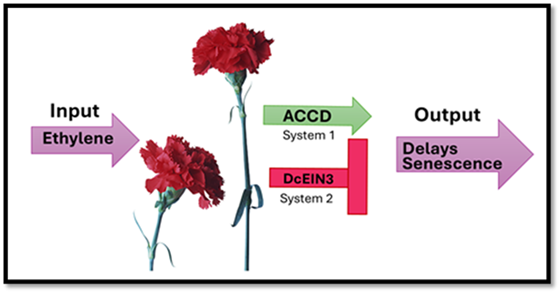 |
|---|
D. caryophyllus (carnations) is a globally cultivated cut flower valued for its color and vase appeal, yet its commercial lifespan is limited by high sensitivity to the plant hormone ethylene. Even slight increases in ethylene levels can induce petal wilting and discoloration, ultimately shortening vase life and reducing market value (Wang et al., 2024; Zhu et al., 2023).
Systems level
This project employs a two-step molecular strategy to reduce ethylene-induced senescence in carnations. Ethylene biosynthesis proceeds from S-adenosyl methionine (SAM) to 1-aminocyclopropane-1-carboxylic acid (ACC) via ACC synthase (ACS), and then to ethylene via ACC oxidase (ACO) (Figure 2). By introducing the bacterial acdS gene, which encodes ACC deaminase (ACCD), ACC can be degraded into ammonia and α-ketobutyrate, reducing substrate availability for ethylene formation. This approach has been shown to decrease ethylene production and extend floral longevity in other floral genera, such as Petunia (Baek et al., 2024; Shahid et al., 2023).
| Figure 2. 2A: Normal Pathway without ACC deaminase. This diagram shows the Yang cycle and ethylene biosynthesis pathway in plants, in which methionine is converted to SAM, then to ACC, which is oxidized by ACO to produce ethylene. MTA is recycled to methionine through the Yang cycle. 2B: Senescence with ACC deaminase (ACCD). This diagram shows the Yang cycle and the ethylene biosynthesis pathway, in which ACC deaminase (ACCD) converts ACC to α-ketobutyrate and ammonia, thereby reducing ethylene levels and delaying senescence. The production of α-ketobutyrate and ammonia serves as a negative feedback loop that lowers ACC levels and is known to be a nutrient that is typically added in fertilizers. (Address the potential outcomes owing to ammonia and ketobutyrate production). | 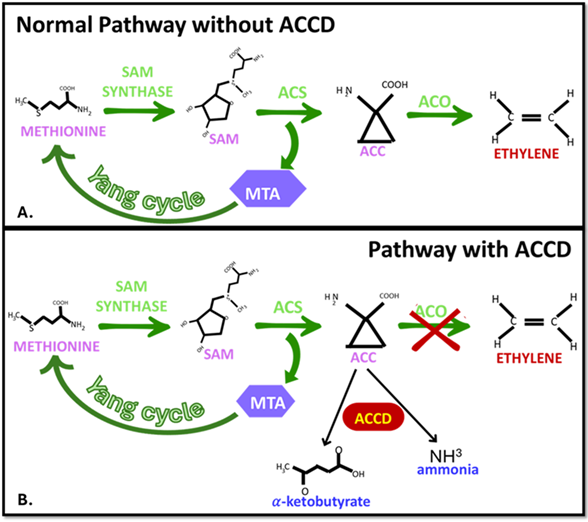 |
|---|
Even when ethylene is present, its downstream signaling cascade determines the progression of senescence. Ethylene perception inactivates the negative regulator CTR1, allowing the EIN2–EIN3 pathway to activate senescence-associated genes. In carnations, genes such as DcEBF1/2 and DcEIN/DcEIL regulate EIN3 stability and petal aging; thus, targeting these signaling components can effectively delay senescence (Zhu et al., 2023; Wang et al., 2023). To suppress this pathway, our project employs RNA interference (RNAi) to silence key ethylene-signaling genes, reducing the plant’s response to ethylene.
RNAi functions by targeting specific mRNA transcripts, preventing their translation into proteins. Dicer enzymes process double-stranded RNA (dsRNA) into siRNAs or microRNAs (miRNAs), which are incorporated into the RNA-Induced Silencing Complex (RISC). Guided by sequence complementarity, RISC binds to target mRNAs, inducing cleavage or translational repression (Koeppe et al., 2023; Gebremichael et al., 2021). For this project, RNAi constructs will be designed to target DcEIN3 and DcEBF transcripts, thereby dampening ethylene signal transduction (Guo & Ecker, 2003).
| Figure 3. 3A: Absence of Ethylene: Active ER-bound receptors (e.g., ETR1) keep CTR1 kinase active, which phosphorylates and inhibits EIN2. EBF1/2 then targets EIN3/EIL1 for degradation, suppressing ethylene-responsive gene expression (Guo & Ecker, 2003; Potuschak et al., 2003). 3B: Presence of Ethylene: Ethylene binding inactivates the receptors and CTR1, allowing EIN2 cleavage and translocation of its C-terminal fragment to the nucleus and cytoplasm. This suppresses EBF1/2 translation, stabilizing EIN3/EIL1 and activating ethylene-responsive genes. As feedback, EIN3/EIL1 later induces EBF1/2 expression to attenuate signaling. In our experiment, siRNA will silence EIN3 (red circle), blocking the ethylene response (Ju, 2012; Li, 2015). | 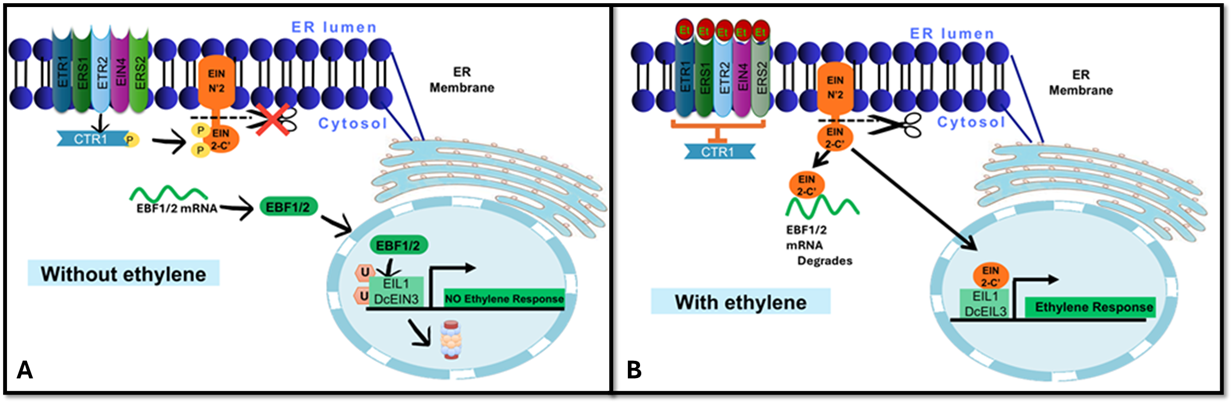 |
|---|
Our approach utilizes acdS expression and RNA interference to target ethylene at two levels: suppressing its biosynthesis and inhibiting its signaling pathways. This dual strategy simultaneously reduces hormone concentrations and cellular sensitivity. This integrated strategy has strong potential to extend carnation lifetime, minimize agricultural byproducts, and reduce storage costs, ultimately improving sustainability and profitability within the floral industry (Wang et al., 2024).
Device level
Challenges and Model System
A major challenge is that plant genes are often difficult to express in bacterial systems due to differences in codon usage, promoter compatibility, and post-translational modification requirements (Baek et al., 2024). Consequently, our high school laboratory setting limits access to the specialized tools and biosafety facilities necessary for direct plant genetic transformation.
To overcome these constraints, we selected E. coli as a safe and accessible model organism for proof-of-concept experiments. This bacterial system allows us to test inducible gene expression and targeted gene suppression using synthetic regulatory elements, demonstrating the core logic of our ethylene-control framework without the need for plant transformation. This adaptation highlights the educational and practical versatility of synthetic biology.
The experimental model employs an IPTG-inducible lac operon system in E. coli. Upon IPTG induction, the lac promoter activates acdS expression, mimicking the reduction in ethylene biosynthesis observed in plants. The same inducible system also drives a silencing construct targeting lacZ—a bacterial analog used to model RNAi-like repression of ethylene-signaling genes.
This study demonstrates interference with ethylene biosynthesis and signaling pathways in carnations to delay senescence. Because direct plant genetic modification is complex and resource-intensive, E. coli is used as a simplified model system to test and visualize gene regulation.
Proof-of-concept design
In this design, E. coli expresses the acdS gene under the control of an IPTG-inducible lac promoter to simulate theto stimulate the reduced ethylene biosynthesis observed in plants. Simultaneously, a small interfering RNA (siRNA) construct targets lacZ to model RNAi-like gene silencing of ethylene-signaling components (Figure 6).
| Figure 6. System 1. 5A: Plasmid Design for Plants: RNA interference (RNAi) involves Dicer processing double-stranded RNA into siRNAs, loading of the guide strand into Argonaute, removal of the passenger strand, and sequence-specific cleavage of target mRNA (Bologna & Voinnet, 2014). | 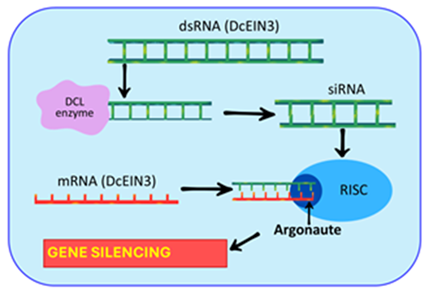 |
|---|
Upon IPTG induction, the lac promoter activates acdS expression while suppressing lacZ expression. Gene regulation will be confirmed through blue-white colony screening on IPTG plates:
Blue colonies indicate lacZ expression (no silencing)
White colonies indicate lacZ repression (successful gene silencing)
This dual system offers a clear, visual demonstration of controllable gene activation and repression, serving as a powerful educational tool for understanding ethylene regulation and gene network engineering in plants.
| Figure 4. The plasmid construct for E. coli is designed to delay ethylene-induced senescence. The design begins with the overexpression of the acdS gene under the control of the Lac promoter; as gene transcription ends, LacZ gene silencing using siRNA driven by a second Lac promoter begins. This design is expected to produce low levels of ethylene, therefore delaying senescence (Hasan Sowrav et al., 2024). (The quality of the picture needs to be improved) | 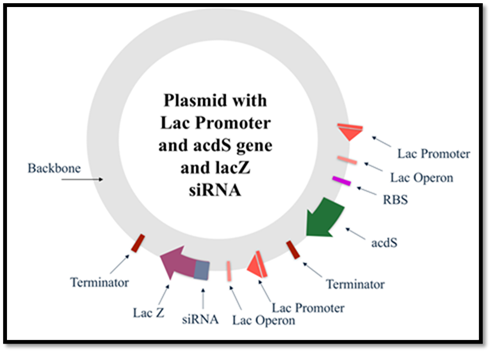 |
|---|
Parts level
Two systems will be engineered to regulate carnation ethylene levels by leveraging the ethylene-inducible ERF1 promoter. The ERF1 promoter acts as a stress-responsive switch, It is activated by ethylene itself and by abiotic stresses such as drought and salt (Solano et al., 1998). Its activation triggers a genetic response that lowers overall ethylene levels, forming a negative feedback loop. (Cite the latest references throughout the project).
Both systems include a terminator sequence to ensure proper transcriptional termination (Figure 5).
| Figure 5. System 1. 5A. Plasmid Design Constructs: This diagram illustrates a conceptual plasmid construct designed to regulate ethylene signaling and senescence in plants. An ethylene-inducible ERF1 promoter drives the expression of the acdS gene, which encodes ACC deaminase (ACCD). This enzyme reduces ethylene production by catalyzing the breakdown of the precursor ACC. A second ERF1 promoter controls the expression of siRNA targeting DcEIN3, which silences ethylene-related genes (Glick B.R., 2014). 5B. Plasmid Design in E. coli: This schematic details a dual-function plasmid construct for E.coli. The acdS gene is expressed under the control of an IPTG-inducible lac promoter, simulating the reduced ethylene biosynthesis observed in plants. Simultaneously, a small interfering RNA (siRNA) construct targets the lacZ gene to model RNAi-like gene silencing of ethylene-signaling components. Functional success is determined via blue-white screening: Blue colonies indicate active lacZ expression (no silencing). White colonies indicate lacZ repression (successful gene silencing). (Glick B.R., 2014). | 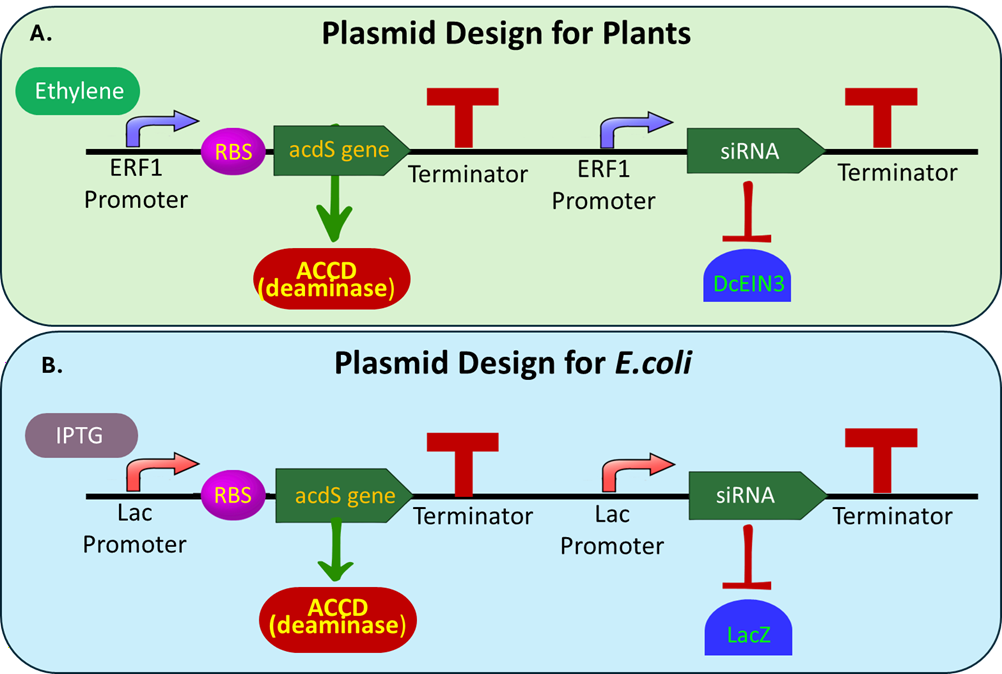 |
|---|
System 1: cytosolic ACC deamination
The first system functions in the cytosol, where it is engineered to upregulate acdS expression. The ethylene-inducible ERF1 promoter drives the transcription of this gene, and the resulting messenger RNA (mRNA) includes a ribosome-binding site (RBS) to ensure efficient translation. This process produces the enzyme 1-aminocyclopropane-1-carboxylic acid (ACC) deaminase. This enzyme actively reduces ethylene biosynthesis by catalyzing the cleavage of ACC, ethylene's direct precursor, into α-ketobutyrate and ammonia. (Figure 5).
System 2: nuclear gene silencing
The second system operates in the nucleus and is designed to downregulate the DcEIL3-1 gene. It also uses the ERF1 promoter, but in this configuration, it drives expression of siRNA. The siRNA is specifically designed to target DcEIL3-1 mRNA transcripts, initiating gene silencing. By suppressing DcEIL3-1 expression, this system interferes with the plant's ethylene biosynthesis and signaling pathways (Xu et al., 2021). (Figure 5).
RNA interference (RNAi) is a cellular defense and regulatory pathway in which plants respond to double-stranded RNA (dsRNA) by generating short guide molecules that silence matching genes. When dsRNA is present in the cell, Dicer-like enzymes cleave it into small interfering RNAs (siRNAs). These siRNAs are then transferred to an Argonaute protein, which keeps only one strand—the guide strand—while the partner (passenger) strand is discarded. The guide-loaded Argonaute complex scans the cell for RNA sequences with complementary bases. Once it finds a matching messenger RNA, Argonaute cleaves that transcript, preventing its translation into a protein (Bologna & Voinnet, 2014).
Safety
E. coli is classified as a model organism due to its rapid growth and reproduction. These traits, along with their genetic simplicity and ease of manipulation, allow E. coli to transform and express foreign plasmids and genes. A Biosafety Level 1 (BSL-1) precaution is advised when handling E. coli in a lab setting. To maintain safety standards, lab safety equipment will be worn, including gloves, closed-toe shoes, lab coats, and appropriate eye protection. In addition, any outside material, such as food, will be removed from the lab. Once the experiment is complete, a bleach solution will be applied to disinfect all equipment used. The lab will then be wiped down with cleaning agents, and all equipment used will be sanitized and disposed of (Rutgers, retrieved 2025).
Discussions
This project presents a sustainable synthetic biology approach to reduce postharvest waste in the floriculture industry by extending the vase life of ethylene-sensitive flowers, such as carnations. Premature senescence caused by ethylene shortens flower longevity, resulting in significant financial losses for growers, wholesalers, and retailers (Wang et al., 2024). By regulating ethylene biosynthesis and signaling, this system aims to reduce wilting, improve product quality, and decrease dependence on chemical preservatives (Oluwaseun S.A., 2024).
Next steps
Protein expression levels will be analyzed by Sodium Dodecyl Sulfate-Polyacrylamide Gel Electrophoresis (SDS-PAGE) to verify upregulation and silencing effects. This provides a clear visual demonstration of controllable gene activation and repression, serving as a proof-of-concept for the regulation of the ethylene pathway.
Beyond carnations, this synthetic biology framework can be adapted to other ethylene-sensitive species—such as roses, tomatoes, and bananas—to extend shelf life and preserve both nutritional and aesthetic quality. This work demonstrates how biological engineering can drive eco-friendly agricultural innovation that aligns economic efficiency with environmental sustainability.
In future applications, this RNA interference strategy can be adapted to silence specific plant genes, offering a sustainable approach to delay flower aging and extend vase life in ethylene-sensitive species.
Plant growth–promoting bacteria (PGPB), including genera such as Pseudomonas, Rhizobium, and Azospirillum, naturally express proteins that facilitate symbiotic relationships with host plants. Research suggests that certain strains of E. coli can also exhibit PGPB-like characteristics, supporting plant development through similar symbiotic mechanisms.
To leverage these properties, we designed a plasmid construct for expression in E. coli. This system enables the production of the PGPB-derived acdS gene (encoding ACC deaminase) while simultaneously incorporating a gene-silencing strategy. In this model, the construct targets the lacZ gene, allowing us to validate the silencing mechanism before applying it to plant systems.
Author contributions
MB, AM, EG, NP, and HU came up with the project concept. MB focused her research on the first system for ethylene production, and EG and HU worked on the second system for ethylene response. NP focused on the siRNA research for EIN3. MB developed the systematic design and proof of concept. AM and NP worked on f editing. All authors contributed to the final manuscript and the Google Slides final product.
Acknowledgements
This project was made possible through the support of the BioBuilder Club, which is integrated into our Research Class under the guidance of Ana White. We are deeply grateful to BioBuilder for providing us with the opportunity to deepen our understanding of synthetic biology and to engage in authentic, research-based learning.We would also like to extend our sincere thanks to our BioBuilder Club mentor, Michael Sheets, for his continuous support, insightful guidance, and valuable feedback throughout the design and development of our project.
References
Baek, S., Naing, A. H., Kang, H., Chung, M. Y., & Kim, C. K. (2024). Overexpression of acdS in petunia
reduces ethylene production and improves tolerance to heat stress. Plant Biology (Stuttgart, Germany), 26(5), 789–797. https://doi.org/10.1111/plb.13672
Bologna, N. G., & Voinnet, O. (2014). The Diversity, Biogenesis, and Activities of Endogenous Silencing
Small RNAs in Arabidopsis. Annual Review of Plant Biology, 65(1), 473–503. https://doi.org/10.1146/annurev-arplant-050213-035728
Kinhal, V. (2024, November 11). How Does the Role of Senescence Affect Crop
Productivity? CID Bio-Science. https://cid-inc.com/blog/how-does-the-role-of-senescence-affect-crop-productivity/
Gebremichael, D. E., Haile, Z. M., Negrini, F., Sabbadini, S., Capriotti, L., Mezzetti, B., & Baraldi, E.
(2021). RNA Interference Strategies for Future Management of Plant Pathogenic Fungi: Prospects and Challenges. Plants, 10(4), 650. https://doi.org/10.3390/plants10040650
Glick, B. R., & Nascimento, F. X. (2021). Pseudomonas 1-Aminocyclopropane-1-carboxylate (ACC)
Deaminase and Its Role in Beneficial Plant-Microbe Interactions. Microorganisms, 9(12), 2467. https://doi.org/10.3390/microorganisms9122467
Guideline for working with bacterial cultures. (n.d.). Waksman Student Scholars Program; Rutgers
Education. Retrieved December 12, 2025, from https://wssp.rutgers.edu/resources/waste
Guo, H., & Ecker, J. R. (2003). Plant Responses to Ethylene Gas Are Mediated by
SCFEBF1/EBF2-Dependent Proteolysis of EIN3 Transcription Factor. Cell, 115(6), 667–677. https://doi.org/10.1016/s0092-8674(03)00969-3
Ju, C., Yoon, G. M., Shemansky, J. M., Lin, D. Y., Ying, Z. I., Chang, J., Garrett, W. M., Kessenbrock,
M., Groth, G., Tucker, M. L., Cooper, B., Kieber, J. J., & Chang, C. (2012). CTR1 phosphorylates the central regulator EIN2 to control ethylene hormone signaling from the ER membrane to the nucleus in Arabidopsis. Proceedings of the National Academy of Sciences, 109(47), 19486–19491. https://doi.org/10.1073/pnas.1214848109
Koeppe, S., Kawchuk, L., & Kalischuk, M. (2023). RNA Interference Past and Future Applications in
Plants. International Journal of Molecular Sciences, 24(11), 9755. https://doi.org/10.3390/ijms24119755
Li, W., Ma, M., Feng, Y., Li, H., Wang, Y., Ma, Y., Li, M., An, F., & Guo, H. (2015). EIN2-Directed
Translational Regulation of Ethylene Signaling in Arabidopsis. Cell, 163(3), 670–683. https://doi.org/10.1016/j.cell.2015.09.037
Shahid, M., Singh, U. B., Mohammad Saghir Khan, Singh, P., Kumar, R., Raj Narian Singh, Kumar, A.,
& Harsh Vardhan Singh. (2023). Bacterial ACC deaminase: Insights into enzymology, biochemistry, genetics, and potential role in amelioration of environmental stress in crop plants. Frontiers in Microbiology, 14. https://doi.org/10.3389/fmicb.2023.1132770
Solano, R., Stepanova, A., Chao, Q., & Ecker, J. R. (1998). Nuclear events in ethylene signaling: a
transcriptional cascade mediated by ETHYLENE-INSENSITIVE3 and ETHYLENE-RESPONSE-FACTOR1. Genes & Development, 12(23), 3703–3714. https://doi.org/10.1101/gad.12.23.3703
Wang, M., Ni, C., Wang, R., Zhong, L., Cheng, Y., Bao, M., & Zhang, F. (2023). Variation in longevity of
cut and in planta flowers of potted carnation varieties affected by their relationship with ethylene and water. Ornamental Plant Research, 3(1), 1–11. https://doi.org/10.48130/opr-2023-0002
Wang, M., Wang, M., Ni, C., Feng, S., Wang, Y., Zhong, L., Cheng, Y., Bao, M., & Zhang, F. (2024).
Differences in ethylene sensitivity, expression of ethylene biosynthetic genes and vase life among carnation varieties. Ornamental Plant Research, 4(1). https://doi.org/10.48130/opr-0024-0002
Wang, T., Sun, Z., Wang, S., Feng, S., Wang, R., Zhu, C., Zhong, L., Cheng, Y., Bao, M., & Zhang, F.
(2023). DcWRKY33 promotes petal senescence in carnation (Dianthus caryophyllus L.) by activating genes involved in the biosynthesis of ethylene and abscisic acid and accumulation of reactive oxygen species. The Plant Journal, 113(4), 698–715. https://doi.org/10.1111/tpj.16075
Xu, H., Luo, D., & Zhang, F. (2021). DcWRKY75 promotes ethylene induced petal senescence in
carnation (Dianthus caryophyllus L.). The Plant Journal, 108(5), 1473–1492. https://doi.org/10.1111/tpj.15523
Zhu, C., Huang, Z., Sun, Z., Feng, S., Wang, S., Wang, T., Yuan, X., Zhong, L., Cheng, Y., Bao, M., &
Zhang, F. (2023). The mutual regulation between DcEBF1/2 and DcEIL3‐1 is involved in ethylene induced petal senescence in carnation (Dianthus caryophyllus L.). The Plant Journal, 114(3), 636–650. https://doi.org/10.1111/tpj.16158