
Shreeya Aravind, Ridhima Bajaj, Anudeep Gadipalli, Siri Nuthalapati, Shriya Palwai, Hanssini Premkumar, Michelle Rarasati, and Hassan Syed, South Forsyth High School BioBuilder, Cumming, Georgia, United States
Reviewed on 9 May 2026; Accepted on 22 June 2026; Published on 26 October 2026
With help from the 2026 BioTreks Production Team.
Airborne pollen exposure in Atlanta increases respiratory-related ER visits by 8%, disproportionately affecting children, older adults, and individuals with asthma. Rather than focusing on treatment after exposure, our project introduces the implementation of RNA interference through BioClay nanoparticles to address pollen production at its biological source. At the biological level, pollen maturation in white oak is largely dependent on gibberellin (GA) signaling, a pathway present in most land plants. When GA binds to the GID1 receptor, DELLA repressors are degraded, enabling pollen development. In annual crops such as tomatoes, this pathway has successfully been suppressed through transient and reversible RNA interference, utilizing spray-applied double-stranded RNA (dsRNA). In this mechanism, dsRNA is processed into siRNAs that cleave GID1 mRNA, maintaining DELLA-mediated repression of pollen-related gene expression. However, translating this approach to perennial trees is challenging due to thick cuticles, long developmental timelines, and rapid degradation of dsRNA, requiring the use of BioClay nanoparticles to protect dsRNA and enable sustained uptake into plant tissues. Building on validated tomato crop applications, we aim to adapt this approach for the white oak, a leading contributor of pollen production in Atlanta due to its high abundance. RT-qPCR (reverse transcription quantitative polymerase chain reaction) and multispecies testing, quantifying GID1 levels, and validating species specificity can evaluate project success. Ultimately, the project extends RNAi intervention from annual crops to perennial trees by enabling a scalable, seasonal, and non-transgenic method for mitigating pollen-driven health challenges.
Keywords: RNA interference, BioClay delivery system, oak pollen reduction, gibberellin signaling, urban air quality
Authors are listed in alphabetical order. Alberto J. Donayre-Torres mentored the group. Please direct all correspondence to mailto:f41100@forsyth.k12.ga.us.
Background
Atlanta consistently records some of the highest pollen levels in the United States, frequently exceeding 1,500 grains per cubic meter (Dillard, 2026). A March 2026 study by the Asthma and Allergy Foundation of America ranked Atlanta as the 34th most challenging city to live in with allergies, placing it worse than average overall. On high-pollen days, pollen counts in the metro area have surpassed 5,000 to 7,000 grains per cubic meter, far above levels seen in many other U.S. cities (Asthma and Allergy Foundation of America, 2025). Moreover, evidence indicates that pollen seasons in Atlanta are occurring earlier than in the past and are becoming longer (Lappe et al., 2023). Pollen levels in Atlanta peak intensely from March to April, while they fluctuate from mild to negligible from August to October, displayed in Figure 1 (Atlanta Allergy & Asthma, 2025).
| Figure 1: Atlanta Allergy Pollen Count (2025). Pollen levels peak from March to April, with earlier pollen development in February. Data found from Asthma and Allergy Foundation of America. | 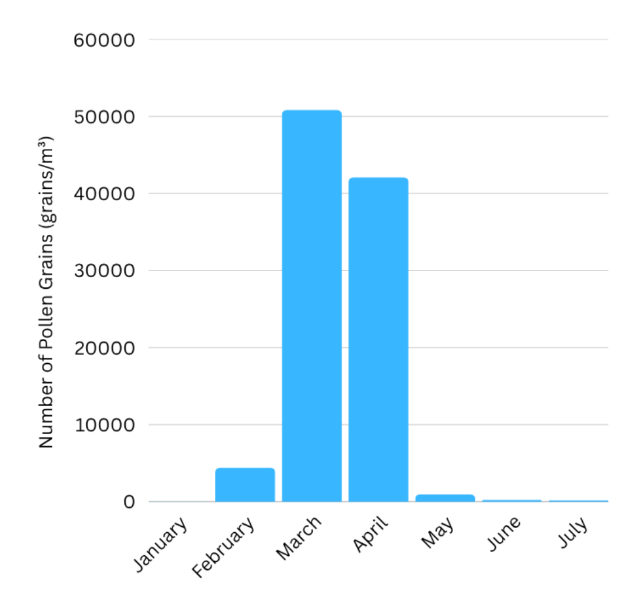 |
|---|
Although pine pollen is the most visible, hardwood trees, especially oak, are the primary drivers of allergic disease in Atlanta. For instance, in the spring of 2025, when Atlanta experienced 10 consecutive days of extremely high pollen, oak was listed as the leading contributor (Grapevine, 2025). Oak pollen grains are small, “measuring about 25 microns” (Grapevine, 2025), allowing them to remain airborne longer and penetrate deeper into the respiratory tract, making them more allergenic than pine pollen. A single mature oak can release up to 3 million pollen grains per day, and Georgia is dominated by over 30 species of oak trees (Dillard, 2026). Particularly, White oak (Quercus alba) is found throughout the state of Georgia, being the most abundant oak species in North Georgia, and is present in many urban areas (Georgia Native Plant Society, n.d.); therefore, it was selected as the focal tree for this project.
The extreme levels of oak tree pollen have measurable health impacts. In a US-based study, 31% of military children with rhinitis, a disease commonly triggered by allergens, were reported to show a positive skin prick test towards oak tree extract allergen, demonstrating the significant effects of oak tree pollen on respiratory conditions (Turacoz Healthcare Solutions, 2021). Higher airborne pollen concentrations have been associated with up to an 8% increase in emergency department visits for asthma and wheeze in the Atlanta metropolitan area (Lappe et al., 2023). Furthermore, local allergists and sinus clinics in the Atlanta area commonly report that many newcomers begin experiencing seasonal allergy symptoms within their first few years of living in the city, a pattern often informally referred to as “Atlanta allergy initiation” (Dillard, 2026). For individuals with asthma or chronic sinus disease, elevated oak pollen commonly triggers wheezing, airway inflammation, sinus infections, and disrupted sleep (Dillard, 2026). Looking ahead, using simulations of climate change scenarios, Anenberg et al. (2017) predict that pollen concentrations are likely to increase, and oak tree pollen seasons are likely to lengthen in the future due to increased temperatures from climate change. Their simulation also predicts that in the Southeastern region of the United States, pollen-related asthma ED visits will increase by 29% from 2010 to 2090, illustrating the impact that pollen will have across decades. Currently, mechanical removal, chemical sprays, and medications are used to mitigate the health impacts of pollen; however, these methods act after pollen is released and do not scale across the urban tree populations effectively.
To combat this, our team considered two approaches. The first was to redesign a leaf bacterium to release GA2ox enzymes and reduce the concentration of hormones required for pollen production. The second was to spray dsRNA onto buds, triggering RNA interference (RNAi) to lower levels of GID1, a protein essential for pollen production. From these two approaches, the latter was selected due to its efficiency and controllability. Unlike the first approach, which reduces hormone concentrations, targeting GID1 offers a more tractable regulatory point, though it may still have broader effects on GA signaling. In addition, spraying dsRNA is more targeted, non-invasive, and scalable than engineering and maintaining modified bacteria. This project extends prior spray-induced RNAi application on annual crops, such as tomato plants, into outdoor woody and perennial species, which have been underexplored compared to its usage on annual crops. Moreover, it targets a developmental commitment window in oak trees: during early bud formation, reproductive tissues undergo a brief but critical period in which they commit to developing pollen. Intervening during this window allows for temporary suppression of signaling pathways without permanently altering the tree’s genome or disrupting later growth.
Systems level
This system is designed to temporarily reduce pollen production during the flowering season without permanently changing the plant’s DNA. The intervention occurs in late winter to early spring, just before flowering begins, a season that “usually extends until late March and May (or June)” (Turacoz Healthcare Solutions, 2021). The timing is critical because genes involved in hormone signaling and pollen development are most active during the pre-flowering and early flowering stages. Applying this system in this time interval allows pollen production to be reduced before pollen release begins.
Additionally, this intervention acts specifically on the flowering buds of the tree. These buds contain tissue that later forms into pollen (Song et al., 2025). By targeting the buds, the system focuses on reproductive development while not affecting the whole tree directly. Through a process known as source-to-sink regulation, resources in plants, including sugars and other macromolecules, are transported from the producing areas (source) to consuming areas (sinks) (Cazzonelli & Pogson, 2010). In oak trees, buds are the main consuming areas, so resources flow toward them. As a result, dsRNA applied to the buds is expected to remain largely localized to these tissues due to sink-directed transport, reducing the likelihood of broader developmental effects, such as dwarfism, in other parts of the tree.
To begin the mechanism, the double-stranded RNA (dsRNA), designed to match a specific target gene, is sprayed onto the buds, triggering RNA interference in plant tissues (Bennett et al., 2022). In the case of this project, the target gene is the GID1 protein gene. Then, the plant utilizes the dsRNA to break down the mRNA of the GID1 protein, which acts as a temporary silencer for the protein. As a result, the crucial GID1 protein is produced in smaller amounts, leading to a reduced pollen production.
Demonstrating reversibility, these temporary effects of dsRNA and RNAi eventually fade and allow normal gene expression after the natural degradation of the dsRNA. Furthermore, the system follows a non-transgenic approach centered on the design of sequence-specific dsRNA targeting GID1. This same approach was demonstrated in the 2024 iGEM Thessaly project, which targeted and silenced genes contributing to fungal virulence while ensuring "species-specific precision in defeating the deadly fungus" (Thessaly iGEM Team, 2024). Similarly, our proposed method is designed to leverage the transient properties of dsRNA without the use of foreign DNA, allowing for similar species-specific precision in a non-invasive and reversible manner.
Device level
Unfortunately, RNA molecules are naturally unstable and degrade quickly due to environmental factors, such as UV radiation, rain and pH changes. This would affect our delivery approach, which utilizes dsRNA, because these conditions can degrade the strand before it penetrates the leaves, preventing successful uptake by the plant. To overcome these challenges, this system is delivered using BioClay, “a nano-sized degradable clay used to release double-stranded RNA, that protects plants from specific disease-causing pathogens”, which allows dsRNA to be slowly released over time.
The device consists of two primary components: (1) dsRNA designed to target the oak gibberellin receptor gene GID1, and (2) BioClay, a layered double hydroxide nanosheet carrier that protects dsRNA and enables sustained release (Mitter et al., 2017). The molecular dynamics between the dsRNA and BioClay can be found in Figure 2.
| Figure 2: Molecule Dynamics of dsRNA + BioClay. Layered structure and positive charge of layered double hydroxide (LDH) materials stabilize nucleic acids. Use of phosphates and chlorine ions protects the stability, structural integrity, and loading efficiency of the treatment. | 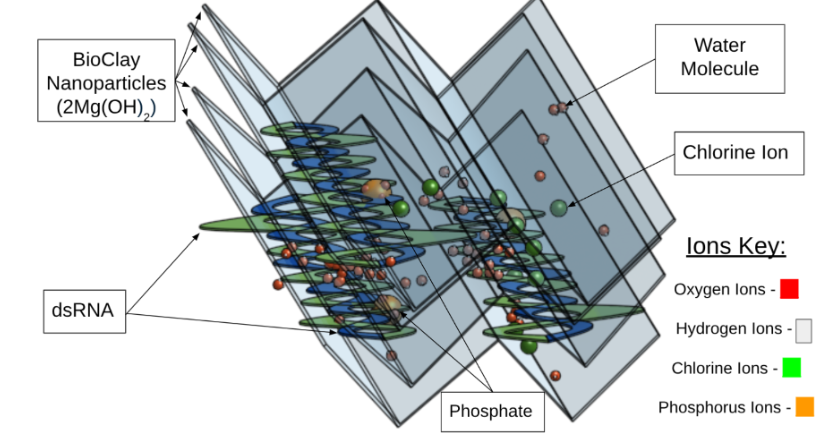 |
|---|
BioClay addresses environmental limitations by electrostatically adsorbing dsRNA onto positively charged nanosheets, shielding it from degradation while enabling gradual release through ion-exchange mechanisms displayed in Figure 2. This extends dsRNA stability from hours to several weeks, aligning RNA availability with the critical developmental window of bud formation (Mitter et al., 2017).
This formulation can be applied as a targeted spray to oak buds during late-winter ecodormancy, when tissues are hormonally responsive but not yet committed to pollen production. Following application, the BioClay–dsRNA complex adheres to bud surfaces, where it releases dsRNA over time. The released dsRNA is taken up into plant tissues and induces RNA interference, leading to degradation of target mRNA transcripts (Dalakouras et al., 2020; Mitter et al., 2017).
Field-simulated studies have demonstrated that a single application of BioClay-delivered dsRNA can sustain RNA interference effects for approximately 20 days without long-term environmental accumulation, providing sufficient persistence for biological impact while maintaining reversibility (Mitter et al., 2017). The Lethbridge HS iGEM team further demonstrated the viability of this approach by successfully producing functional siRNA constructs through PCR amplification, in vitro transcription, and RNase H digestion, achieving confirmed construct concentrations of up to 1787.7 µg/mL, and identifying BioClay as their delivery method to maintain construct stability and minimize environmental health risks (Lethbridge HS iGEM Team, 2021).
Overall, this device enables targeted, sequence-specific modulation of plant signaling pathways in outdoor environments while remaining temporary, non-transgenic, and environmentally contained (Dalakouras et al., 2020).
Parts level
This proposed system targets endogenous hormone regulation in oak trees by modifying the gibberellin (GA) signaling pathway through a spray-induced gene silencing mechanism. This approach relies on the interaction between gibberellins, their receptor GID1, DELLA repressors, ubiquitination machinery, and the proteasome to regulate pollen development.
Gibberellin (GA) is a plant hormone essential for reproductive development, including pollen formation. However, GA signaling depends on the receptor protein GID1, which functions to “stimulate GA responses including seed germination” and “stem elongation” (Hauvermale, 2012). Without effective GID1 function, GA signaling is significantly reduced, preventing activation of downstream processes required for pollen production. For this reason, this system targets GID1 rather than GA itself, allowing for more precise disruption of the signaling pathway to potentially reduce, though not eliminate, broader hormonal effects. The GA-GID1 Pathway is displayed in Figure 3.
| Figure 3: GA-GID1 Pathway. Figure shows transcriptional pathway expression of pollen development at the molecular level. Occurs according to the tree’s temperature regulation and season, around late winter. | 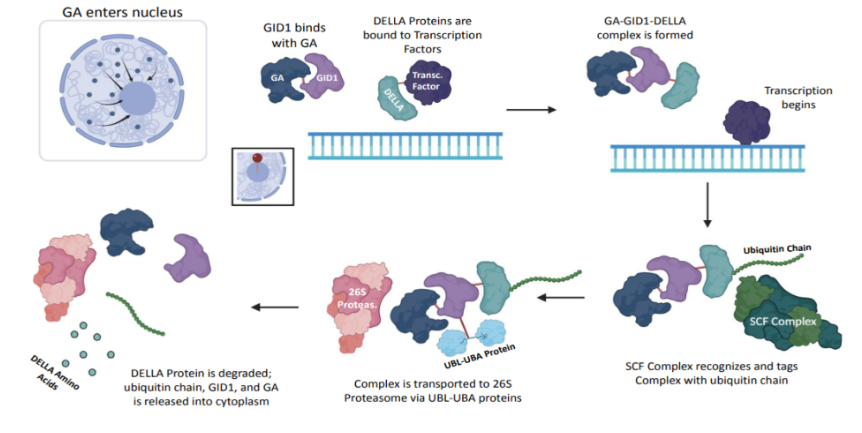 |
|---|
In the absence of GA, DELLA proteins act as transcriptional repressors by inhibiting factors responsible for developmental progression (Davière & Achard, 2013). When GA is present, it binds to GID1, forming a GA–GID1 complex that subsequently interacts with DELLA proteins. This complex can be “recognized and ubiquitinated by the SCF complex” (Fukazawa et al., 2015). Ubiquitination, a process involving the attachment of a polypeptide ubiquitin chain, commits DELLA proteins to irreversible degradation by the 26S proteasome. (Sun, 2011; Fukazawa et al., 2015; Bard et al., 2018; Schrader, 2009). The degradation of DELLA proteins relieves transcriptional repression, allowing GA-responsive genes involved in pollen development to be expressed (Davière & Achard, 2013).
Disrupting this pathway by reducing GID1 expression prevents DELLA degradation, maintaining repression of pollen-related gene expression. There are two different homologs for the GID1 protein, GID1a and GID1b. The project focuses on targeting the GID1a homolog because it is more prevalent in oak species, and there is limited data on the GID1b homolog in gene databases. Experimental evidence supports this approach: mutations in GID1 (gid1a-1 gid1b-1) have been shown to reduce fertility and pollen development by approximately 66% (Griffiths et al., 2006). While real-world application will likely produce a smaller effect due to environmental variability, this demonstrates the effectiveness of targeting GID1 as a control point for pollen regulation.
To achieve this, the system utilizes dsRNA to induce RNA interference (RNAi) targeting GID1 mRNA (Venu et al., 2024). Following cellular uptake, dsRNA is processed by the RNase III enzyme Dicer into short interfering RNAs (siRNAs) approximately 20–25 nucleotides in length (Choudhary et al., 2007). These siRNAs are incorporated into the RNA-induced silencing complex (RISC), which binds complementary mRNA sequences and induces cleavage, preventing translation. In this system, siRNAs specifically target transcripts encoding the GID1 receptor, reducing protein expression and limiting GA signaling.
As a result, reduced GID1 availability prevents DELLA degradation, maintaining transcriptional repression and limiting pollen development. Spray-induced gene silencing (SIGS) systems have demonstrated the ability to reduce target gene expression by approximately 70–90% depending on sequence design and delivery efficiency (Wei et al., 2023), supporting the feasibility of this RNAi-based approach.
Importantly, GID1 primarily regulates growth and reproductive pathways, with no evidence suggesting direct involvement in essential processes such as photosynthesis or nutrient uptake (UniProt, 2026). This supports the specificity of the intervention, although further validation is required to confirm minimal off-target effects in complex environmental conditions.
Safety
The development of strong environmental and safety procedures prior to application can result in deliberate methods to counteract negative environmental effects that protect human sustainability. In regards to the human safety of the dsRNA + BioClay, research has shown that the use of the BioClay – dsRNA treatment has a low risk of causing harm to humans and other mammals. According to the OECD, “available evidence suggests that dsRNAs have a long record of safe consumption by humans and other mammals” (Organisation for Economic Co-operation and Development, n.d.). This claim is justified by not only the physiological and immune barriers within humans and mammals, but also the natural occurrence of nucleic acid, like dsRNA.
Additionally, the University of Queensland argues that BioClay naturally degrades in the presence of moisture and carbon dioxide. This usually occurs throughout a 6-8 week period (Mitter et al, 2017). In regards to the human safety of BioClay, the paper “A Perspective on RNAi-based Biopesticides” states that the layered double hydroxide structure of BioClay is similar to that of many safe human medications. Due to these chemical similarities, the safety associated with LDH medications can likely represent BioClay in matters of human safety. As a result, the treatment is less likely to be associated with the adverse effects pertained to inorganic/artificial matter – dangerous chemical reactions, non-biodegradability, and physical disruption (Organisation for Economic Co-operation and Development, n.d.).
Additionally, application of the treatment is unlikely to affect pollinators and nectar production as the treatment targets wind-pollination or anemophily in White Oak trees. Anemophily is used by certain types of perennial trees for pollinator-independent pollination (Moisset, n.d.). The treatment targets these trees as they make up a majority of allergen-related pollen production. Though only 10-18% plants wind pollinate, trees such as oak, birch, and cedar produce millions of pollen grains, dominating the pollen landscape (Asam et al., 2015). However, pollinators only interact with plants that use entomophily or pollinator-dependent pollination (Moisset, n.d.). Since the treatment targets only trees that use wind-pollination, entomophily pollination or nectar production won’t be affected. As a result, pollinators, such as bees, moths, and butterflies, are not likely to be negatively affected since entomophilous flowers can create sufficient nectar.
This project presents a potentially viable method to decrease the allergenic pollen levels in Atlanta by temporarily reducing the amount of pollen produced by the Oak tree, a species common to this city. This will positively impact the health of Atlanta residents as the reduction in pollen leads to a decrease in allergenic responses. The application of this project is expected to mitigate the health consequences of urban air mixing with allergenic pollen. For those with conditions of asthma and chronic sinus diseases, the minimization of pollen will prevent the triggering of the aggressive symptoms they might normally face without the implementation of this project. Moreover, it is expected to reduce the amount of emergency room visits due to pollen-related respiratory conditions.
In terms of environmental impacts, the temporary decrease in pollen for that period will consequently reduce the amount of fertilization for that season. This is expected to produce less Oak tree acorns as well. However, the negative ecological consequences and effects on local fauna are factors considered in the project’s design. Many urban experts argue that the regulation of allergy-related pollen production could be balanced with predicted declines in acorn production to minimize ecological effect. An NIH paper by Stevanovic et al. discussed that targeting only specific high-allergy, anemophily species, avoiding insect-pollinated trees, and increasing the biodiversity of tree species are ways to mitigate ecological effects of the treatment (Stevanovic et al., 2025).
This is the main reason for the project's focus on the White Oak tree. Firstly, White Oak trees are prevalent in Atlanta’s ecosystem and release high-allergy pollen through anemophily pollination. As a result, the project's targeting of White Oak trees will mean both decreasing pollen production and blocking off-target effects to insect pollinators such as honey bees and butterflies. Additionally, the design of the dsRNA around the genetic components of White Oak trees means the treatment is intended to primarily decrease pollen synthesis in White Oak and similarly related species, though off-target effects in other species cannot be fully ruled out. This means that other animals and pollinator-dependent tree species will less likely be affected by the genetic regulation caused by the dsRNA treatment.
Finally, acorn production is activated by the fertilization of female trees by pollen. This is why the project’s focus on regulating pollen can result in a decrease in acorn production. However, cities contribute to an environmental phenomena known as “botanical sexism” where more trees are produced that only contain male parts (McGill University, 2024). As a result, increasing the diversity of trees will mean introducing new species that have both male and female parts, contributing to more acorn-producing or female trees within the area.
Discussions
Atlanta experiences some of the highest airborne pollen levels in the United States, with oak pollen serving as a major driver of seasonal allergic disease in urban environments (Sleep & Sinus Centers of Georgia, 2025; Grapevine, 2025). Climate change has intensified this burden by extending pollen seasons and increasing peak concentrations, contributing to measurable increases in asthma-related emergency department visits (Lappe et al., 2023; Anenberg et al., 2017). These trends highlight pollen exposure as both an environmental and public health concern.
Current approaches primarily focus on symptom management rather than exposure reduction. Treatments such as antihistamines and allergen immunotherapy improve individual outcomes but do not address the environmental source of allergens (Cleveland Clinic, 2023). As pollen levels rise, this reactive approach contributes to sustained healthcare demand, emphasizing the need for interventions that reduce exposure at the population level.
Even modest reductions in pollen levels could yield meaningful benefits. In Atlanta, peak pollen events are associated with an estimated 8–10% increase in respiratory-related emergency visits (Lappe et al., 2023), while projections suggest pollen-related asthma visits may increase by approximately 29% in the southeastern United States over time (Anenberg et al., 2017). This showcases that although Atlanta might not be largely impacted by pollen-related emergency visits, other areas in the southeastern United States are strongly affected by pollen-related ER visits, and that pollen-related ER visits will increase in the future.
Although the team attempted to derive a mathematical function to describe the treatment’s effect in pollen, factors such as temperature, climate, dsRNA release-rate, UV level, and wind flow made the situation too complex for mathematical application. However, there is a correlation that decreases in pollen production contribute to a decrease in pollen-related ER visits. By targeting pollen production directly, this approach reduces exposure rather than relying on long-term treatment adherence, which is often limited in practice (Ridolo et al., 2022; Benjamin, 2012).
This system addresses that gap by using spray-applied double-stranded RNA to target GID1 mRNA through RNA interference, temporarily suppressing pollen development prior to release (Dalakouras et al., 2020; Venu et al., 2024). Because the approach acts at the mRNA level rather than modifying DNA, its effects are reversible and limited to a single season, allowing normal gene expression to resume after treatment (Mitter et al., 2017; Dalakouras et al., 2020). This non-transgenic and temporary design strengthens its safety profile while enabling controlled, need-based application (Organisation for Economic Co-operation and Development, n.d.; Dalakouras et al., 2020).
Already, factors such as tree distribution and pest management are actively regulated by urban planners to improve the aesthetic, economic, and environmental quality of cities. In parallel, extensive research and planning efforts focus on tree canopy distribution and the integration of pest management strategies, such as integrated pest management (IPM), to support agriculture, green infrastructure, and urban design. These practices demonstrate that the growth, maintenance, and even biological functions of urban vegetation are not entirely natural, but are instead deliberately managed systems (Giarusso, 2019).
Within this context, the proposed treatment represents a logical extension of existing urban environmental control strategies. As a controllable, temporary, and non-transgenic intervention, it aligns closely with current regulatory frameworks and can be implemented in a similarly targeted and need-based manner. Rather than disrupting natural systems, this approach builds upon the reality that urban ecosystems are already engineered and optimized for human health and livability. By incorporating pollen regulation into these established management practices, the solution positions pollen control as a practical and scalable component of urban planning, with the potential to significantly improve accessibility and quality of life for individuals affected by seasonal allergies.
However, several challenges remain. Environmental factors such as UV radiation and rainfall may reduce treatment stability, while spray-based delivery introduces variability in targeting efficiency and consistency across large tree populations (Dalakouras et al., 2020; Mitter et al., 2017). Additionally, although oak trees are wind-pollinated, reductions in pollen output may produce indirect ecological effects that warrant monitoring (Asam et al., 2015; Dalakouras et al., 2020).
Future work should focus on improving delivery consistency and environmental persistence, as well as exploring alternative strategies such as root-based or soil-mediated delivery systems to enhance uptake efficiency and reduce environmental exposure. Expanding this approach to additional tree species and incorporating ecological assessment will be essential for evaluating scalability and long-term impact (Mitter et al., 2017).
Overall, reducing pollen production at the source offers a proactive, scalable strategy to mitigate climate-driven increases in allergen exposure. By combining a reversible, non-transgenic design with targeted molecular intervention, this approach shifts allergy management from reactive treatment toward environmental prevention, with the potential to improve respiratory health outcomes and reduce long-term healthcare burden in high-risk urban environments.
Next steps
The next phase of our project involves testing our design. Our first objective is to spray a designed dsRNA into a model organism. The dsRNA used in this study will be synthesized from a designed DNA template using in vitro transcription, followed by purification and annealing of complementary RNA strands prior to loading onto BioClay for application. First, we will explore the known RNAi efficiency of various model organisms and determine its suitability for our experimental system. This is important to the experimental design as it will help test the treatment’s functionality in a model organism. For instance, Nicotiana benthamiana is a commonly used organism because it can be easily transformed or agroinfiltrated (Baksa et al., 2025). However, the tomato plant (Solanum lycopersicum) is another organism in which RNAi technology has been used widely as a genetic tool for functional genomics study (Termolino, 2021). Additionally, tomato plants have more visible buds and could therefore be more suitable for testing the application of dsRNA via buds. Considerations such as these are essential when choosing the model organism.
This is why future proof-of-concept testing, of the dsRNA and BioClay treatment, will be on the S. lycopersicum plant. The tomato plant is a multicellular organism with a complex stem architecture. Additionally, the S. lycopersicum releases pollen during the reproduction season. This allows for direct testing of pollen functionality when using the treatment. As a result, these characteristics of the S. lycopersicum make it resemble the White Oak more closely than N. benthamiana due to its reproductive architecture and visible floral buds. This is why it will become a more efficient benchmark regarding the feasibility of the design. Although tomato flowers can benefit from pollinator-assisted buzz pollination, they are largely self-pollinating under controlled conditions. However, this pollinator dependency wouldn't result in ecological downstream effects. This is because the experiments will happen in under controlled lab settings without pollinators.
The dsRNA spray is made by first designing and amplifying a GID1a DNA sequence. This sequence is checked using BLAST analysis to reduce off-target effects, (National Center for Biotechnology Information, n.d.) The dsDNA template is separated into ssDNA and then used for in vitro transcription with RNA polymerase, ribonucleotides, magnesium ions, and reaction buffers to create ssRNA. Ion-exchange chromatography and RNase-free DNase I treatment are used to remove any leftover DNA, proteins, and ionic contaminants. This is followed by acid phenol and chloroform extraction to isolate purified ssRNA from the liquid phase. Finally, complementary ssRNA strands are brought together at 85°C for 3 minutes, then cooled slowly to 4°C to form stable dsRNA.
Finally, although the model organism has buds which could be sprayed on, plant bud intake of dsRNA is a developing field of research. Therefore, it is essential to consider foliar application with mechanical enhancements such as sandpaper abrasions and tissue wounding as well as spraying at high pressures (7-8 bars) (Bennett et al., 2020). Nevertheless, research suggests that “spray-induced gene silencing (SIGS) technology represents an ecologically sustainable approach” (Chen et al., 2025), reinforcing its feasibility in our experimentation.
The second objective is to evaluate the RNAi efficiency. Firstly, due to the expected reduction of GID1a, it is hypothesized that the model organism will have more vegetative than reproductive buds. This is because the absence of GID1a will result in buds remaining vegetative and not produce pollen. Therefore, we can compare the shape and texture of buds to identify the number of reproductive and vegetative buds in the control and experimental groups. We can use methods such as RT-qPCR, quantitative reverse transcription polymerase chain reaction, in order to quantify the amount of a target mRNA in cells. This method uses fluorescence intensity to calculate the amount of target mRNA present after each cycle (Thermo Fisher Scientific, n.d.). One-step RT-qPCR combines reverse transcription and PCR in a single tube and buffer, using only sequence-specific primers.
While performing experimentation, we will incorporate no-spray controls for comparison and a negative control such as spraying with scrambled dsRNA to differentiate sequence-specific RNAi from off-target effects or non-specific cellular responses. Additionally, our experimentation period will align with either the cell expansion phase or floral transition window of the target organism; this way, the RNAi will target mRNA that would translate into proteins that affect either growth or bud formation.
Author contributions
HS led the project and wrote the Discussion section. HS and AG developed the Device and Parts sections, including research on system design and molecular components. AG wrote the Safety section. SA, SN, SP, and RB wrote the Next steps section, outlining the experimental design and proof-of-concept strategy. RB contributed to the Background section by researching pollen exposure and its public health impact. SP and SN developed the Systems Level section, describing the overall function and implementation of the proposed system. The Abstract was written collaboratively by all authors.
MR contributed to system-level development and overall project refinement. All authors participated in researching key aspects of the project, including RNA interference, BioClay delivery systems, gibberellin signaling, and pollen-related health impacts. All authors reviewed, edited, and approved the final manuscript.
Acknowledgements
We would like to thank Dr. Janet Standeven for her guidance, support, and encouragement throughout this project, as well as for providing valuable insight into the biosafety considerations of our work. Her feedback was invaluable in shaping the direction and quality of our research. We are also grateful to Dr. Alberto J. Donayre Torres for his assistance and contributions, particularly his knowledge of environmental feedback systems, which helped strengthen our project’s design. Additionally, we would like to thank our teacher and advisor, Mrs. Pamala Seeley, for her continued support and for providing the resources and environment necessary to complete this project.
References
Anenberg, S., Weinberger, K. R., Roman, H., Neumann, J. E., Crimmins, A., Fann, N., Martinich, J., & Kinney, P. L. (2017). Impacts of oak pollen on allergic asthma in the USA and potential effect of future climate change: a modelling analysis. Lancet, 389, S2–S2. https://doi.org/10.1016/s0140-6736(17)31114-5
Asam, C., Hofer, H., Wolf, M., Aglas, L., & Wallner, M. (2015). Tree pollen allergens–An update from a molecular perspective. Allergy, 70(10), 1201–1211. https://doi.org/10.1111/all.12696
Atlanta Allergy & Asthma. (2025, April 17). Atlanta Allergy & Asthma’s Pollen Count Cited in The New York Times. atlantaallergy.com. https://www.atlantaallergy.com/articles/view/582-atlanta-allergy–asthmas-pollen-count-cited-in-the-new-york-times
Baksa, I., Nagy, T., Barta, E., Havelda, Z., Varallyay, E., Silhavy, D., Burgyan, J., & Szittya, G. (2015). Identification of Nicotiana benthamiana microRNAs and their targets using high throughput sequencing and degradome analysis. BMC Genomics, 16, 1025. https://doi.org/10.1186/s12864-015-2209-6
Bard, J. A. M., Goodall, E. A., Greene, E. R., Jonsson, E., Dong, K. C., & Martin, A. (2018). Structure and Function of the 26S Proteasome. Annual Review of Biochemistry, 87, 697–724. https://doi.org/10.1146/annurev-biochem-062917-011931
Benjamin, R. M. (2012, January 1). Medication Adherence: Helping Patients Take Their Medicines as Directed. Public Health Reports, 127(1). https://doi.org/10.1177/003335491212700102
Bennett, M., Deikman, J., Hendrix, B., & Iandolino, A. (2020). Barriers to efficient foliar uptake of dsRNA and molecular barriers to dsRNA activity in plant cells. Frontiers in Plant Science, 11, 816. https://doi.org/10.3389/fpls.2020.00816
Cazzonelli, C. I., & Pogson, B. J. (2010). Source to sink: regulation of carotenoid biosynthesis in plants. Trends in Plant Science, 15(5), 266–274. https://doi.org/10.1016/j.tplants.2010.02.003
Chen, C., Imran, M., Feng, X., Shen, X., & Sun, Z. (2025). Spray-induced gene silencing for crop protection: Recent advances and emerging trends. Frontiers in Plant Science, 16, 1527944. https://doi.org/10.3389/fpls.2025.1527944
Choudhary, S., Lee, H. C., Maiti, M., He, Q., Cheng, P., Liu, Q., & Liu, Y. (2007). A double-stranded-RNA response program important for RNA interference efficiency. Molecular and Cellular Biology, 27(11), 3995–4005. https://doi.org/10.1128/MCB.00186-07
Cleveland Clinic. (2023, August 9). Allergy shots: Effectiveness, side effects & what to expect.https://my.clevelandclinic.org/health/treatments/25194-allergy-shots
Dalakouras, A., Wassenegger, M., Dadami, E., Ganopoulos, I., Pappas, M. L., & Papadopoulou, K. (2020). Genetically Modified Organism-Free RNA Interference: Exogenous Application of RNA Molecules in Plants. Plant Physiology, 182(1), 38–50. https://doi.org/10.1104/pp.19.00570
Davière, J.-M., & Achard, P. (2013). Gibberellin signaling in plants. Development, 140(6), 1147–1151.
Dillard, D. (2026, April 16). Atlanta Pollen Counts Explained: What You Need to Know. sleepandsinuscenters.com. https://sleepandsinuscenters.com/blog/atlanta-pollen-counts-explained-what-you-need-to-know#:~:text=Whether%20you're%20a%20longtime,here%20to%20share%20what%20works
Dillard, D. (2026, April 16). Oak Pollen in Atlanta: Essential Tips to Manage Allergies. sleepandsinuscenters.com. https://www.sleepandsinuscenters.com/blog/oak-pollen-in-atlanta-essential-tips-to-manage-allergies
Fukazawa, J., Mori, M., Watanabe, S., Miyamoto, C., Ito, T., Takahashi, Y., & Takahashi, Y. (2015). DELLA function in gibberellin signaling. Plant Cell Physiology, 56(1), 1–9.
https://pmc.ncbi.nlm.nih.gov/articles/PMC4883832/
Georgia Native Plant Society. (n.d.). White Oak (Quercus alba). gnps.org. https://gnps.org/plant/white-oak-quercus-alba/#:~:text=Quercus%20alba%2C%20the%20white%20oak,this%20tree%20easy%20to%20identify.
Giarusso, T. (2019). Tree Canopy Assessment for the City of Decatur, Georgia. Georgia Institute of Technology; City of Decatur. www.decaturga.com
Grapevine, R. (2025, April 4). Atlanta allergies: Hardwood trees driving ‘extremely high’ pollen counts. healthbeat.org. https://www.healthbeat.org/atlanta/2025/04/04/allergies-pollen-georgia-asthma-mold-air/
Griffiths, J., Murase, K., Rieu, I., Zentella, R., Zhang, Z. L., Powers, S. J., Gong, F., Phillips, A. L., Hedden, P., Sun, T. P., & Thomas, S. G. (2006). Genetic characterization and functional analysis of the GID1 gibberellin receptors in Arabidopsis. The Plant Cell, 18(12), 3399–3414. https://doi.org/10.1105/tpc.106.047415
Thessaly iGEM Team. (2024). Hardware. iGEM 2024. https://2024.igem.wiki/thessaly/model#pre
Hauvermale, A. L., Ariizumi, T., & Steber, C. M. (2012). Gibberellin signaling: A theme and variations on DELLA repression. Plant Physiology, 160(1), 83–92. https://doi.org/10.1104/pp.112.200956.
Lappe, B. L., Ebelt, S., D'Souza, R. R., Manangan, A., Brown, C., Saha, S., Harris, D., Chang, H. H., Sole, A., & Scovronick, N. (2023). Pollen and asthma morbidity in Atlanta: A 26-year time-series study. Environment International, 177, 107998. https://doi.org/10.1016/j.envint.2023.107998
Lethbridge HS iGEM Team. (2021). Knaptime is Over. iGEM. https://2021.igem.org/Team:Lethbridge_HS
McGill University. (2024, September 13). Office for Science and Society. https://www.mcgill.ca/oss/article/student-contributors-environment/botanical-sexism-really-blame-increased-pollen-allergies-urban-cities
Mitter, N., Worrall, E. A., Robinson, K. E., Li, P., Jain, R. G., Taochy, C., Fletcher, S. J., Carroll, B. J., Lu, G. Q., & Xu, Z. P. (2017). Clay nanosheets for topical delivery of RNAi for sustained protection against plant viruses. Nature Plants, 3, 16207. https://doi.org/10.1038/nplants.2016.207
Moisset, B., Reel, S., Seiler, N., Buchanan, S., & Colla, S. (n.d.). Bee Pollination. USDA Forest Service. Retrieved April 30, 2026, from https://www.fs.usda.gov/wildflowers/pollinators/animals/bees.shtml
National Center for Biotechnology Information. (n.d.). BLAST: Basic local alignment search tool (BLASTn).https://blast.ncbi.nlm.nih.gov/Blast.cgi?PROGRAM=blastp&PAGE_TYPE=BlastSearch&LINK_LOC=blasthome
Organisation for Economic Co-operation and Development. (n.d.). RNA interference-based pesticides. oecd.org. https://www.oecd.org/en/topics/sub-issues/pesticides-and-biocides/rna-interference-based-pesticides.html
Ridolo, E., Incorvaia, C., Pucciarini, F., Makri, E., Paoletti, G., & Canonica, G. W. (2022). Current treatment strategies for seasonal allergic rhinitis: where are we heading? Clinical and Molecular Allergy, 20(1), 9. https://doi.org/10.1186/s12948-022-00176-x
Schrader, E. K., Harstad, K. G., & Matouschek, A. (2009). Targeting proteins for degradation. Nature Chemical Biology, 5(11), 815–822. https://doi.org/10.1038/nchembio.250
Song, G. Q., Jaikham, J., & Wang, W. (2025). Flowering pathway genes: Key targets for accelerated breeding in woody plants. Plant Cell Reports, 45(1), 16. https://doi.org/10.1007/s00299-025-03690-9
Stevanovic, K., Sinkkonen, A., Pawankar, R., & Zuberbier, T. (2025). Urban greening and pollen allergy: Balancing health and environmental sustainability. The Journal of Allergy and Clinical Immunology: In Practice, 13(2), 275–279. https://doi.org/10.1016/j.jaip.2024.12.017
Sun, T. (2011). The molecular mechanism and evolution of the GA–GID1–DELLA signaling module in plants. Current Biology, 21(9), R338–R345. https://doi.org/10.1016/j.cub.2011.02.036
Termolino, P. (2021). RNA interference (RNAi) in tomato crop research. Methods in Molecular Biology, 2264, 163–175. https://doi.org/10.1007/978-1-0716-1201-9_11
Thermo Fisher Scientific. (n.d.). Basic Principles of RT-qPCR. thermofisher.com. https://www.thermofisher.com/us/en/home/brands/thermo-scientific/molecular-biology/molecular-biology-learning-center/molecular-biology-resource-library/spotlight-articles/basic-principles-rt-qpcr.html#:~:text=What%20is%20RT%2DqPCR?,genetic%20testing%2C%20a
Turacoz Healthcare Solutions. (2021, January). t7 Oak Pollen. thermofisher.com. https://www.thermofisher.com/phadia/us/en/resources/allergen-encyclopedia/t7.html
UniProt. (2026). UniProt. https://www.uniprot.org/uniprotkb/Q6L545/entry
Venu, E., Ramya, A., Babu, P. L., Srinivas, B., Kumar, S., Reddy, N. K., Babu, Y. M., Majumdar, A., & Manik, S. (2024). Exogenous dsRNA-Mediated RNAi: Mechanisms, Applications, Delivery Methods and Challenges in the Induction of Viral Disease Resistance in Plants. Viruses, 17(1), 49. https://doi.org/10.3390/v17010049
Wei, D., Wang, S., & Niu, J. (2023). RNAi-based pesticides: current knowledge and potential applications for Integrated Pest Management. Entomologia Generalis, 43(1), 1–4. https://doi.org/10.1127/entomologia/2023/1988