
Anna Barger, Yunwoo Choi, Stephanie Qin, Binita Shaw, James Vacca, Alex Wang, Joe Yang, and Jungin Yoon, Western Reserve Academy, Hudson, Ohio, United States of America
Reviewed on 9 May 2026; Accepted on 22 June 2026; Published on 26 October 2026
With help from the 2026 BioTreks Production Team.
Perchlorate (ClO4–) is a harmful chemical commonly found in arid and semi-arid regions worldwide. While it occurs naturally, perchlorate concentrations have increased drastically due to anthropogenic activities. This presents a major challenge to agriculture in arid regions and risks contaminating drinking water. Even at concentrations in the microgram range, perchlorate is toxic—for example, when present in soil, it interferes with plant growth by competitively inhibiting nutrient uptake. Current treatments are often expensive and ineffective, and potential bioremediation strategies rely on anaerobic pathways that are unachievable in nature. Therefore, this paper aims to engineer a three-step degradation pathway in Pseudomonas chloritidismutans (P. chloritidismutans), a bacterium capable of withstanding harsh, arid environments. Enzymes expressed from a plasmid operon will first reduce perchlorate, after which the resulting intermediates will be processed by the chassis’ endogenous chlorate reduction and dismutation pathways to finally produce chloride and oxygen. A Flavodiiron protein module will also be introduced to prevent intracellular oxygen accumulation, ensuring that perchlorate is not outcompeted as the terminal electron acceptor and thereby allowing the system to function under aerobic conditions. If successful, this chassis could be deployed directly to contaminated soil and water sources, providing a cost-effective approach to perchlorate pollution without the need for additional infrastructure.
Keywords: Bioremediation, perchlorate, Pseudomonas chloritidismutans, in situ remediation
Authors are listed in alphabetical order. Eric J. Young mentored the group. Please direct all correspondence to mailto:marmersteinv@wra.net.


Background
Perchlorate (ClO4⁻) is a naturally occurring anion composed of one chlorine atom bonded to four oxygen atoms. It is commonly found in arid and semi-arid regions, where it accumulates in soil and groundwater. Perchlorate forms stable salts with cations such as potassium, ammonium, and sodium (Perchlorates, 2014). Perchlorate originates from both natural deposition and anthropogenic sources, as illustrated in Figure 1, and it has been detected in soil and water systems worldwide. Its prevalence in water supplies is particularly concerning because perchlorates can persist for decades unless remediation occurs (Fang & Naidu, 2023).
| Figure 1. Anthropogenic sources and environmental transport of perchlorate. Major human-made sources of perchlorate contamination include munitions, fireworks, and Chilean nitrate fertilizer. Perchlorate released from these sources can enter the environment through industrial waste, atmospheric fallout, or agricultural application. Once deposited, perchlorate can leach into soil and groundwater. Plants growing in affected soil can absorb perchlorate through their roots; once accumulated, it may reduce plant growth and potentially enter the food chain. [Created in BioRender. Barger, A. (2026) https://BioRender.com/ud8s1qs] | 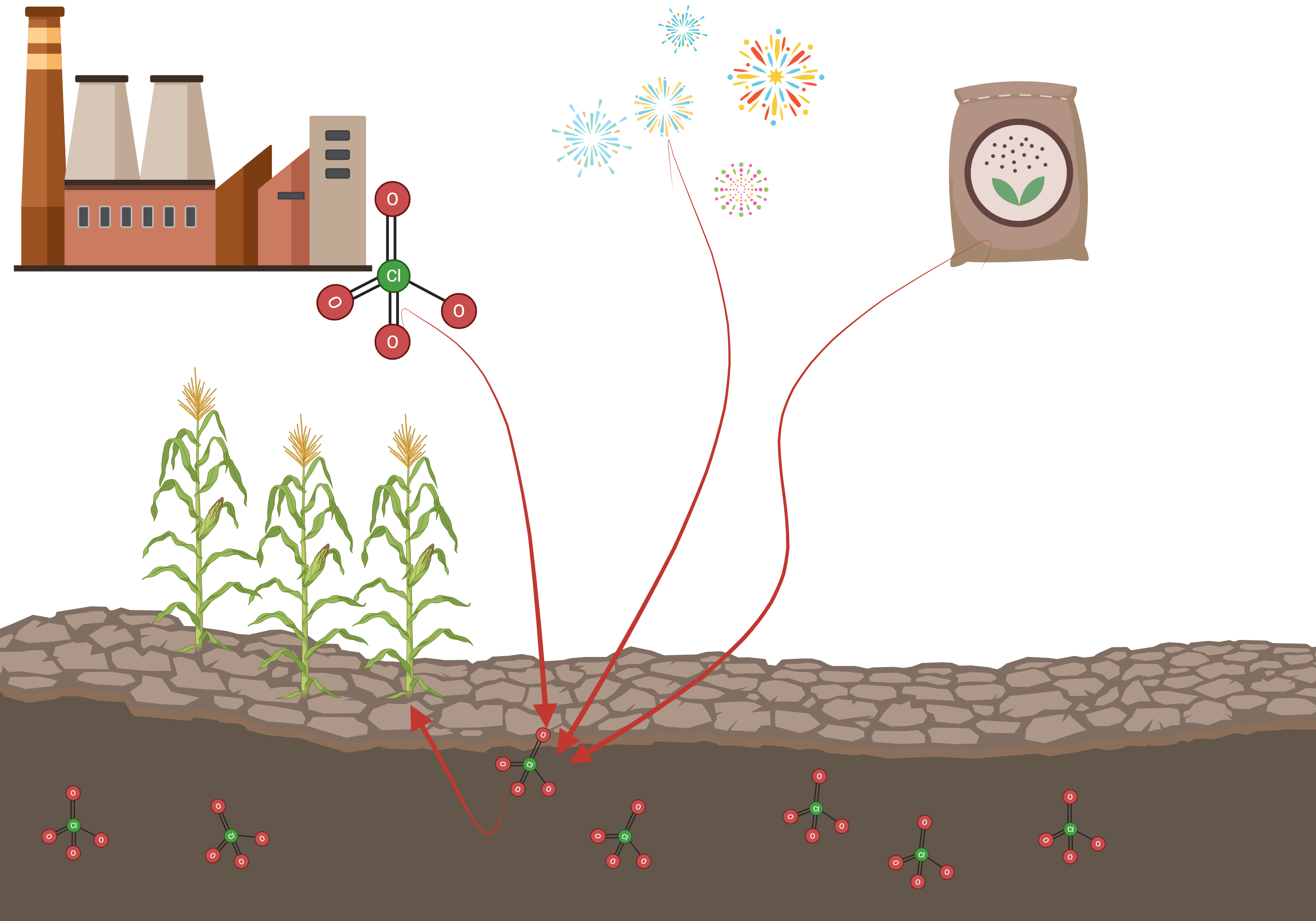 |
|---|
Due to its high solubility, perchlorate can migrate with groundwater if it enters the water table, creating a water-quality problem that extends beyond a localized area. This is especially concerning in arid climates, where water resources are already limited (EPA, 2008).
In humans, the primary risk is to the endocrine system. Perchlorate inhibits the sodium-iodide symporter, reducing iodide uptake into the thyroid and thereby decreasing the availability of thyroid hormones (De Groef et al., 2006). This is particularly harmful during pregnancy and childhood, as thyroid hormones play a critical role in supporting healthy development during these stages. (Perchlorate Maximum Contaminant Level (MCL) Review; “Perchlorate in Drinking Water | California State Water Quality Control Board”).
Beyond human health, perchlorate also poses significant challenges to revegetation and agriculture. Studies have shown that it negatively affects plants to varying degrees. For example, potting soil containing just 1 percent perchlorate by weight exhibited restricted germination and growth, reduced leaf area, and reduced biomass. Although perchlorate occurs naturally worldwide, its widespread use in munitions, fireworks, and fertilizer has driven a global increase in environmental concentrations in recent years (EPA, 2013, p. 190). Even at the microgram level, these compounds prove detrimental to plant health (Bardiya & Bae, 2011). Since perchlorate ions are similar in size and charge to essential minerals, they can enter root membranes and compete with nitrate, sulfate, and chloride, ultimately disrupting normal nutrient uptake (Yu et al., 2004). In addition to this, perchlorate’s chaotropic properties interfere with interactions between water and macromolecules, causing their denaturation (Díaz-Rullo et al., 2021). Over time, perchlorate accumulates in plant tissues, leading to yellowing (chlorosis), tissue death (necrosis), and leaf tip burn, as shown in Figure 2 (Sahu & Kumari, 2024).
| Figure 2. Impact of perchlorate on plant growth. Perchlorate competes with nutrient ions, ultimately leading to chlorosis and necrosis as exposure levels vary. [Created in BioRender. Yoon, J. (2026) https://BioRender.com/1y6dv41] | 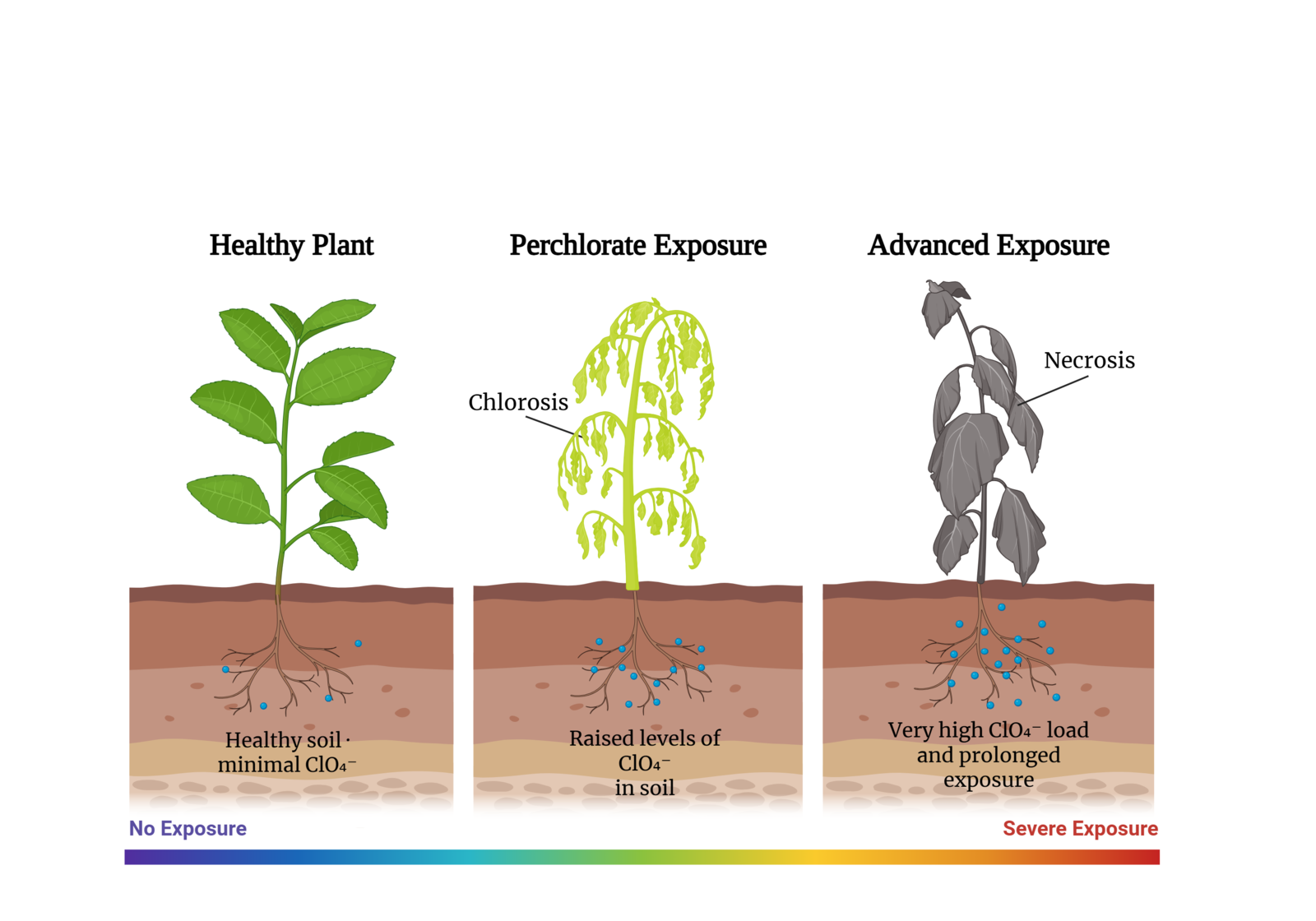 |
|---|
Despite the negative effects described above, the Environmental Protection Agency does not currently regulate perchlorate as a drinking water contaminant (EPA, 2026; Fang & Naidu, 2023). However, legislation proposed for 2026 aims to limit perchlorate concentrations to 20 µg/L, 40 µg/L, or 80 µg/L depending on the regulatory threshold adopted (EPA, 2026). Current approaches for treating perchlorate contamination exist but are generally limited in their effectiveness. Ion exchange, a common method that uses resin beads to capture perchlorate ions and replace them with non-toxic alternatives, is expensive and generates secondary waste (Office of Pollution Prevention and Technology Development, 2003). Selective membrane filtration methods such as reverse osmosis have also been applied, yet they are energy-intensive to implement (Office of Pollution Prevention and Technology Development, 2003). Chemical reductants such as Zero Valent Iron and Titanium (III) often require UV light and elevated temperatures to drive the reaction, making them costly, hazardous, and difficult to scale (Office of Pollution Prevention and Technology Development, 2003).
Among these approaches, bioremediation through reduction processes is a promising alternative. However, traditional biological perchlorate treatments have shown limited effectiveness across many environments (ITRC (Interstate Technology & Regulatory Council), 2007). Perchlorate-reducing bacteria tend to preferentially use other ions, such as nitrate and sulfate, as terminal electron acceptors, and identifying cost-effective electron donors for the breakdown process remains a barrier to large-scale implementation (Ma et al., 2025). Most critically, these pathways operate almost exclusively under anaerobic conditions, restricting their potential for in situ bioremediation (Wolterink et al., 2002).
Our project aims to engineer P. chloritidismutans AW-1—a bacterium first isolated from the biomass of an anaerobic chlorate-reducing bioreactor—as a perchlorate remediator (Wolterink et al., 2002). By constructing a recombinant plasmid for transformation into this organism, we will develop a genetically enhanced construct capable of breaking down perchlorate through three sequential steps: two reduction pathways followed by dismutation. P. chloritidismutans already has the capability to reduce chlorate to chlorite, and chlorite to chloride and oxygen (Wolterink et al., 2002). On top of this, we will introduce perchlorate reductase via plasmid to complete the pathway for perchlorate reduction. Since P. chloritidismutans AW-1 is a facultative anaerobe, oxygen would otherwise outcompete perchlorate as the terminal electron acceptor (Mehboob et al., 2015); therefore, we will introduce genes encoding an oxygen-consuming module to scavenge intracellular O2 and maintain electron flux through the perchlorate reduction pathway. Compared to current solutions, this approach will not require energy-intensive infrastructure or high maintenance; instead, its targeted pathway will optimize the efficiency of perchlorate degradation.
Systems level
This project aims to construct a bacterium capable of performing perchlorate remediation for deployment in arid regions and their groundwater. Remediation occurs through three sequential biochemical reactions: reduction, in which the perchlorate reductase enzyme catalyzes the reductive deoxygenation of perchlorate (ClO₄⁻) to chlorate (ClO₃⁻); a second reduction, in which chlorate reductase enzyme reduces chlorate to chlorite (ClO₂⁻); and dismutation, in which chlorite is simultaneously reduced and oxidized to form chloride ions (Cl⁻) and molecular oxygen, as shown in Figure 3 (Rectanus et al., 2015; ITRC (Interstate Technology & Regulatory Council), 2007).
| Figure 3. Perchlorate reduction pathway. From top to bottom: perchlorate reductase, chlorate reductase, and chlorite dismutase. [Created in BioRender. Barger, A. (2026) https://BioRender.com/dc8derk] | 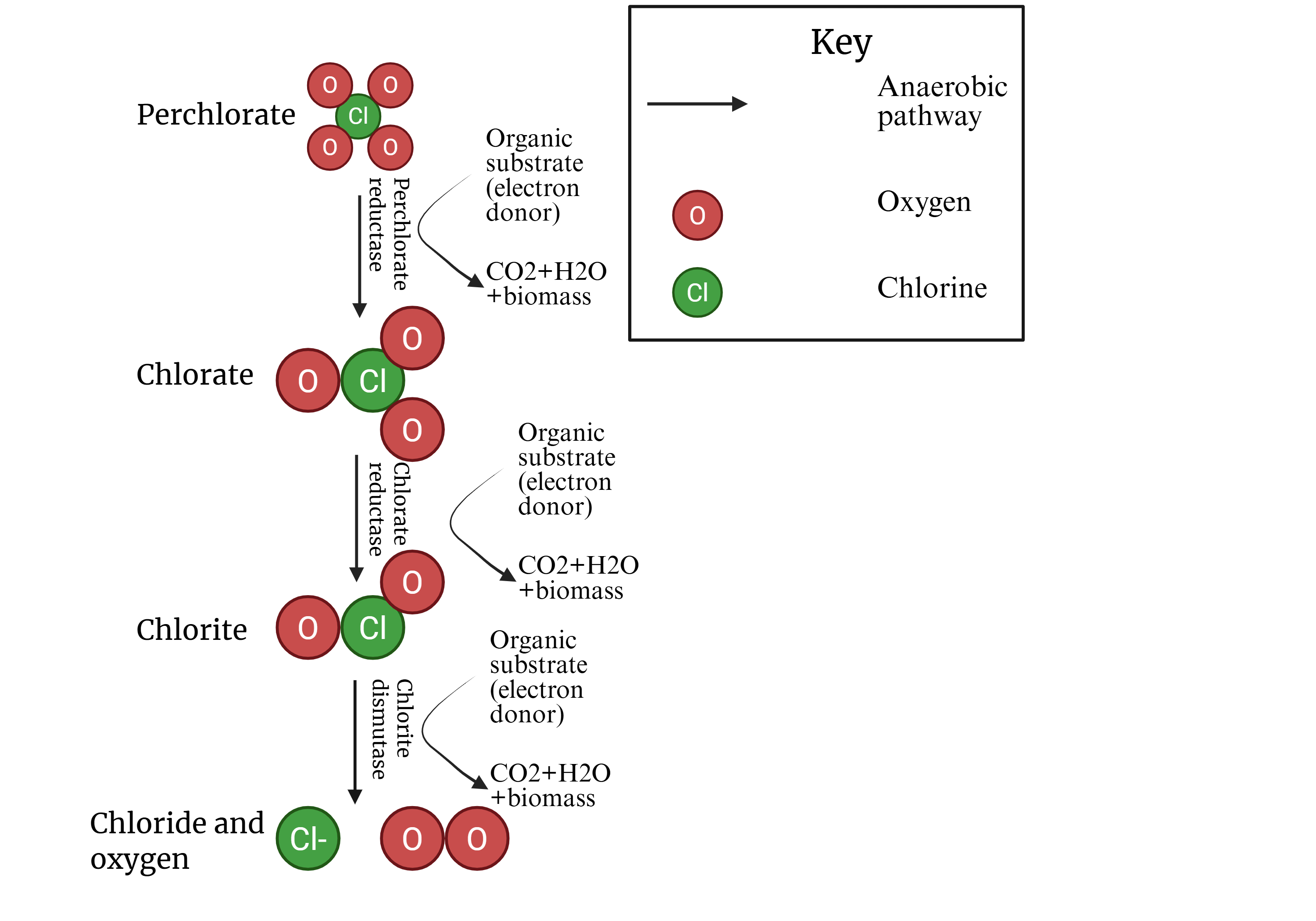 |
|---|
The chassis, P. chloritidismutans AW-1, is selected because of the species’ ability to perform both aerobic and anaerobic respiration, its habitation in soil and water, and the AW-1 strain’s built-in chlorate-degrading pathway genes (Gomila et al., 2022; Wolterink et al., 2002). The bacterium possesses a single circular chromosome of approximately 5.1 Mb (Genome Assembly, 2026). To ensure optimal growth for P. chloritidismutans, it will be cultured anaerobically in 120 mL flasks containing 40 mL of liquid DSMZ Medium 944 and incubated at 30°C. This recipe is obtained from BacDive (Stutzerimonas Chloritidismutans, 2019). Chloramphenicol (25 µg/mL) and kanamycin (25 µg/mL) will be added to the medium as selectable markers (Mehboob et al., 2009). To enable P. chloritidismutans’ remediation capabilities, the pcrABCD operon encoding perchlorate reductase will be introduced into the bacterium via electroporation. This enzyme catalyzes the initial reduction of perchlorate to chlorate. Afterwards, its byproducts will be continuously broken down by the enzymes already present in the chassis.
A second recombinant plasmid encoding an oxygen-consuming enzyme module will also be introduced via electroporation into P. chloritidismutans to ensure the pathway's effectiveness. This module expresses a Class C Flavodiiron protein (FDP), which is used by many bacteria and archaea to support anaerobic or micro-oxic metabolism (Flavodiiron Proteins, 2026). Oxygen is ubiquitously present in arid soils and groundwater; modeling predicts that its higher reduction potential relative to perchlorate makes it a more favorable final electron acceptor, potentially diverting electrons away from the perchlorate reductase and thereby inhibiting the enzyme’s activity (Farhan & Hatzinger, 2009; Chaux et al., 2017). Specifically, under mildly basic conditions similar to those of the cell cytosol, oxygen has a reduction potential of E° = 0.401 V, which is greater than that of perchlorate (E° = 0.17 V) (Harvey, n.d.). The FDP module addresses oxygen competition by serving as an electron sink, thereby reducing oxygen to water. In addition to removing environmental oxygen, this device also reduces cellular oxygen generated as a byproduct of the chlorite dismutation pathway, preventing feedback inhibition of the reduction pathway.
Electron donors for both perchlorate reduction and oxygen consumption will be supplied via the host’s native metabolic pathways, using organic carbon sources such as acetate, which is commonly present in soil and groundwater.
Device level
Two recombinant plasmids necessary for pathway functioning will be assembled through restriction enzyme digestion and ligation. We plan to express the pcrABCD operon sourced from Dechloromonas agitata, which encodes the perchlorate reduction complex responsible for reducing perchlorate (ClO4–) to chlorate (ClO3–); due to its large size (5555 bp), it will be cloned using the pGLDV_17 [RK2] broad host range plasmid backbone (Bender et al., 2005; Gilbert et al., 2023). Expression for the perchlorate reductase enables P. chloritidismutans to initiate perchlorate reduction, from which the intermediates are passed into the chlorate reduction and dismutation pathways within the chassis.
The pcrABCD operon will be cloned into plasmid pGLDV_17 downstream of the strong, constitutive cat promoter. The cat promoter was selected to ensure continuous, reliable expression of perchlorate reductase, enabling consistent perchlorate reduction in various environments where inducible regulation may be unreliable or inefficient. Since the pcrABCD operon has four enzyme subunits, separate ribosome-binding sites (RBS) will be designed using the Salis Lab RBS calculator and inserted before each gene. To prevent readthroughs and metabolic burden, the lambda t0 terminator built into the CmR (cat promoter) system will be used. Codon optimization will be performed on the exogenous genes for P. chloritidismutans to improve translation efficiency by aligning codon usage with host tRNA abundance, thereby minimizing ribosome stalling at non-canonical codons.
The second plasmid encodes an oxygen-consuming module based on the Class C Flavodiiron protein (FDP) system. The core structure of the FDP protein is composed of two domains: the N-terminal metallo-β-lactamases (enzymes using a metal ion to break down antibiotics) domain containing a diiron center, and a C-terminal flavodoxin-like (acidic, soluble, electron-transfer proteins) domain containing flavin mononucleotide (FMN), a coenzyme essential for cellular electron transport, as shown in Figure 4 (Flavodiiron Proteins, 2026; Merriam-Webster, n.d.). Class C FDPs are chosen in this design for their extra C-terminal composed of a flavin reductase-like domain that directly accepts electrons from NAD(P)H, which streamlines the electron transport chain (Borges et al., 2019, p. 93). Specifically, Class C-Type 1 (Flv3) from Synechocystis will be used, as it is the only Class C FDP that has been biochemically studied; notably, in 2002, the recombinant Synechocystis Flv3 protein was capable of reducing O₂ to water in vitro without generating reactive oxygen species (Borges et al., 2019, p. 94).
| Figure 4. Structure and the electron transport mechanism for the Class C-Type 1 (Flv3) Flavodiiron Protein. The C-terminal NAD(P)H-dependent flavin reductase domain (Class C only) initiates the oxygen scavenging process by directly accepting electrons from NADH or NADPH (NAD(P)H + FAD → NAD(P)+ + FADH₂). These electrons are then transferred to the flavodoxin-like domain that reduces FMN to FMNH₂ (FADH₂ + FMN → FAD + FMNH₂). Finally, electrons are delivered to the N-terminal metallo-β-lactamase–like domain with a diiron center, where molecular oxygen is reduced to water (O₂ + 4e− + 4H+ → 2H₂O) that completes the process without generating harmful species. [Created in BioRender. Yoon, J. (2026) https://BioRender.com/9xgbdkd] | 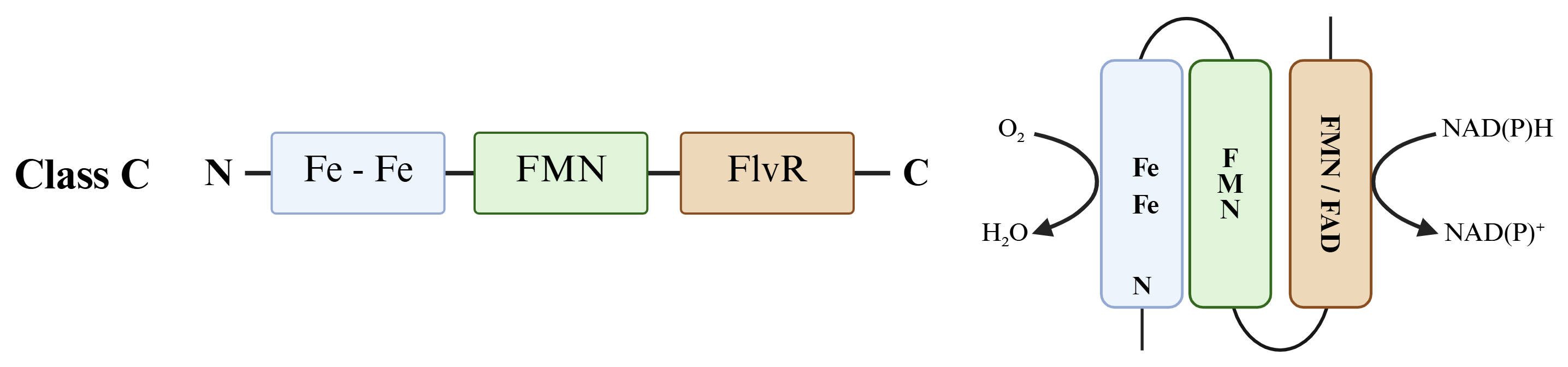 |
|---|
The sll0550 gene encoding the above-specified type of FDP will be introduced into the pBBR1MCS-2 vector backbone, grown, and selected for kanamycin resistance at 25 µg/mL (Borges et al., 2019; Kovach et al., 1995). To avoid unnecessary metabolic burdens, the FDP oxygen-scavenging system will be under the control of an endogenous, OxyR-regulated katB promoter inserted upstream of the FDP operon (Zhang et al., n.d.). Within plant cells and soil, elevated oxygen levels and metabolic activities lead to the formation of reactive oxygen species such as hydrogen peroxide (Alam et al., 2025; Mansoor et al., 2022). During oxidative stress, the OxyR transcription regulator undergoes a conformational change and binds to the katB promoter, initiating transcription of genes downstream of the promoter (Ochsner et al., 2000). Although FDP cannot directly break down reactive oxygen species, it lowers oxygen levels, resolving the root cause of their formation; additionally, by reducing oxygen to water in a single reaction, it prevents the formation of toxic intermediates (Folgosa et al., 2018). The FDP protein is expected to function in the cytosol, where it can access both intracellular and diffuse environmental oxygen and perform reduction, enabling efficient oxygen reduction without requiring membrane localization.
Overall, this design allows the system to dynamically respond to intracellular and environmental oxygen levels by producing FDP only when needed, effectively reducing oxygen into water and establishing a favorable environment for perchlorate reduction (Millard et al., 2023).
Parts level
Plasmids
Plasmid pGLDV_17 is a broad-host-range cloning vector that replicates across a broad range of Gram-negative bacteria, including the Pseudomonas species, via the RK2 origin (oriV) (Gilbert et al., 2023; Thomas et al., 1982). This makes it particularly suitable for stable maintenance of P. chloritidismutans under harsh conditions. pGLDV_17 contains the chloramphenicol resistance gene (for selection at 25 µg/mL), the cat promoter, the pcrABCD operon genes, the lambda t0 terminator, and the M13 reverse primer site, enabling efficient amplification and sequencing of the inserted constructs.
Plasmid vector pBBR1MCS-2 contains the kanamycin resistance gene (selection at 25 µg/mL, depending on host sensitivity) (Kovach et al., 1995). The katB promoter sequence, along with the OxyR binding site, will be PCR-amplified from the genomic DNA of P. chloritidismutans. The amplified promoter sequence will be purified and digested with the specified restriction enzymes and ligated upstream of the sll0550 gene of the Class C-Type 1 (Flv3) FDP protein, as illustrated in Figure 5.
| Figure 5. Plasmids with Vectors pGLDV_17 and pBBR1MCS-2. pGLDV_17 carries the perchlorate-reducing genes, while pBBR1 carries the oxygen-reducing genes. [Created in BioRender. Q, S. (2026) https://BioRender.com/t3s5yxi] | 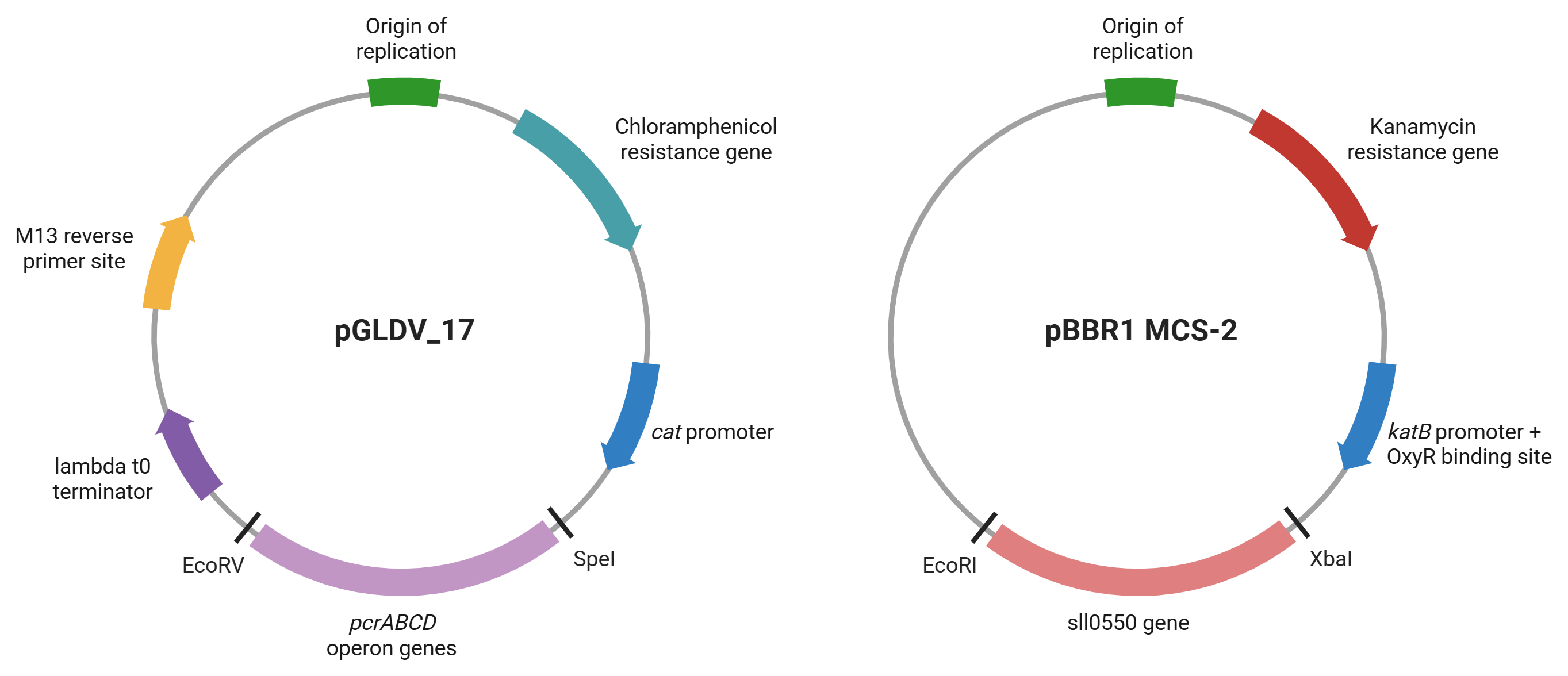 |
|---|
Perchlorate reductase operon
The pcrABCD operon encodes a multi-subunit enzyme complex responsible for the reduction of perchlorate to chlorate, originally isolated from the gram-negative bacterium Dechloromonas agitata CKB. The pcrA gene (NCBI Accession number: AY180108) encodes the 105 kDa catalytic α-subunit of perchlorate reductase (Bender et al., 2005). pcrA contains a molybdopterin-binding domain and an N-terminal twin-arginine signal peptide that directs the folded enzyme to the periplasm via the Tat export pathway. It reduces perchlorate to chlorate at the molybdopterin active site. The pcrB gene (NCBI Accession number: AY953269) encodes the 37 kDa electron-transfer β-subunit. pcrB contains four cysteine-rich clusters that bind one 3Fe-4S and three 4Fe-4S centers, forming the electron relay from the membrane-facing side of the complex to pcrA. It lacks its own signal peptide and is co-translocated with pcrA through the Tat export pathway. The pcrC gene (NCBI Accession number: AY953270) encodes a 25 kDa tetraheme c-type cytochrome. pcrC connects the pcrAB catalytic unit to the upstream electron donor. It holds four heme groups in place via CXXCH motifs and requires the host ccm pathway. pcrC is not membrane-bound. In the native organism, a separate NirT-type cytochrome links the pcrABC complex to the membrane quinol pool. The pcrD gene (NCBI Accession number: AY953271) encodes a 25 kDa molybdenum chaperone protein. pcrD assists insertion of the Mo cofactor into pcrA in the cytoplasm prior to Tat export and is not believed to be part of the active enzyme. It is homologous to NarJ and other system-specific chaperone proteins in the type II DMSO reductase family.
FASTA sequences of pcrABCD genes will be submitted to commercial gene synthesis companies such as GenScript and TwistBioscience for assembly into a single operon with EcoRV and SpeI restriction sites. Given that anti–Shine–Dalgarno sequences are located at the 3’ end of the 16S rRNA in most bacteria, a synthetic Shine–Dalgarno-like ribosome binding site will be placed upstream of each gene and short spacer sequences will be inserted in between the RBS and the start codon to maintain safe distances for accurate translation (Jha et al., 2020). The resulting synthesized genetic fragment will later be inserted into the pGLDV_17 vector backbone downstream of the cat promoter and upstream of the lambda t0 terminator via restriction digest.
Class C-Type 1 (Flv3) flavodiiron protein system
The sll0550 gene from Synechocystis sp. PCC 6803 encodes a 63.5 kDa (573 amino acid) flavoprotein that mediates electron transfer from NADH to oxygen, reducing it to water. This reaction proceeds via a four-electron reduction pathway, minimizing the formation of harmful reactive oxygen species. This Class C Flavodiiron protein is composed of three redox cofactors (diiron center, FAD, and FMN) integrated into a polypeptide chain, enabling efficient intramolecular electron transport (Lala et al., 2018). Such a streamlined combination is advantageous compared to oxygen-reducing systems in other organisms, which often require separate proteins and multiple pathways to perform the same function.
The sll0550 coding sequence will be obtained from the database and synthesized as a linearized DNA fragment with EcoRI and XbaI restriction sites by a commercial gene synthesis company. Before synthesis, the sequence will be codon-optimized for expression in P. chloritidismutans AW-1 to improve translation efficiency and protein yield. The gene will be inserted into the pBBR1MCS-2 vector via restriction digestion and ligation. The construct will be placed under the control of the OxyR-regulated katB promoter to enable oxygen-responsive expression.
Endogenous chlorate reductase genes
The reduction of chlorate (ClO₃⁻) to chlorite (ClO₂⁻) within P. chloritidismutans is catalyzed by the endogenous chlorate reductase enzyme complex, encoded by the clrABCD operon (Wolterink et al., 2003). Since P. chloritidismutans chlorate reductase operon genes are not well documented, the general protein functions are assumed to be similar to those of the clrABCD operon from Ideonella dechloratans (Ideonella dechloratans), whose gene sequences will be used in this design due to their more comprehensive characterization and sequencing.
The 2,745-bp clrA gene encodes the catalytic α-subunit, which contains a molybdopterin cofactor that forms the active site responsible for catalysis. The 987-bp clrB gene encodes a β-subunit containing iron–sulfur clusters that facilitate electrons from donors to the catalytic clrA subunit. The 582-bp clrD gene encodes a chaperone protein that aids the folding and integration of the molybdenum cofactor. The 720-bp clrC gene encodes a cytochrome c-type protein that contains a heme, which connects the reductase complex to the cellular electron transport chain (Thorell et al., 2003).
Endogenous chlorite dismutase genes
The cld gene (UniProt Accession number: B1AAM3) encodes the 110 kDa chlorite dismutase, a heme enzyme that catalyzes the conversion of chlorite into chloride and molecular oxygen, completing the final step of the perchlorate detoxification pathway (MetaCyc Metabolic, 2010; Mlynek et al., 2011).
Safety
Environmental containment
Potential risks may arise from the deployment of genetically engineered organisms (GEOs). Although simulation testing in soil and water environments will be conducted in varying conditions—such as temperature, pH, and salinity—the released GEOs may persist, spread, or disrupt native microbial ecosystems (Gilbert et al., 2023). If our design proves successful in bioremediating perchlorates, we will have proof-of-concept and look into redesigning it with environmental containment safety features such as a passcode kill switch. The passcode kill switch employs engineered Lacl/GalR-family transcription factors in a two-layer repression structure, where unauthorized growth of strains without the “passcode” molecules will induce cell death (Chan et al., 2015). Environmental signals (a, b, and c) are converted to regulatory states through ligand-responsive transcription factors. Functioning like a logic gate, the bacteria only survives in the presence of both inputs A and B and the absence of input C, as illustrated in Figure 6. Inputs A and B could be derived from common molecules in the environment deployed, while input C may function as an exclusion signal, coming from molecules with low likelihood of existing in the arid soil, indicating a non-authorized environment. Specific molecules are to be investigated.
| Figure 6. Logic-gated passcode kill switch mechanism. The passcode kill functions as a biological gate, restricting the survival of the engineered strain to the intended environment. Inputs A and B represent required permissive environmental signals, while input C represents a signal associated with an unauthorized environment. The circuit allows cell survival only when A and B are present and C is absent, following the logic expression A AND B AND NOT C. If either condition is not satisfied, the circuit will trigger the production of toxic molecules, leading to cell lysis. [Created in BioRender. Yoon, J. (2026) https://BioRender.com/3ng8kw9] | 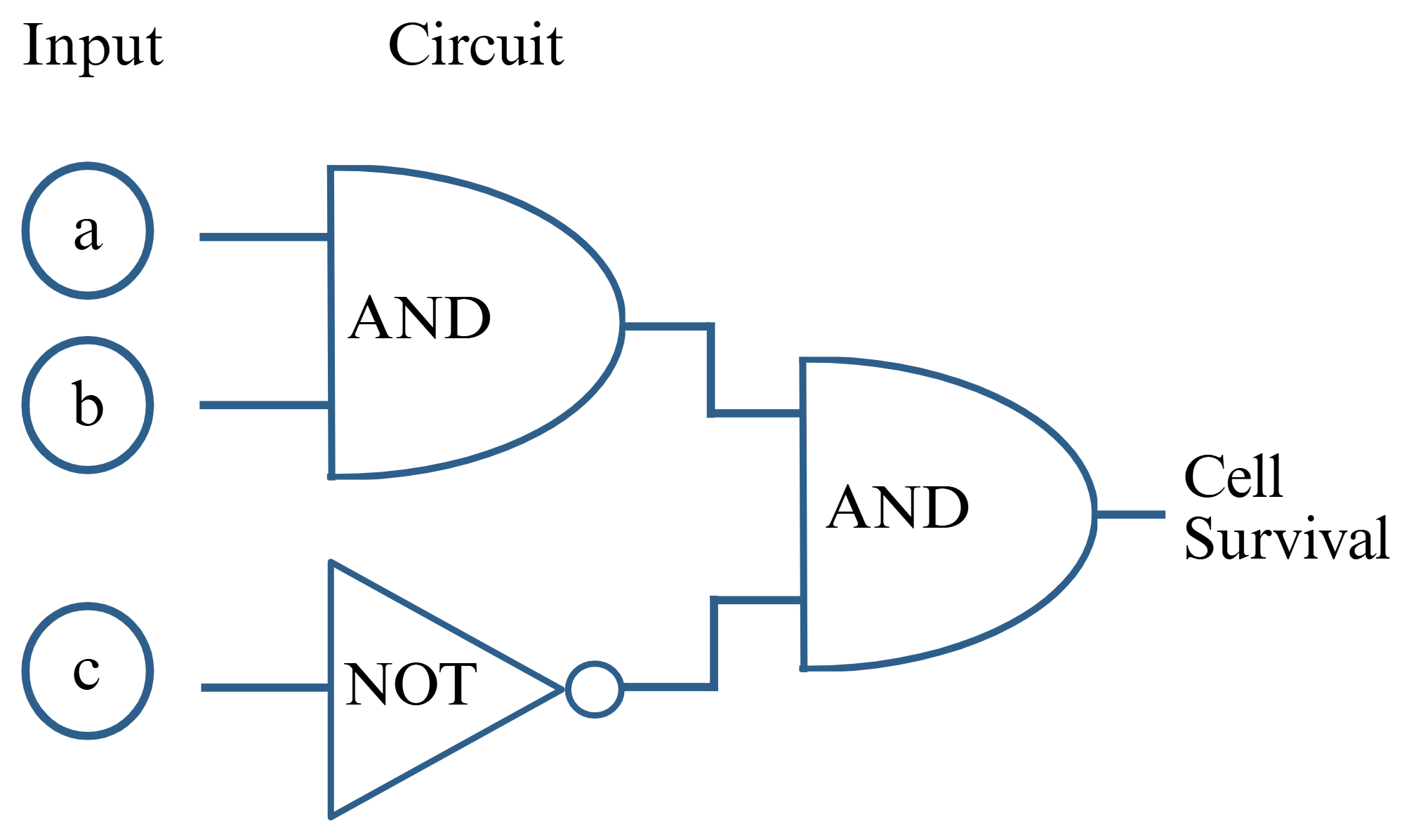 |
|---|
Horizontal gene transfer
While the broad-host-range plasmids used in this design are favorable for their size, which allows incorporation of an operon and enables hosts to adapt to the environment, they also pose a higher risk of horizontal gene transfer (HGT) (Takahashi et al., 2026). HGT happens when bacteria transfer genes, most commonly plasmids, between them as a form of evolution (Lerner et al., 2024). The engineered genes, the pcrABCD operon, and the FDP module, may in this case become transferred to native soil micro-organisms and disrupt the natural balance. Antibiotic resistance genes carried within the GEOs, initially used for colony selection, also face the risk of HGT, potentially creating a public health threat by turning harmless bacteria into dangerous, untreatable “superbugs” (Lerminiaux & Cameron, 2019). Therefore, we will remove antibiotic resistance genes for real on-site deployment.
There are 3 major paths for HGT to occur: conjugation, transformation, and transduction. Given that both pBBR1 and pGLDV_17 are non-conjugative plasmid vectors, they will not contribute to cell-to-cell gene transfer (conjugation). However, uptake of free environmental DNA (transformation) by other bacteria may happen after lysis of a bacteriophage-infected cell; as bacteriophages are common in arid soil transduction is commonly performed by native bacteria (Burmeister, 2015; Zablocki et al., 2016). To address this issue, when revising our design, we will consider applying chromosomal integration of plasmids via homologous or site-specific recombination to increase stability and, in turn, minimize the likelihood of HGT (Gu et al., 2015).
Biochemical safety
Chlorite (ClO2–), the substrate for the third step of the three-step perchlorate breakdown pathway, is toxic and very reactive (Agency for Toxic Substances and Disease Registry, 2011). Chlorite is harmful to the cells as it oxidizes protein-bound methionine (Met) residues and ultimately leads to protein degradation. Accumulation of such toxic intermediates within the host cell risks cell malfunction and even cell lysis (Vincent et al., 2023). With proof-of-concept, this design may be further refined to adjust the breakdown efficiencies of the consecutive pathways. Specifically, expression of chlorate reductase can be downregulated using CRISPR interference to repress transcription, while expression of the downstream chlorite dismutase can be increased by elevating plasmid copy number or strengthening its cat promoter.
Competition
Introduction of GEOs may also pose ecological risks if engineered strains compete with native organisms for nutrients and resources. Although P. chloritidismutans uses acetate as an electron donor, which is also a common carbon source for many native soil heterotrophs, P. chloritidismutans in this design is expected to mainly rely on chlorate as a terminal electron acceptor for anaerobic respiration, which greatly minimizes the risks of competition (Wolterink et al., 2002; Millard et al., 2023). In addition, the population level will also be monitored so they would not outcompete native microbes and shift local community composition. Future kill switch integration in this design will limit long-term persistence once perchlorate is depleted.
Handling safety
P. chloritidismutans AW-1 is classified as Biosafety Level 1, indicating that it is non-pathogenic and can be handled under standard microbiological practices in a minimally restricted laboratory ("Pseudomonas Chloritidismutans," n.d.). Before testing the engineered construct in soil and water samples or testing fields, the bacterial remediation performance will first be assessed in perchlorate-supplemented medium. Perchlorate will be purchased as a 1000 mg/L water solution from Sigma Aldrich.
Although the bacterial strain is low risk, perchlorate is a hazardous chemical due to its severe health impacts. To avoid risks associated with its handling, chemical containers will be sealed and labeled clearly with hazard information. Experiments involving perchlorate will be performed in a fume hood when necessary. Lab researchers will receive training in chemical handling, sterilization, spill response, waste disposal, and emergency procedures, including the proper use of eyewash and safety shower stations. Appropriate personal protective equipment, including lab coats, gloves, and safety goggles, will be worn all times. In the event of a spill or leak, the area will be isolated and cleaned in accordance with institutional hazardous materials protocols. Perchlorate-contaminated wastes will be collected, labeled as hazardous chemical waste, and disposed of through designated hazardous waste drop-off locations following federal regulations.
Discussions
This construct offers a promising alternative to perchlorate remediation, as conventional approaches such as ion exchange, reverse osmosis, and chemical reduction with zero-valent iron or titanium are often limited by high cost, secondary waste generation, and poor scalability (Office of Pollution Prevention and Technology Development, 2003). Existing biological treatment, on the other hand, is largely restricted to anaerobic conditions that can not be reliably maintained in natural soil or groundwater environments (Lalucat et al., 2006). Therefore, by pairing the aerobic perchlorate reduction pathway with an oxygen-scavening module in a soil-dwelling chassis, the design introduces a more comprehensive approach to perchlorate remediation.
A key advantage of this design is that, unlike chemical reduction methods that require inputs such as UV light or heat, each of the reduction and dismutation processes in this engineered circuit releases energy when coupled with the oxidation of electron donors such as acetate. The high reduction potentials of perchlorate (E° = ∼1.28 V) and chlorate (E° = 1.03 V) make them thermodynamically ideal electron acceptors for microbial reduction (Bardiya & Bae, 2011). Chlorite is then converted to chloride and oxygen in a single exergonic reaction (Ettwig et al., 2012). These thermodynamically favorable characteristics support the construct’s use as a low-energy, passive bioremediation strategy that does not require external energy inputs.
If successfully deployed, this system is expected to decrease soil perchlorate levels while increasing chloride concentration. This shift in soil composition could help revitalize arid regions and create opportunities to reintroduce crops that previously could not tolerate perchlorate-contaminated soils (Srinivasan & Viraraghavan, 2009). Thus, beyond contaminant removal, the construct has potential agricultural and ecological benefits in affected environments.
Despite these advantages, several challenges must be addressed before environmental deployment. One major concern is plasmid stability, as the pcrABCD and FDP constructs may undergo segregational loss over many generations since antibiotic selection, which cannot be applied at contaminated sites. To address this, plasmid retention should be monitored during repeated subculturing and soil-microcosm experiments, and chromosomal integration should be considered if plasmid loss significantly impacts pathway performance.
Beyond plasmid stability, the long-term persistence and environmental stability of the bacteria in arid soils also present major challenges. Arid environments are characterized by low water activity, high ultraviolet (UV) radiation exposure, wide diurnal temperature fluctuations, and other stressors (Fang & Naidu, 2023). While P. chloritidismutans was isolated from the biomass of a bioreactor, its classification within the Pseudomonas genus suggests broad environmental tolerance; however, its sustained viability and remediation activity should still be monitored. Encapsulation in carrier systems such as alginate beads, biochar, or clay granules could be used to protect the cells against desiccation and UV damage (Carpena-Istan et al., 2025). Periodic re-inoculation of the contaminated site might also be considered if a rapid decrease in the bacterial population is observed.
Before field application, the construct should progress through a validation framework that gradually transitions from controlled conditions to real soil environments. Initial validation in liquid culture should confirm that the pcrABCD operon expresses a functional perchlorate reductase complex and that the FDP module maintains low intracellular oxygen under ambient atmospheric conditions. These outcomes could be assessed using dissolved-oxygen electrodes and perchlorate depletion over time. Following the approach used by Wolterink et al. (2002), growth will be quantified using optical density measurements and plating dilution series for viable cell counts. In parallel, the kill switch mechanism described in the Safety section should be tested to ensure that it remains functional over extended deployment periods and under prolonged environmental stress. The second validation stage should move the engineered strain into contained soil microcosms, where ion chromatography can track substrates, intermediates, and products to confirm that pathway flux is balanced and that toxic chlorite does not accumulate between enzymatic steps. The final validation stage should involve small, contained field plots using perchlorate-spiked or naturally contaminated soil, paired with 16S rRNA sequencing of the surrounding microbial community to detect any unintended ecological shifts (Nnadi et al., 2023).
Finally, since CO₂ is produced during cellular respiration and released as a byproduct of perchlorate reduction, a carbon fixation strategy could be incorporated to improve stability. We envision co-culturing the P. chloritidismutans strain with a CO₂-fixing cyanobacterium, such as Synechocystis sp. or utilizing polyhydroxyalkanoate biosynthesis pathways. Since a single bacterial chassis has limited capacity to accommodate additional genetic circuits without incurring an excessive metabolic burden, this co-culture strategy provides a molecular and scalable approach to improving environmental sustainability and system efficiency (Mehboob et al., 2009). However, since different bacterial types rely on different energy sources and have different growth rates, future co-culturing designs should test growth compatibility, metabolite exchange, pH stability, and competition between the two organisms before environmental application.
Next steps
Target gene sequences will be retrieved from source organisms and codons optimized for expression in P. chloritidismutans. Recombinant plasmids pGLDV_17 with perchlorate reduction genes and pBBR1MCS-2 with oxygen- reducing genes will be designed in silico and synthesized commercially (Wolterink et al., 2002). We will prioritize inserting the oxygen-reducing plasmid. Successful transformation will be confirmed through antibiotic selection and colony PCR.
Functional validation of the FDP system will be performed by measuring oxygen consumption and water production under aerobic conditions, confirming its role as an effective oxygen sink. Oxygen could be added either at the start or during the activation of the FDP module to determine whether the module allows reductive pathway activity to continue under oxygen exposure.
Once the oxygen-scavenging module is successfully functioning, the second plasmid containing the perchlorate reduction genes will be introduced. Successful transformation will be confirmed through antibiotic selection and molecular verification. Perchlorate reduction effectiveness will be evaluated by measuring the perchlorate and its reduction products (chlorate, chlorite, and chloride) using ion chromatography or mass spectrometry. Host stability, growth rate, and overall cellular health will also be monitored to evaluate metabolic burden. Growth should be monitored across multiple electron donors and environmental conditions, including pH, temperature, and salinity.
The research done by Wolterink et al. used chlorate and acetate as model electron acceptor and donor substrates under controlled anaerobic conditions. In their methods, strain AW-1 was cultivated in a strictly anaerobic medium, with dissolved oxygen removed by boiling and cooling under nitrogen. This provides a useful methodological framework for testing whether the engineered strain can maintain the low-oxygen conditions needed for remediation metabolism (Wolterink et al., 2002).
Chlorate reductase and chlorite dismutase enzyme activities can be determined with cell-free extracts. Chlorate reductase activity can be determined spectrophotometrically by monitoring the oxidation of reduced methyl viologen at 578 nm and 30°C; Chlorite dismutase activity can be determined by measuring oxygen production with a Clark-type oxygen electrode (Wolterink et al., 2002). One unit of enzyme activity is defined as the amount of enzyme required to convert 1 μmol of chlorate per minute. Protein concentration will be measured via Bradford Assay, with bovine serum albumin as the standard (Wolterink et al., 2003). Oxygen & CO2 will be analyzed via gas chromatography & thermal conductivity detector (Mehboob et al., 2009).
If endogenous expression from clr and cld genes is insufficient to sustain the necessary pathway flux, additional copies of these genes may be introduced onto the pBBR1MCS-2 plasmid to enhance the pathway. If Chlorite ion toxicity is observed, pathway flux may be rebalanced by increasing chlorite dismutase expression and downregulating chlorate reductase enzymes to minimize intracellular chlorite accumulation. Additional controls should include a non-transformed P. chloritidismutans strain, a strain carrying only the oxygen-scavenging plasmid, and a strain carrying only the perchlorate-reduction plasmid. These controls would help clarify the results of perchlorate remediation.
Author contributions
S.Q. proposed the project idea and initiated introductory research on the design. A.B., S.Q., A.W., and J.Ya. conducted the early research process and completed the background and abstract. A.B., Y.C., S.Q., B.S., J.V., J.Ya., and J.Yo. contributed to writing and editing the background, systems, device, parts, safety, discussion, and next steps sections. Everyone contributed to the animation of the video. A.B., J.Yo, and S.Q designed the images and graphics for the project.
Acknowledgements
We sincerely thank the Western Reserve Academy Science Department for offering the resources and opportunities that made this project possible. We are especially grateful to Ms. Marmerstein for her guidance and advice throughout the development of our work. Her insights into system function, gene identification, and academic writing were invaluable, and this paper would not have been possible without the countless hours she dedicated to guiding and supporting us.
We would also like to express our deepest gratitude to our mentor, Dr. Eric Young. During the Biobuilder season, he offered consistent support and encouragement for our ideas and proposals, providing alternative approaches and new perspectives whenever we encountered roadblocks. His continuous guidance even after the conclusion of the Biobuilder season was instrumental in the editing and refinement of this paper.
References
Agency for Toxic Substances and Disease Registry. (2011, November 29). Public Health Statement for Chlorine Dioxide and Chlorite. https://wwwn.cdc.gov/TSP/PHS/PHS.aspx?phsid=580&toxid=108
Alam, P., Faizan, M., Arif, Y., Azzam, M. M., Hayat, S., Afzal, S., & Albalawi, T. (2025). Reactive oxygen species: Balancing agents in plants. Frontiers in Plant Science, 16. https://doi.org/10.3389/fpls.2025.1713590
Bardiya, N., & Bae, J.-H. (2011). Dissimilatory perchlorate reduction: A review. Microbiological Research, 166(4), 237-254. https://doi.org/10.1016/j.micres.2010.11.005
Bender, K. S., Shang, C., Chakraborty, R., Belchik, S. M., Coates, J. D., & Achenbach, L. A. (2005). Identification, characterization, and classification of genes encoding perchlorate reductase. Journal of Bacteriology, 187(15), 5090-5096. https://doi.org/10.1128/jb.187.15.5090-5096.2005
Borges, P. T., Romão, C. V., Saraiva, L. M., Gonçalves, V. L., Carrondo, M. A., Teixeira, M., & Frazão, C. (2019). Analysis of a new flavodiiron core structural arrangement in Flv1-ΔFlR protein from Synechocystis sp. PCC6803. Journal of Structural Biology, 205(1), 91-102. https://doi.org/10.1016/j.jsb.2018.11.004
Burmeister, A. R. (2015). Horizontal gene transfer: Figure 1. Evolution, Medicine, and Public Health, 2015(1), 193-194. https://doi.org/10.1093/emph/eov018
Carpena-Istan, V., Jurado, M. M., Suarez-Estrella, F., Lopez-Gonzalez, J. A., Estrella-Gonzalez, M. J., Martinez-Gallardo, M. R., Toribio, A. J., Salinas, J., & Lopez, M. J. (2025). Effective microbial formulations using sustainable carriers for the remediation of plastic-affected soils. Journal of Environmental Management, 379, 124887. https://doi.org/10.1016/j.jenvman.2025.124887
Chan, C. T. Y., Lee, J. W., Cameron, D. E., Bashor, C. J., & Collins, J. J. (2015). 'Deadman' and 'passcode' microbial kill switches for bacterial containment. Nature Chemical Biology, 12(2), 82-86. https://doi.org/10.1038/nchembio.1979
Chaux, F., Burlacot, A., Mekhalfi, M., Auroy, P., Blangy, S., Richaud, P., & Peltier, G. (2017). Flavodiiron proteins promote fast and transient O2 photoreduction in Chlamydomonas. Plant Physiology, 174(3), 1825-1836. https://doi.org/10.1104/pp.17.00421
De Groef, B., Decallonne, B. R., Van der Geyten, S., Darras, V. M., & Bouillon, R. (2006). Perchlorate versus other environmental sodium/iodide symporter inhibitors: Potential thyroid-related health effects. European Journal of Endocrinology, 155(1), 17-25. https://doi.org/10.1530/eje.1.02190
Díaz-Rullo, J., Rodríguez-Valdecantos, G., Torres-Rojas, F., Cid, L., Vargas, I. T., González, B., & González-Pastor, J. E. (2021). Mining for perchlorate resistance genes in microorganisms from sediments of a hypersaline pond in atacama desert, chile. Frontiers in Microbiology, 12. https://doi.org/10.3389/fmicb.2021.723874
EPA. (2008, October 10). Drinking water: Preliminary regulatory determination on perchlorate. Federal Register, 73(197), 60262-60282. https://www.federalregister.gov/documents/2008/10/10/E8-24042/drinking-water-preliminary-regulatory-determination-on-perchlorate
EPA. (2013). Perchlorate. In America's children and the environment (3rd ed., pp. 190-192). https://www.epa.gov/sites/default/files/2015-06/documents/ace3_2013.pdf
EPA. (2026, January 6). Perchlorate in Drinking Water. United States Environmental Protection Agency. Retrieved January 28, 2026, from https://www.epa.gov/sdwa/perchlorate-drinking-water#proposed-perchlorate
Ettwig, K. F., Speth, D. R., Reimann, J., Wu, M. L., Jetten, M. S. M., & Keltjens, J. T. (2012). Bacterial oxygen production in the dark. Frontiers in Microbiology, 3. https://doi.org/10.3389/fmicb.2012.00273
Fang, C., & Naidu, R. (2023). A review of perchlorate contamination: Analysis and remediation strategies. Chemosphere, 338. https://doi.org/10.1016/j.chemosphere.2023.139562
Farhan, Y. H., & Hatzinger, P. B. (2009). Modeling the biodegradation kinetics of perchlorate in the presence of oxygen and nitrate as competing electron acceptors. Bioremediation Journal, 13(2), 65-78. https://doi.org/10.1080/10889860902902016
Flavodiiron proteins. (2026). Instituto de Tecnologia Química e Biológica António Xavier. Retrieved April 22, 2026, from https://www.itqb.unl.pt/labs/Functional-Biochemistry-of-Metalloenzymes/research-interests/what-we-s/flavodiiron-proteins#:~:text=The%20two%20metal%20sites%20are,subtypes%20of%20Class%20C%20enzymes
Folgosa, F., Martins, M. C., & Teixeira, M. (2018). The multidomain flavodiiron protein from clostridium difficile 630 is an nadh:oxygen oxidoreductase. Scientific Reports, 8(1). https://doi.org/10.1038/s41598-018-28453-3
Genome assembly PseChl. (2026). National Library of Medicine. Retrieved April 22, 2026, from https://www.ncbi.nlm.nih.gov/datasets/genome/GCF_000495915.1/
Gilbert, C., Brumwell, S. L., Crits-Christoph, A., Kang, S. C., Martin-Moldes, Z., Alsharif, W., Esmurria, A., Nguyen, M.-A., Lee, H. H., & Ostrov, N. (2023). A scalable framework for high-throughput identification of functional origins of replication in non-model bacteria. ScienceDirect. https://doi.org/10.1101/2023.05.19.541510
Gomila, M., Mulet, M., García-Valdés, E., & Lalucat, J. (2022). Genome-Based taxonomy of the genus stutzerimonas and proposal of S. frequens sp. nov. and S. degradans sp. nov. and emended descriptions of S. perfectomarina and S. chloritidismutans. Microorganisms, 10(7), 1363. https://doi.org/10.3390/microorganisms10071363
Gu, P., Yang, F., Su, T., Wang, Q., Liang, Q., & Qi, Q. (2015). A rapid and reliable strategy for chromosomal integration of gene(s) with multiple copies. Scientific Reports, 5(1). https://doi.org/10.1038/srep09684
Harvey, D. (n.d.). Standard reduction potentials by element. Chemistry LibreTexts. Retrieved May 9, 2026, from https://chem.libretexts.org/Ancillary_Materials/Reference/Reference_Tables/Electrochemistry_Tables/P1%3A_Standard_Reduction_Potentials_by_Element
Ideonella dechloratans insertion sequence ISIde1, clrA gene, clrB gene, clrD gene and clrC gene. (n.d.). https://www.ncbi.nlm.nih.gov/nuccore/AJ566363
ITRC (Interstate Technology & Regulatory Council). (2007). Remediation technologies for perchlorate contamination in water and soil. PERC-2. Washington, D.C.: Interstate Technology & Regulatory Council, Perchlorate Team. https://itrcweb.org/wp-content/uploads/2024/09/PERC-2.pdf
Jha, V., Roy, B., Jahagirdar, D., McNutt, Z. A., Shatoff, E., Boleratz, B. L., Watkins, D. E., Bundschuh, R., Basu, K., Ortega, J., & Fredrick, K. (2020). Structural basis of sequestration of the anti-Shine-Dalgarno sequence in the bacteroidetes ribosome. Nucleic Acids Research, 49(1), 547-567. https://doi.org/10.1093/nar/gkaa1195
Kovach, M. E., Elzer, P. H., Steven Hill, D., Robertson, G. T., Farris, M. A., Roop, R., & Peterson, K. M. (1995). Four new derivatives of the broad-host-range cloning vector pBBR1MCS, carrying different antibiotic-resistance cassettes. Gene, 166(1), 175-176. https://doi.org/10.1016/0378-1119(95)00584-1
Lala, S. M., Naik, H., & Balwani, M. (2018). Diagnostic delay in erythropoietic protoporphyria. The Journal of Pediatrics, 202, 320-323.e2. https://doi.org/10.1016/j.jpeds.2018.06.001
Lalucat, J., Bennasar, A., Bosch, R., García-Valdés, E., & Palleroni, N. J. (2006). Biology of Pseudomonas Stutzeri. Microbiology and Molecular Biology Reviews, 70(2), 510-547. https://doi.org/10.1128/mmbr.00047-05
Lerminiaux, N. A., & Cameron, A. D. (2019). Horizontal transfer of antibiotic resistance genes in clinical environments. Canadian Journal of Microbiology, 65(1), 34-44. https://doi.org/10.1139/cjm-2018-0275
Lerner, A., Benzvi, C., & Vojdani, A. (2024). The potential harmful effects of genetically engineered microorganisms (GEMs) on the intestinal microbiome and public health. Microorganisms, 12(2), 238. https://doi.org/10.3390/microorganisms12020238
Ma, X., Zhang, Q., Tan, X., Lu, Y., Wang, H., & Zhu, G. (2025). Biological co-reduction of perchlorate and nitrate in wastewater: Insights into the competitive inhibition mechanisms in UASB reactors. Environmental Research, 282, 121950. https://doi.org/10.1016/j.envres.2025.121950
Mansoor, S., Ali Wani, O., Lone, J. K., Manhas, S., Kour, N., Alam, P., Ahmad, A., & Ahmad, P. (2022). Reactive oxygen species in plants: From source to sink. Antioxidants, 11(2), 225. https://doi.org/10.3390/antiox11020225
Mehboob, F., Junca, H., Schraa, G., & Stams, A. J. M. (2009). Growth of pseudomonas chloritidismutans aw-1t on n-alkanes with chlorate as electron acceptor. Applied Microbiology and Biotechnology, 83(4), 739-747. https://doi.org/10.1007/s00253-009-1985-9
Mehboob, F., Oosterkamp, M. J., Koehorst, J. J., Farrakh, S., Veuskens, T., Plugge, C. M., Boeren, S., Willem, Schraa, G., Stams, A. J. M., & Schaap, P. J. (2015). Genome and proteome analysis of Pseudomonas chloritidismutans AW-1T that grows on n-decane with chlorate or oxygen as electron acceptor. Environmental Microbiology, 18(10), 3247–3257. https://doi.org/10.1111/1462-2920.12880
MetaCyc Metabolic Pathway Database. (2010, June 15). https://bf2i-artsymbiocyc.insa-lyon.fr/gene?id=MONOMER-15700&orgid=META
Millard, P., Gosselin‐Monplaisir, T., Uttenweiler‐Joseph, S., & Enjalbert, B. (2023). Acetate is a beneficial nutrient for E. coli at low glycolytic flux. The EMBO Journal, 42(15). https://doi.org/10.15252/embj.2022113079
Mlynek, G., Sjöblom, B., Kostan, J., Füreder, S., Maixner, F., Gysel, K., Furtmüller, P. G., Obinger, C., Wagner, M., Daims, H., & Djinović-Carugo, K. (2011). Unexpected diversity of chlorite dismutases: A catalytically efficient dimeric enzyme from nitrobacter winogradskyi. Journal of Bacteriology, 193(10), 2408-2417. https://doi.org/10.1128/jb.01262-10
Nnadi, M. O., Bingle, L., & Thomas, K. (2023). Bacterial community dynamics and associated genes in hydrocarbon contaminated soil during bioremediation using brewery spent grain. Access Microbiology, 5(6). https://doi.org/10.1099/acmi.0.000519.v3
Ochsner, U. A., Vasil, M. L., Alsabbagh, E., Parvatiyar, K., & Hassett, D. J. (2000). Role of the Pseudomonas aeruginosa oxyR-recG operon in oxidative stress defense and DNA repair: OxyR-Dependent regulation of katB-ankB, ahpB, and ahpC-ahpF. Journal of Bacteriology, 182(16), 4533-4544. https://doi.org/10.1128/jb.182.16.4533-4544.2000
Office of Pollution Prevention and Technology Development. (2003, July). Perchlorate contamination treatment alternatives. California State Water Resources Control Board. https://www.waterboards.ca.gov/rwqcb4/water_issues/programs/remediation/perchlorate/03_0925_usepa_draft_treatment_alternatives.pdf
Perchlorates [Fact sheet]. (2014, March 25). Agency for Toxic Substances and Disease Registry. Retrieved January 14, 2026, from https://wwwn.cdc.gov/TSP/PHS/PHS.aspx?phsid=892&toxid=181#:~:text=The%20terms%20perchlorate%20or%20perchlorate,alkali%20or%20alkaline%20earth%20metal
Pseudomonas chloritidismutans. (n.d.). JGI Genomes Online Database. Retrieved April 20, 2026, from https://gold.jgi.doe.gov/organism?id=33929
Rectanus, H., Darlington, R., Kucharzyk, K., & Moore, S. (2015, January). Attenuation pathways for munitions constituents in soils and groundwater. NAVFAC. https://exwc.navfac.navy.mil/Portals/88/Documents/EXWC/Restoration/er_pdfs/a/navfacexwc-ev-tr-1503-attenpath-mc-201501f.pdf?ver=5-72yLaDyq26ezuI5O7JUg%3D%3D
Sahu, N., & Kumari, A. (2024). Perchlorate stress in plants: Insights into growth and physiological consequences. Emerging Contaminants, 291-305. https://doi.org/10.1016/b978-0-443-18985-2.00002-x
Srinivasan, A., & Viraraghavan, T. (2009). Perchlorate: Health effects and technologies for its removal from water resources. International Journal of Environmental Research and Public Health, 6(4), 1418-1442. https://doi.org/10.3390/ijerph6041418
Stutzerimonas chloritidismutans (DSM 13592, KCTC 12116, CCUG 51509). (2019). BacDive. Retrieved April 22, 2026, from https://bacdive.dsmz.de/strain/13003
Synechocystis sp. PCC 6803 DNA, complete genome. (n.d.). https://www.ncbi.nlm.nih.gov/nuccore/BA000022.2?from=2807211&to=2808932&report=fasta&strand=2
Takahashi, K., Ohara, K., Higuchi, K., Ohmura, T., Okabe, S., Johnson, D. R., & Oshiki, M. (2026). Horizontal and vertical gene transfer shape the plasmid host range in surface-associated microbial systems. IScience, 29(4), 115299. https://doi.org/10.1016/j.isci.2026.115299
Thomas, C. M., Hussain, A. A. K., & Smith, C. A. (1982). Maintenance of broad host range plasmid rk2 replicons in pseudomonas aeruginosa. Nature, 298(5875), 674-676. https://doi.org/10.1038/298674a0
Thorell, H. D., Stenklo, K., Karlsson, J., & Nilsson, T. (2003). A gene cluster for chlorate metabolism in Ideonella dechloratans. Applied and Environmental Microbiology, 69(9), 5585-5592. https://doi.org/10.1128/aem.69.9.5585-5592.2003
Vincent, M. S., Vergnes, A., & Ezraty, B. (2023). Chlorate contamination in commercial growth media as a source of phenotypic heterogeneity within bacterial populations. Microbiology Spectrum, 11(2). https://doi.org/10.1128/spectrum.04991-22
Wolterink, A. F. W. M., Jonker, A. B., Kengen, S. W. M., & Stams, A. J. M. (2002). Pseudomonas chloritidismutans sp. nov., a non-denitrifying, chlorate-reducing bacterium. International Journal of Systematic and Evolutionary Microbiology, 52(6), 2183-2190. https://doi.org/10.1099/00207713-52-6-2183
Wolterink, A. F. W. M., Schiltz, E., Hagedoorn, P.-L., Hagen, W. R., Kengen, S. W. M., & Stams, A. J. M. (2003). Characterization of the chlorate reductase from Pseudomonas chloritidismutans. Journal of Bacteriology, 185(10), 3210-3213. https://doi.org/10.1128/jb.185.10.3210-3213.2003
Yu, L., Cañas, J. E., Cobb, G. P., Jackson, W. A., & Anderson, T. A. (2004). Uptake of perchlorate in terrestrial plants. Ecotoxicology and Environmental Safety, 58(1), 44-49. https://semspub.epa.gov/work/09/1137732.pdf?utm
Zablocki, O., Adriaenssens, E. M., & Cowan, D. (2016). Diversity and ecology of viruses in hyperarid desert soils. Applied and Environmental Microbiology, 82(3), 770-777. https://doi.org/10.1128/aem.02651-15
Zhang, H., Zhan, Y., Yan, Y., & Liu, Y. (n.d.). The Pseudomonas stutzeri-Specific Regulatory Noncoding RNA NfiS Targets katB mRNA Encoding a Catalase Essential for Optimal Oxidative Resistance and Nitrogenase Activity. Journal of Bacteriology. Journals.asm.org/doi/10.1128/jb.00334-19