
Sai Kundanika Bobba, Sudeep Gandra, Megha Ganesan, Derek Kim, Nandita Mannepalli, Tanvi Palan, Aaliya Panda, and Teresa Walker, Alpharetta High School Biotechnology Club, Alpharetta, Georgia, United States
Reviewed on 9 May 2026; Accepted on 22 June 2026; Published on 26 October 2026
With help from the 2026 BioTreks Production Team.
Approximately 50% of the world’s arable land is affected by aluminum toxicity, which reduces root growth and limits nutrient and water uptake, ultimately decreasing crop productivity. We aim to address this issue specifically in Georgia’s red clay soils by exploring how we can enhance root development and crop performance at the genetic level. We focused on improving plant tolerance to aluminum stress by leveraging the Aluminum-Activated Malate Transporter (ALMT). This protein releases malate from roots to chelate and neutralize Al³⁺ ions in acidic soil. Using CRISPR-Cas9 gene editing, we plan to enhance the expression of the plant’s native ALMT gene to promote root growth, improve nutrient uptake, and reduce susceptibility to aluminum damage. We also investigated grafting techniques to strengthen root systems and support plant growth in nutrient-poor, acidic soils. We expect enhanced ALMT activity to increase root length and thickness, improve water and nutrient absorption, and provide greater resistance to aluminum toxicity. This offers a sustainable alternative to chemical soil treatments, allowing crops to thrive in Georgia’s red clay soils. By creating stronger and longer roots, farmers can cultivate a wider variety of crops, expand usable farmland, lower production costs, and adopt more environmentally responsible agricultural practices.
Keywords: Aluminum toxicity, ALMT gene, CRISPR-Cas9, red clay soil, root development
Authors are listed in alphabetical order. Letitiah Etheridge mentored the group. Please direct all correspondence to mailto:etheridgel@fultonschools.org.
Background
Aluminum toxicity is one of the most significant constraints on global agricultural productivity, affecting approximately 50% of the world's arable land (Kochian et al., 2015). In acidic soils with a pH below 5.0, aluminum is solubilized into its most phytotoxic form, Al³⁺, which rapidly inhibits root elongation and disrupts nutrient and water uptake, ultimately reducing crop yields (Sade et al., 2016). This problem is particularly acute in Georgia's red clay soils, which are characterized by high acidity and elevated concentrations of soluble aluminum, conditions that severely limit the range of crops that can be successfully cultivated in the region.
Plants have evolved several mechanisms to cope with aluminum toxicity, one of the most well-characterized being the secretion of organic acids from root tips. Malate, in particular, chelates Al³⁺ ions in the rhizosphere, which is a small area of soil that is directly influenced by a plant’s roots. This prevents aluminum from entering root cells and disrupting cellular processes (Fernie & Martinoia, 2009). This secretion is mediated by the Aluminum Activated Malate Transporter (ALMT) family of proteins, whose expression is regulated by the transcription factor Sensitive to Proton Rhizotoxicity 1, which integrates cellular responses to both proton and aluminum toxicity (Zhang et al., 2019). The wheat ALMT gene, TaALMT1, was among the first identified in this family and established a foundational understanding of malate-based aluminum exclusion as a heritable tolerance mechanism (Sasaki et al., 2004). Essentially, the ALMT gene helps release malate from the roots, which binds to toxic aluminum in the soil and helps protect the roots from damage, allowing the roots to grow better and absorb more water and nutrients. In fact, more recent studies have shown that ALMT gene families are present across multiple plant species and play important roles in aluminum stress responses, suggesting that ALMT-based tolerance mechanisms may be broadly applicable in agricultural crops (Zhang et al., 2023).
Despite the well-established role of ALMT in aluminum tolerance, conventional agricultural interventions such as lime application and chemical soil amendments remain the dominant approach to managing acidic soils. These solutions are expensive, environmentally unsustainable, and offer only temporary relief, as they do not address the underlying genetic susceptibility of crops to aluminum stress (Kochian et al., 2015). Furthermore, root-infecting nematodes present an additional biotic stressor in these environments, compounding damage to already compromised root systems and further diminishing plant productivity.
| Figure 1. Enhancing root growth in Georgia red clay soils through ALMT gene editing | 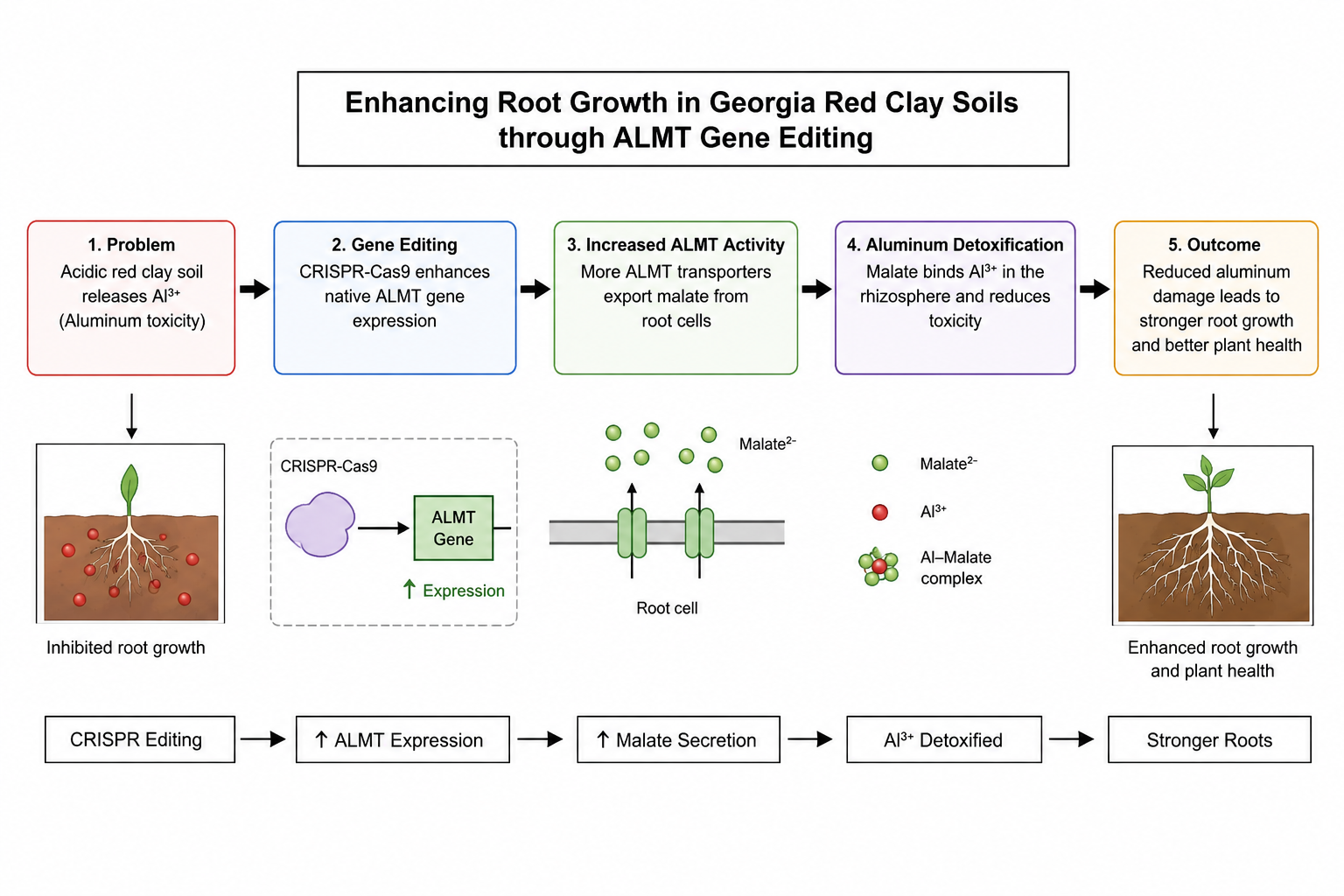 |
|---|
Recent advances in clustered regularly interspaced short palindromic repeats-CRISPR-associated protein 9 (CRISPR-Cas9) gene editing technology offer a promising avenue for engineering durable, genetically encoded aluminum tolerance. By precisely enhancing the regulatory elements governing ALMT expression, it may be possible to upregulate malate secretion without introducing foreign genetic material, thereby producing crops that are better equipped to thrive in acidic, aluminum-rich soils. This process is outlined in detail in Figure 1. Complementary grafting strategies, which pair aluminum- tolerant rootstocks with commercially valuable scions, offer an additional non- chemical approach to improving root resilience under stress conditions (Kochian et al., 2015; Sade et al., 2016).
This study investigates the combined potential of CRISPR-based regulatory editing and grafting techniques to improve crop performance in Georgia's red clay soils, with the goal of developing sustainable, scalable solutions to aluminum toxicity that reduce dependence on chemical inputs and expand the agricultural viability of acidic land.
Methodology
To test how nearby roots affect plant growth in aluminum-rich soil, we designed an experiment using green onion (Allium fistulosum) because it is easy to regrow and its root and scion structures are clearly visible (Vu, 2021). Green onions can regrow roots even after being cut, as long as part of the white bulb remains, which makes them a good model for observing root development over a short period of time (Greaves, 2020). This setup allows us to model a grafting-like situation without actually performing grafting, which requires more time and precision (Hunter, 2021). In grafting, we would have to connect two different sections from two different plants and use tape or another material to bind them together and have them stick together without actually being connected by the roots. We would have to take the scion of one plant and the roots of another plant, and the general goal is to enhance the growth of the plant with stronger roots from another plant (GARDEN TIPS, 2024). The goal of this setup was to see whether the presence of a nearby root system could improve root growth in difficult soil conditions. This idea is based on how grafting works, where a strong root system supports another plant. Even though the roots in our experiment were not physically connected, we wanted to see if simply being positioned one to two centimeters near another root system could still have a positive effect. To make our results more reliable, we repeated each red clay condition twice so we could compare patterns and reduce the chance of random error.
We prepared five clear plastic cups as our growing environments. Four cups were filled with about two inches of Georgia red clay soil to represent acidic soil conditions with high aluminum content. One cup was filled with loose, regular soil to act as a control where plants could grow without stress. We then collected five green onions and trimmed off the roots and part of the white bulb, making sure that enough of the base remained so the plant could regrow. We set up three different conditions to compare plant growth. In the first condition, two cups of red clay soil contained both a root mass and a separate scion placed about one inch apart. In the second condition, two cups of red clay soil contained only the scion with no nearby roots. In the third condition, the control cup with regular soil contained both rootstock and scion. All plants were covered with about one inch of soil and labeled clearly. The cups were placed near a window so they could receive consistent sunlight, and all plants were watered regularly to keep conditions as similar as possible. We made sure each cup received about the same amount of water and light to reduce differences caused by environmental factors.
Systems level
This project addresses aluminum toxicity by engineering crops to be naturally resistant rather than relying on external soil treatments. Instead of expensive and temporary solutions, this system works from within the plant to enable survival and growth in Georgia's acidic red clay soils. By strengthening the plant at both the genetic and structural level, crops are able to absorb more nutrients and water, achieve higher yields, and thrive in soils that were previously too harsh for productive farming. This provides farmers with long-lasting, cost-effective, and environmentally responsible solutions that remain effective across multiple growing seasons. However, one concern with transgenic crops is that editing genes like ALMT could affect other plant functions, or spread to nearby plants. We plan on addressing this by using precise edits, stress-specific promoters, and thorough controlled testing. Furthermore, since ALMT is conserved across many plant species, the response to editing it is not necessarily identical for every plant grown in Georgia. Different crops such as corn, soybeans, peanuts, and vegetables possess varying baseline aluminum tolerance levels, ALMT gene variants and regulatory systems, root structures, and stress-response pathways. As a result, enhancing ALMT expression would likely produce different outcomes depending on the species, and in some plants the modification may be more effective than in others. Therefore, future research should investigate how ALMT gene editing affects a variety of agriculturally important crops under Georgia red clay soil conditions in order to determine which species benefit most from this approach and whether additional genetic modifications may be necessary for certain plants.
Device level
The engineered crop system is designed to improve the tolerance of aluminum in highly acidic soils by changing plant functions. This system merges CRISPR-Cas9 gene editing to improve the regulation of the ALMT pathway–detoxifying aluminum at the plant's roots–with grafting strategies that pair roots that are aluminum tolerant with high-producing plants. Grafting is a technique where two plants are joined so they grow as one. A rootstock provides the root system and is chosen for traits such as stress tolerance. This solution, with the use of CRISPR-Cas9 gene editing and grafting, helps crops to better handle toxic aluminum levels.
Parts level
This system focuses on specific genetic pieces, particularly the individual genes, regulatory sequences, and proteins involved in aluminum tolerance, that are needed to build up aluminum tolerance in crops. While other traditional methods do help manage acidic soil, they often do not change the plant’s genetics, resulting in only a temporary modification, meaning traditional methods only treat soil conditions, not the plant itself. These methods do not change the genetic makeup of the plant, but rather temporarily treat the soil conditions. Instead, our solution uses parts like the ALMT gene, which can be edited with the CRISPR-Cas9 to increase crop production and reduce toxic aluminum levels at the plant’s roots. Additionally, grafting allows the decrease of stress levels and an increase in aluminum resistance.
Safety
To make sure this project is safe, we would carry the procedure out in controlled lab and greenhouse environments before working in an actual field. While working in the lab, proper safety equipment such as safety goggles and gloves would be used, and standard procedures would be followed to avoid contamination or accidental exposure. Before any real-world testing, the genetically modified plants would be closely studied in greenhouse conditions to make sure the changes are working as intended and not causing unexpected problems. We would specifically check that increasing ALMT expression improves root growth without negatively affecting the plant in other ways, as well as observing how the plants interact with the soil to make sure they are not harming natural soil organisms. If field testing is conducted later, it would follow strict safety rules and monitoring to make sure the plants stay controlled.
Results
| Figure 2. (A) The experimentation process, also known as the green onion model system. (B) Root and shoot comparisons providing clear qualitative evidence that proximity to an existing root mass enhances scion root development and overall vigor in Georgia red clay soil. In the two red clay cups that contained both a separated root mass (rootstock) and a freshly cut onion top (scion), the scions produced noticeably longer, thicker, and more branched root systems compared to those in the two red clay cups that lacked a neighboring root mass. The scions grown with rootstock in red clay also exhibited healthier, more turgid green shoots and visibly greater leaf elongation over the observation period. In contrast, scions placed alone in red clay soil developed sparse, short, and thin roots, and their shoot growth remained stunted, with some yellowing of the tips. | 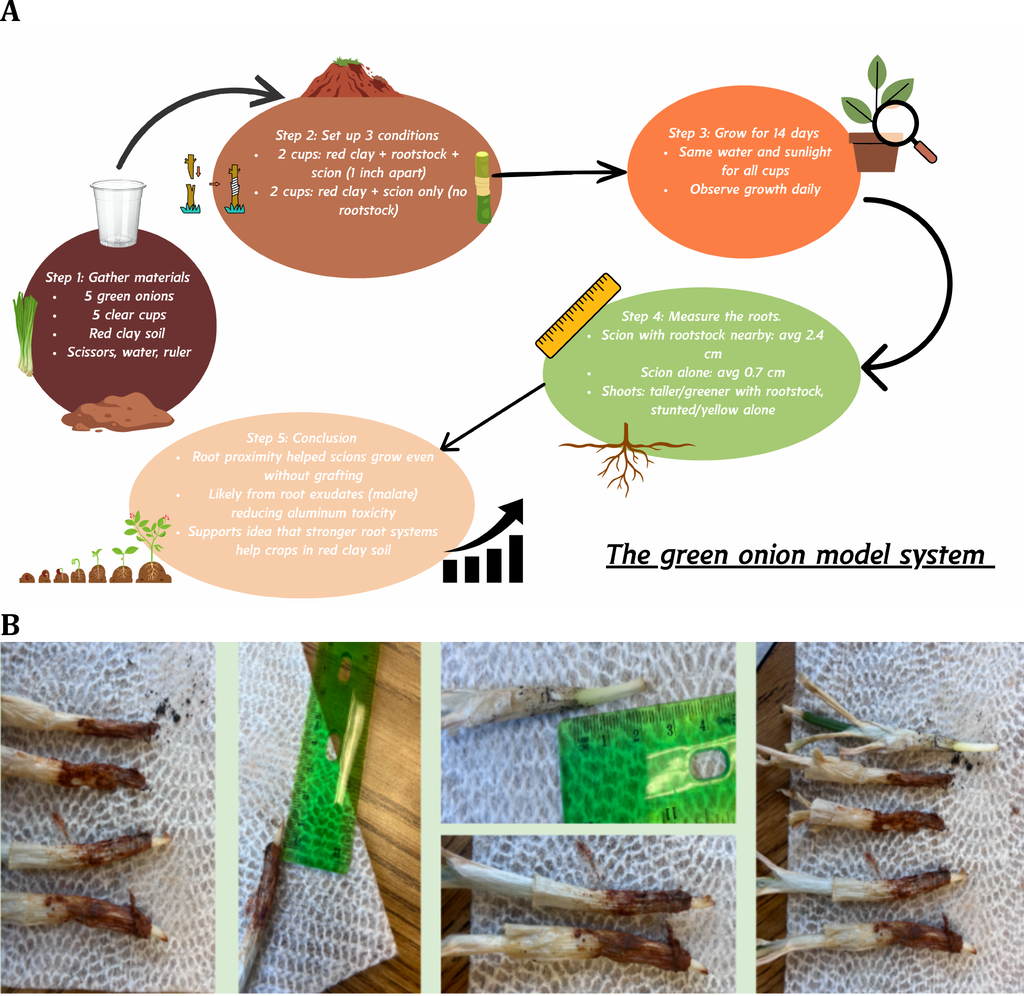 |
|---|
Table 1. Average scion root growth after 14 days in each condition
| Condition | Average Scion Root Length (cm) |
|---|---|
| Red Clay Soil + Rootstock Nearby | 2.4 |
| Red Clay Soil – Scion Only | 0.7 |
As clearly demonstrated by Table 1, the positive control cup containing regular loose soil with both rootstock and scion showed the most rapid and robust overall growth, as expected given the absence of aluminum toxicity and the soil’s lighter texture. Importantly, the improvement observed in the red clay plus rootstock treatment relative to the red clay-only treatment indicates that the mere presence of an adjacent established root system, without direct vascular grafting, can partially mitigate the inhibitory effects of acidic, aluminum-rich soil. This outcome supports the hypothesis that root-root interactions, potentially mediated by root exudates, altered rhizosphere chemistry, or physical soil conditioning, can stimulate root initiation and elongation in a neighboring propagule. These observations serve as proof-of-concept that strategies aimed at strengthening the root environment (such as grafting onto tolerant rootstocks) have the potential to improve crop establishment in challenging red clay soils.
Discussions
This project addresses aluminum toxicity in Georgia's red clay soils by combining CRISPR-Cas9 gene editing of the ALMT pathway with grafting strategies, offering a more sustainable and long-lasting alternative to conventional chemical soil treatments. Rather than applying lime or other amendments that provide only temporary relief, this approach works at the genetic and structural level to help crops survive and thrive in acidic, aluminum-rich conditions.
The results of the green onion model experiment suggest that strengthening the root environment may help plants better tolerate the stressful conditions present in Georgia’s red clay soils. The improved root growth observed when scions were placed near an established root mass supports the idea that grafting-based strategies could enhance crop establishment in acidic, aluminum-rich environments. These findings also suggest that interactions within the rhizosphere, such as changes in soil chemistry or signaling between nearby roots, may play an important role in mitigating aluminum stress and should be investigated further in future studies.
However, there are important limitations to acknowledge. Green onions were chosen for their ease of regrowth and visible root structures, but they may not fully represent how more sensitive crop species respond to aluminum stress. Root length, shoot vigor, and branching were assessed qualitatively rather than through precise measurements, so it is difficult to draw statistically confident conclusions from these observations. Additionally, since the rootstock and scion were not physically grafted together, the experiment models the effects of root proximity rather than true grafting, and the specific mechanisms behind the observed improvement remain unclear.
On the genetic side, using CRISPR-Cas9 to upregulate the native ALMT gene rather than introducing foreign genetic material offers a promising and more targeted approach to building aluminum tolerance into crops. Enhancing the expression of a gene the plant already uses to chelate Al3+ ions means the modification works within the plant's existing biological framework. Furthermore, different plant species would likely respond differently to ALMT gene editing because plants have different natural levels of aluminum tolerance, root structures, and gene regulation systems. Every plant would not respond the same way, but ALMT enhancement could serve as a starting point for improving aluminum tolerance in acidic soils. At the same time, this approach comes with challenges, including ensuring the precision of edits across different crop varieties, meeting regulatory requirements for gene-edited crops, and conducting multi-season field trials to confirm that the benefits are consistent and stable over time. It is also worth considering whether increased malate secretion alone would be sufficient in soils with very high aluminum concentrations, or whether additional modifications targeting other tolerance mechanisms would be necessary.
Additionally, since most cellular mechanisms do not function independently, modifying the ALMT pathway could unintentionally influence other biological processes within the plant. Since the ALMT gene is connected to ion transport, stress signaling, and overall root metabolism, increasing its expression may affect other pathways related to nutrient balance, growth regulation, or environmental adaptation (Liu & Zhou, 2018). Future research should therefore investigate how ALMT gene editing interacts with other cellular systems and evaluate whether unintended physiological effects occur. This can be addressed through controlled greenhouse studies, multi-generational testing, and molecular analysis of edited plants to ensure that enhanced aluminum tolerance does not negatively impact overall plant health or development.
From a practical standpoint, this combined approach has the potential to significantly benefit farmers working with Georgia's acidic red clay soils. Chemical liming requires repeated application and adds to production costs each season while a genetically encoded solution would remain effective across multiple growing seasons without additional intervention. By expanding the range of crops that can be grown in previously unusable land, reducing dependence on chemical inputs, and lowering long-term production costs, this approach aligns with the goal of developing sustainable and environmentally responsible agricultural practices.
The most important next step is to move from proof-of-concept to controlled experimentation. This means developing CRISPR-edited model plants with enhanced ALMT expression, growing them alongside unedited controls in Georgia red clay soil, and collecting detailed measurements including root length, root density, plant height, biomass, chlorophyll content, survival rate, and yield over several weeks. Testing how plants respond to both aluminum toxicity and root-infecting nematodes, which are an additional stressor in these soils, would also help clarify whether ALMT enhancement addresses multiple challenges simultaneously. Analyzing how changes in malate secretion affect soil microorganisms would further ensure that the approach does not unintentionally disrupt the broader soil ecosystem before any field deployment.
Next steps
One logical next step is to directly test whether enhancing ALMT gene expression through CRISPR-Cas9 gene editing leads to measurable improvements in plant growth under the specific conditions of Georgia’s red clay soils compared to plants without the ALMT gene. This can be accomplished by developing a set of genetically edited model plants in which the native ALMT gene is either upregulated or modified at the genetic level to increase expression under acidic stress. These edited plants should be grown alongside non-edited controls in identical soil conditions characterized by low pH and elevated aluminum concentrations. Over the course of several weeks, detailed measurements should be collected, including root length, root density, biomass accumulation, plant height, chlorophyll content, survival rate, and eventual yield. By comparing these metrics across groups, we can determine whether and the extent to which increased malate release improves tolerance to aluminum toxicity and supports overall plant health in a way that is both consistent and scalable.
In addition to testing the direct effects of ALMT enhancement, it is equally important to better understand how different stress factors present in red clay soils interact with one another to influence plant growth. Red clay soil is not only high in aluminum, but it can also contain harmful organisms like root infecting nematodes that damage plant roots. To study these factors more clearly, we would set up three different growing conditions: acidic soil with aluminum only, neutral soil with nematodes only, and natural red clay soil that includes both stresses. We would then grow both edited and unedited plants in each condition. This would help us figure out whether ALMT mainly helps against aluminum toxicity, or if it also improves overall root strength in more complex environments. We also plan to compare different methods of improving plant growth side by side. In this experiment, we would test three groups of plants: normal plants, plants improved through grafting with stronger root systems, and plants edited using CRISPR to enhance ALMT expression. All three groups would be grown in the same red clay soil conditions so the results can be directly compared. This would help us understand which method works best and whether combining both approaches could lead to even better results.
Author contributions
SB led the project by managing deadlines, coordinating team responsibilities, and ensuring all members had the resources and information needed to collaborate effectively. She served as the main point of contact for questions and communication within the team and worked closely with mentors to keep them updated and made sure their feedback and guidance were incorporated into our work. SG contributed to the experiment by conducting research on what genes our team should use. He discovered that the ALMT gene was useful in the first place. He also contributed mainly to the discussion section. MG helped design the experiment and identified grafting as a potential method to solve the issue of plants struggling to grow in red clay soil. She helped conduct the experiment, interpret results, and report them. She primarily wrote the methodology section. DK provided the necessary materials and led the execution of the experiment throughout its duration. NM contributed to the overall research and primarily worked on the results section. TP researched possible genes we could edit within the plant to help improve growth. She also primarily worked on the safety section of this paper. AP elaborated on the next steps section of this paper and refined the abstract and purpose of our research. TW conducted research on what genes we can use to effectively genetically modify plants to increase resistance to aluminum toxicity. She primarily worked on the parts and device level sections.
Acknowledgements
We would like to sincerely thank our mentors Letitiah Etheridge, Janet Standeven, and Sean Pascoe for their guidance, support, and continuous encouragement throughout this project. Their feedback helped us strengthen both the experimental design and the scientific reasoning behind our work, and their mentorship and advice played an important role in shaping the direction of our research. We would also like to acknowledge BioBuilder for providing the opportunity to engage in synthetic biology research. This program gave us access to valuable learning experiences.
References
Fernie, A. R., & Martinoia, E. (2009). Malate. Jack of all trades or master of a few? Phytochemistry, 70(7), 828–832. https://doi.org/10.1016/j.phytochem.2009.04.023
GARDEN TIPS. (2024, November 24). Popular Method 😨Of GRAFTING PLANTS | Grafting Tips🍀 #grafting #videos #skill. YouTube. https://www.youtube.com/watch?v=_rR9npvFilo
Greaves, V. (2020, February 25). How to Regrow Green Onions From Scraps. Allrecipes. https://www.allrecipes.com/article/save-money-diy-fresh-green-onions/
Hunter, P. (2021). The molecular biology of grafting. EMBO Reports, 22(11). https://doi.org/10.15252/embr.202154098
Kochian, L. V., Piñeros, M. A., Liu, J., & Magalhaes, J. V. (2015). Plant Adaptation to Acid Soils: The Molecular Basis for Crop Aluminum Resistance. Annual Review of Plant Biology, 66, 571–598. https://doi.org/10.1146/annurev-arplant-043014-114822
Liu, J., & Zhou, M. (2018). The ALMT Gene Family Performs Multiple Functions in Plants. Agronomy, 8(2), 20. https://doi.org/10.3390/agronomy8020020
Sade, H., Meriga, B., Surapu, V., Gadi, J., Sunita, M. S. L., Suravajhala, P., & Kavi Kishor, P. B. (2016). Toxicity and tolerance of aluminum in plants: tailoring plants to suit to acid soils. BioMetals, 29(2), 187–210. https://doi.org/10.1007/s10534-016-9910-z
Vu, H. (2021, May 5). How to Regrow Green Onions from Scraps (In Water & Soil). Hungry Huy. https://www.hungryhuy.com/regrow-green-onions/
Zhang, F., Jiang, S., Li, Q., Song, Z., Yang, Y., Yu, S., Nie, Z., Chu, M., & An, Y. (2023). Identification of the ALMT gene family in the potato (Solanum tuberosum L.) and analysis of the function of StALMT6/10 in response to aluminum toxicity. Frontiers in Plant Science, 14. https://doi.org/10.3389/fpls.2023.1274260
Zhang, X., Long, Y., Huang, J., & Xia, J. (2019). Molecular Mechanisms for Coping with Al Toxicity in Plants. International Journal of Molecular Sciences, 20(7), 1551. https://doi.org/10.3390/ijms20071551