
Thomas Gunawan, Ye Sung Han, Daffa Hidayat, Daffi Muhammad Hidayat, and Melody Regina Wijaya, Sinarmas World Academy, South Tangerang City, Banten, Indonesia
Reviewed on 9 May 2026; Accepted on 22 June 2026; Published on 26 October 2026
With help from the 2026 BioTreks Production Team.
Cananga odorata is a tropical flowering plant species that is economically important in aromatherapy and traditional medicine due to its numerous medicinal properties. Although the three species (C. odorata var. odorata forma genuina (Genuina), C. odorata var. odorata forma macrophylla (Macrophylla), and C. odorata var. Fruticosa (Fruticosa) have notable differences in chemical properties; they are often difficult to distinguish due to strong morphological similarities. This issue can potentially be solved using volatile organic compound (VOC) profiling, as they provide a reliable chemical signature for each species. This study compares the VOC profiles of these species and assesses their therapeutic potential for five biofunctional properties (antimicrobial, anxiolytic, anti-inflammatory, spasmolytic, and expectorant activities) and chemical traits (monoterpene, oxygenated monoterpene, methoxylbenzene, sesquiterpene, phenylpropanoid). Chemical components of essential oil extracted from the flowers of each variant were separated using a non-targeted GC-MS/MS analysis to identify and quantify compounds within each sample. We identified 94 non-repeating VOCs, with Macrophylla having the highest methoxylbenzene VOCs (31.97%) and no sesquiterpene concentrations, and is the sole plant variant that contains Geraniol (13.00%). On the other hand, Genuina is characterised by a high concentration of oxygenated monoterpenes (24.74%), with unique profiling, as it is the single variant to have Linalool (17.57%) and Eucalyptol (4.82%). Lastly, Fruticosa had the highest sesquiterpene content (35.40%) and chemical diversity, possessing VOCs such as Humulene (5.12%), Beta Ocimene (10.84%), and Pinene Isomers (9.17%). Due to its geraniol composition, Macrophylla may exhibit anxiolytic and neuroprotective properties. Furthermore, while Genuina may support stress relief and promote sleep, due to its diverse profiling, Fruticosa may have broader applications in treating anxiety and neuropsychiatric conditions. These findings provide additional understanding of their therapeutic differences, supporting more accurate selection for aromatherapy and medicinal applications.
Keywords: Cananga odorata, volatile organic compounds (VOCs), GC-MS/MS, and phytochemical profiling.
Authors are listed in alphabetical order. Haoran Wei mentored the group. Please direct all correspondence to mailto:haoran_wei@swa-jkt.com.


Background
Cananga odorata (Lam.) Hook. f. and Thom., which belongs to the tropical family Annonaceae and is distributed throughout Southeast Asia. This flower has been perceived as commercially valuable and culturally important for many years. It can be classified into three different forms: C. odorata var. odorata forma Genuina is the most aromatic and is therefore mainly of use in the manufacture of fragrances via the extraction of essential oils; C. odorata var. Fruticosa is grown as an ornamental, and C. odorata forma macrophylla is used in traditional ceremonies by Indonesian people and also in traditional medicine (Hulyati et al., 2014) (Manner and Elevitch, 2006). While DNA barcoding has been applied to C. odorata using chloroplast markers (Hermawan et al., 2026); its utility for intraspecific variant-level discrimination remains limited, as standard barcoding loci lack sufficient resolution to reliably distinguish within-species variants (Hollingsworth et al., 2011; CBD, 2020). Therefore, there is a need for a tool with intraspecific variant differentiation to identify the differences in chemical profile between the three species so that unlabeled cultivars can be used for proper therapeutic or cultural purposes.
Currently, there is no rapid and practical method to distinguish between C. odorata variants. Conventional identification relies on farmers' expertise and visual observation of morphological traits, with local cultivators reporting that meaningful morphological differentiation can take 2–5 years (local farmers, personal communication, July 2025). Although DNA barcoding provides accuracy, it is too complex and impractical for field use. The lack of a reliable differentiation method has contributed to the proliferation of fraudulent practices in the essential oil trade, which directly harm the farmers’ livelihoods and undermine market trust (Arctander, 1960; Chakira Abacar Soilihi, 2017; Scentspiracy, 2024).
To combat this, this study uses Gas Chromatography-Mass Spectrometry/Mass Spectrometry (GC-MS/MS) to identify and differentiate the volatile organic compound (VOC) profiles of three C. odorata species. Additionally, we used this tool to further map their VOCs across 5 therapeutic applications (antimicrobial, anti-inflammatory, spasmolytic, expectorant, and anxiolytic), acting as a first step in differentiating the three species and their potential therapeutic applications.,This study used the GC-MS/MS as its high sensitivity and precision in separating, quantifying, and identifying volatile compounds, producing comprehensive and replicable phytochemical data from complex plant matrices (Stashenko and Martínez, 2012). Similar to Adams (2007), we identified compounds by matching our data with spectral libraries and comparing them with retention indices, which eliminates the need for expensive isolation or purification procedures. This significantly reduces analysis time while also maintaining the integrity of our samples. Notably, each species is a distinct botanical form with different genetic backgrounds, meaning that their VOC profiles are expected to show unique chemical compositions (Benini et al., 2012; Zheng et al., 2024). However, it is important to note that environmental conditions may contribute to VOC expression within each variant (Maffei et al., 2018), though acknowledging these contributions is beyond the scope of this study.
From these chemical profiles, this paper further differentiates each species by categorising each bioactive compound in 5 therapeutic groups: antimicrobial, anti-inflammatory, anxiolytic, spasmolytic, and expectorant. Overall, this study aims to establish the chemical foundation for rapid species authentication, supporting quality control in essential oil production, evidence-based selection for therapeutic applications, and the reduction of misidentification-related fraud in the Cananga market.
Materials and methods
Plant Material and Sample Collection
Flowers of three Cananga odorata varieties, Genuina (Co52), Macrophylla (Co48), and Fruticosa, were collected in Blitar, East Java, Indonesia. Each type of material was collected from a single mature tree of the parent species and was verified by local farmers with expertise in C. odorata cultivation. Additionally, species identity was further supported by previously published chloroplast DNA barcoding data using the same samples reported by Hermawan et al., (2026). collected in Blitar, East Java, Indonesia. Fresh flower samples were placed into headspace vials immediately after collection and transported to the laboratory in a cool box maintained at approximately -18°C using a sodium chloride dry ice mixture over a transit period of approximately 18 h. When they arrived in the laboratory, the samples were kept in -80°C freezers to maintain metabolism slowed in sealed headspace vials until they could be analysed.
To ensure each member’s safety, precautions such as the use of gloves and safety boots were taken during sampling. Additionally, during GC-MS/MS analysis, a mask and lab coat was worn to prevent the inhalation of dangerous VOCs.
Headspace-GC-MS/MS Analysis. Headspace gas chromatography-mass spectrometry (HS-GC-MS/MS) was used on a Thermo Scientific TSQ 9610 triple quadrupole GC-MS system fitted with a TriPlus RSH autosampler to analyse VOCs. This study uses Piacentini’s method (Piacentini et al., 2022). Fresh flower samples (each weighing 1.0 g) were stored inside 20 mL headspace vials and spun at 250 RPM with 10 s on time and 2 seconds off cycles at 80°C for 25 min. Afterwards, 1.0 mL of headspace vapour was removed using a syringe heated at 90°C and injected into the GC system with three enriching cycles (a repeated sampling or concentration step used to increase the amount of volatile compounds collected from the headspace before analysis)at 1-min intervals. The purpose of these enriching cycles is to improve sensitivity of the GC-MS/MS, especially for compounds present at very low concentrations, allowing for a stronger analysis.
This study uses a TG-5SilMS column (30 m × 0.25 mm i.d., 0.25 µm film thickness) for chromatographic separation, using helium as a carrier gas and a constant 1.0 mL/min flow rate. Furthermore, we maintained the injection port temperature at 230°C in split mode with a split ratio of 10:1. The oven started at 50°C, increasing up to 150°C at 20°C/min over five minutes, where each sample’s run time was approximately 9 min.
The mass spectrometer’s ion source and transfer line temperature were operating in electron ionisation (EI) mode at 250°C. Additionally, full-scan mass spectra were obtained over a mass range of 15–200 m/z at 0.2 s scan time. Chromeleon was used to obtain and process the data used for the GC-MS/MS (Thermo Fisher Scientific, n.d.).
Compound Identification and Quantification
VOCs identification was achieved by the comparison of the experimental mass spectra with the spectra in the 2023 NIST mass spectral library database with the help of Chromeleon software (Thermo Fisher Scientific, n.d.). The quality of spectral match scores and retention time compatibility determined the identification of compounds. In relative quantification, the peak area percentages were calculated, and each sample was normalised to 100%. No internal standards and no authentic reference compounds were used. Only one injection for a single species was done without technical replicates.
Chemical Classification and Biofunctional Categorisation
Not all 94 detected VOCs were included in this study. To be included, VOCs must have their chemical identity confirmed with at least 80% confidence with respect to the 2023 NIST spectral library and be at least greater than 0.1% of the total detected compounds in the species. These inclusion criteria were determined using previous studies. Afterwards, it was classified into five chemical groups: (A) monoterpene hydrocarbons, (B) oxygenated monoterpenes, (C) methoxybenzene derivatives, (D) sesquiterpene hydrocarbons, and (E) phenylpropanoids (Lo et al., 2024). This grouping was done to generate initial pharmacological hypotheses; afterwards, through further classification of VOCs by their phytochemical applications. Each compound was then individually checked against published scientific studies to confirm it had actual experimental evidence of a specific pharmacological effect. It is important to note that compounds that cannot be directly linked to these studies were excluded from this paper.
Data Visualization
Comparative analyses and visualisations, including grouped bar charts, stacked bar charts, heatmaps, and Venn diagrams, were generated using Microsoft Excel,specialised data visualisation software such as SR plot to illustrate chemical composition differences and therapeutic property distributions among the three species, Miro to illustrate a Venn diagram, and FlowerBase to specifically generate a heatmap (Tang et al., 2023; Wang et al., 2025; Miro, n.d.). Additionally, compounds identified in Table 1 were assigned numerical codes (Table 2) to facilitate cross-referencing. A three-circle Venn diagram was constructed to illustrate the distribution of VOCs across the three species, distinguishing species-exclusive compounds from those shared between two or all three species.
Results
The figure below shows a horizontal bar chart of the relative area for all three C. odorata variants across five chemical classes: Monoterpene (A) (e.g., α-pinene), Oxygenated Monoterpene (B) (e.g., eucalyptol), Methoxylbenzene (C) (e.g., methyl eugenol), Sesquiterpene (D) (e.g., β-caryophyllene), and Phenylpropanoid (E) (e.g., safrole). This figure was made using SR plot (Tang et al., 2023).
| Figure 1. A Stacked Bar Chart Visualising the Relative Area (%) of Major Chemical Compound Classes Across MA, GE, and FU Groups. | 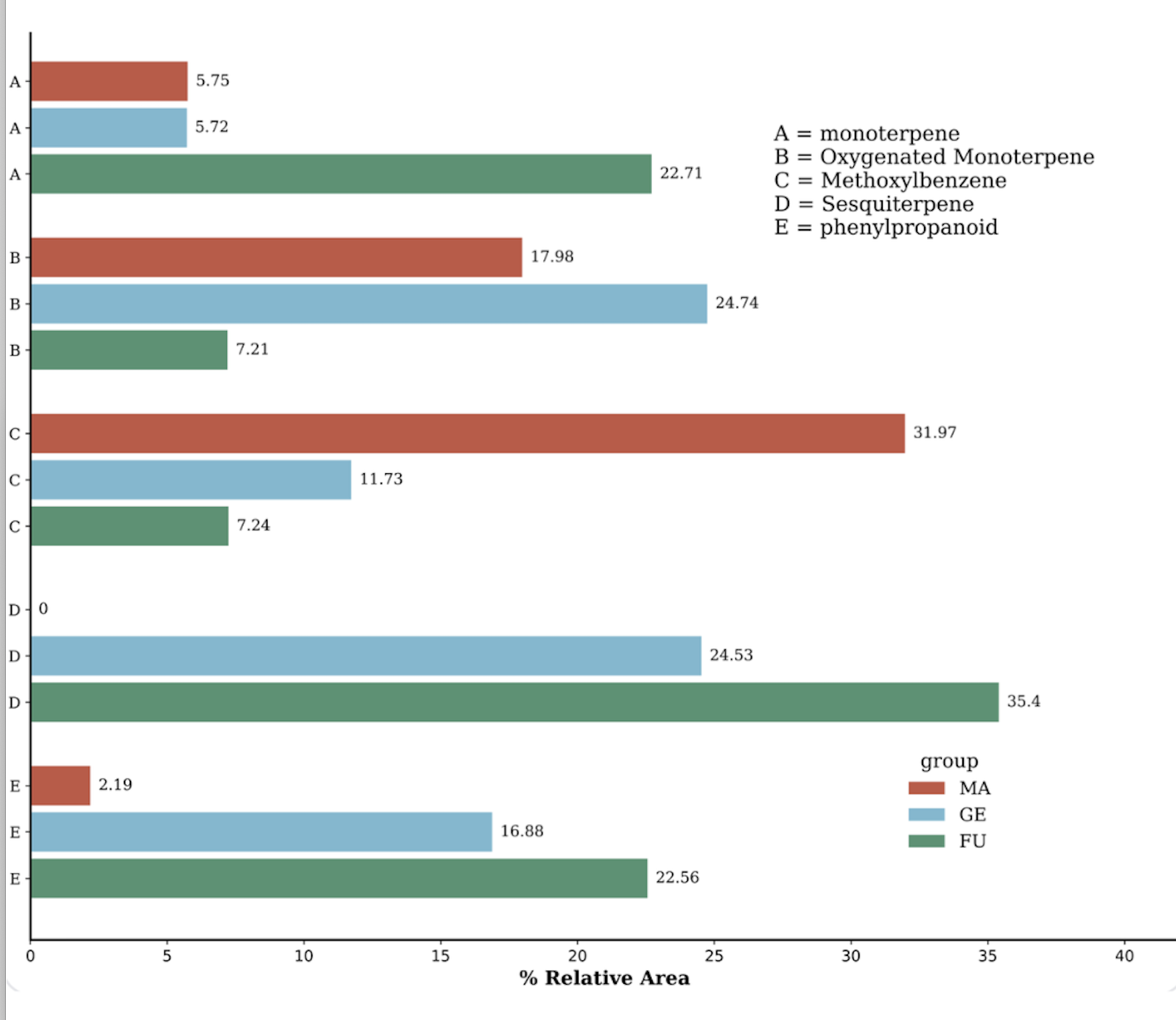 |
|---|
GC-MS/MS analysis identified 94 non-repeating VOCs across the three variants, enabling comparative phytochemical profiling as described below.Overall, each species displayed distinct trends. For instance, Fruticosa had the most consistent dominance, as it recorded the highest relative areas in regions such as monoterpenes (22.71%), sesquiterpenes (35.40%), and phenylpropanoids (22.56%). This domination suggests a chemotype that is characterised by diverse terpenoid biosynthesis. Interestingly, only Macrophylla lacked any sesquiterpene accumulation. This may indicate a potential loss-of-function in Macrophylla’s sesquiterpene biosynthetic machinery.
On the other hand, Macrophylla was distinguished by its high percentage of methoxylbenzene content (31.97%), with almost quintuple concentration compared with Fruticosa. From this, it can be inferred that this characteristic is unique to the Macrophylla species. Conversely, its phenylpropanoid contribution was markedly low (2.19%). Notably, geraniol (compound 65) was detected exclusively in Macrophylla at 13.00%, and was absent in both Genuina and Fruticosa. In C. odorata var. macrophylla, the monoterpene synthase CoTPS4 has been shown to catalyse the production of geraniol directly from geranyl pyrophosphate (GPP) (Jin et al., 2015), suggesting that differential expression or activity of this enzyme, or a functional homologue between variants, may account for the exclusive accumulation of geraniol in Macrophylla. This variant-specific accumulation represents the most biochemically distinctive feature observed across the three chemotypes and warrants further genetic investigation. Genuina contained the greatest amount of oxygenated monoterpene (24.74%), suggesting that this group actively oxidises monoterpene precursors to create new products.
These different patterns may hint at the three species' distinct chemotypes, which can possibly be explained by the divergence in metabolic pathways that control the specific biosynthesis of VOCs. For instance, in C. odorata, floral VOCs are mainly derived from three biosynthetic routes: the mevalonate (MVA) pathway and the 2-C-methyl-D-erythritol 4-phosphate (MEP) pathway, which produce terpenoids, and the shikimate pathway, which produces phenylpropanoid and benzenoid compounds (Jin et al., 2015). Due to the differences in terpene synthase (TPS) gene expression, this is what we suspect to be the catalyst in these variations. This can be seen in the Fruticosa species, where they have CoTPS2 and CoTPS3, who catalyses the production of β-ylangene, β-copaene, and α-bergamotene, compared to more general species who uses COTPS21 homologues, which produce β-caryophyllene. (Jin et al., 2015; Zheng et al., 2024). These differences may therefore also reflect how further distinct ecological adaptations each species had to endure. Hence, adaptations including pollinator specificity may differ, as floral VOC composition is a key mediator of plant–pollinator interactions (Bergman et al., 2024). Future transcriptomic analysis targeting TPS gene expression across the three variants would help confirm this mechanistic link.
The figure below is a five-ellipse Venn diagram showing the intersection and distinct patterns for VOCs among the five therapeutic classifications(anti-inflammatory (AI), antimicrobial (AM), spasmolytic (S), anxiolytic (ANX), and expectorant (EX) was created on Miro (Miro, n.d.). Each number within the regions of the Venn diagram represents how many VOCs were found in each classification category that are either common or exclusive to each classification. .
| Figure 2. A Venn Diagram Illustrating the Distribution of VOCs in Five Therapeutic Categories | 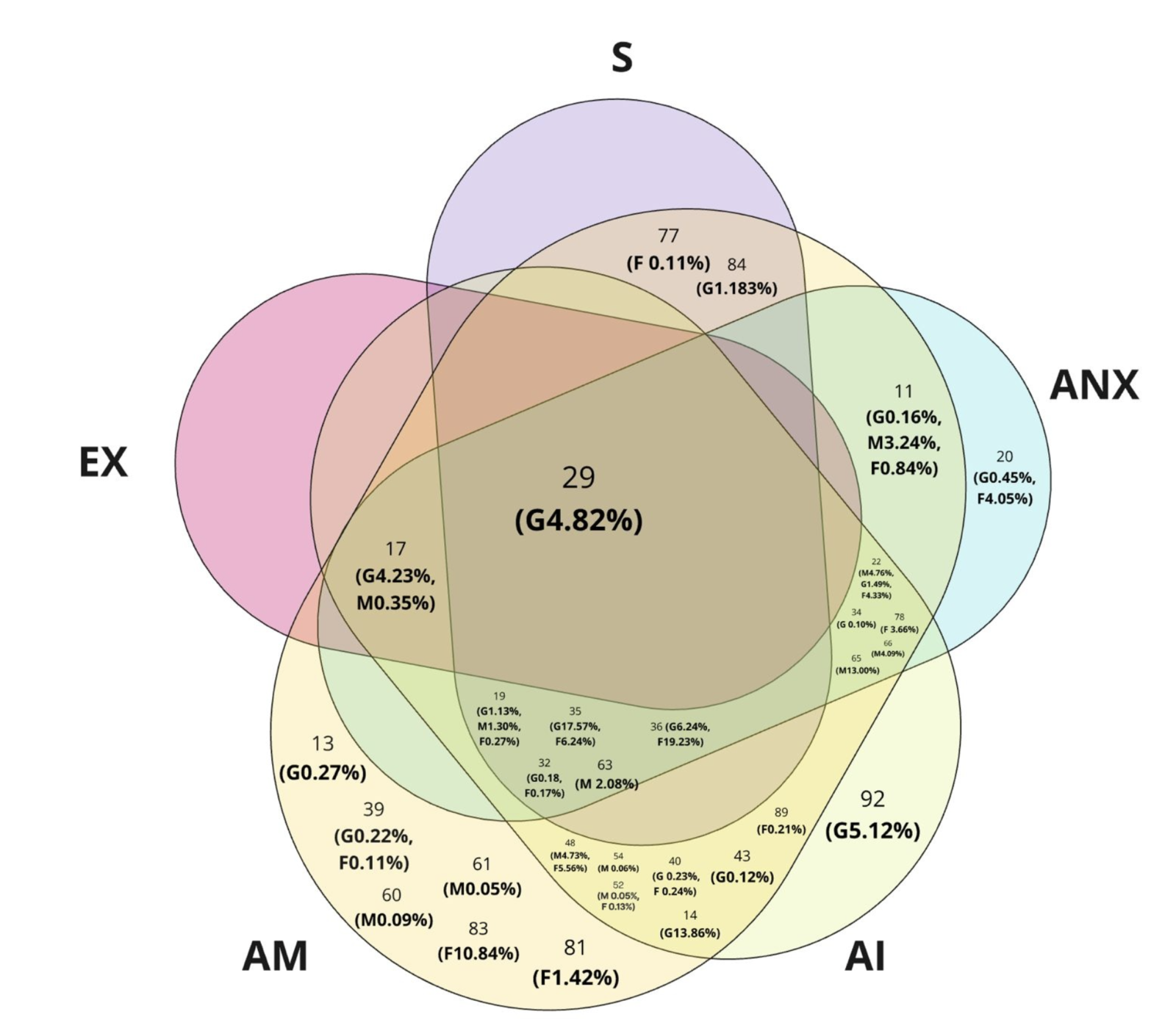 |
|---|
We used the data from Table 1 and converted the compounds into numbers for efficiency (Table 2). Afterwards, we performed a five-ellipse Venn diagram analysis (Figure 2.) based on the plant’s pharmacological functions (determined using literature search which is summarized in Table 3) to visualize the distribution of VOCs in the three variants of C. odorata, focusing on their anti-inflammatory (AI), antimicrobial (AM), spasmolytic (AS), anxiolytic (ANX), and expectorant (EX) properties. The numbers above represent the VOCs in the three samples.
Pharmacological categorisation of VOCs into five therapeutic properties (antimicrobial, anti-inflammatory, anxiolytic, spasmolytic, and expectorant) was visualised using a five-ellipse Venn diagram (Figure 2.), with compound numbers cross-referenced to Table 2. The most notable finding was that eucalyptol (compound #29) is the one compound that appears in every category, making it the most multi-functional bioactive VOC. Benzaldehyde (19), Methyleugenol (32), linalool (35), and Caryophyllene (36) are the next most active, appearing in four categories (antimicrobial, anti-inflammatory, anxiolytic, spasmolytic). Anethole (#63) and 3-Carene (#17) is third, appearing in four categories also (antimicrobial, anti-inflammatory, spasmolytic, and expectorant).
| Figure 3. A Venn Diagram Showing the Distribution of VOCs in the Three C. odorata species | 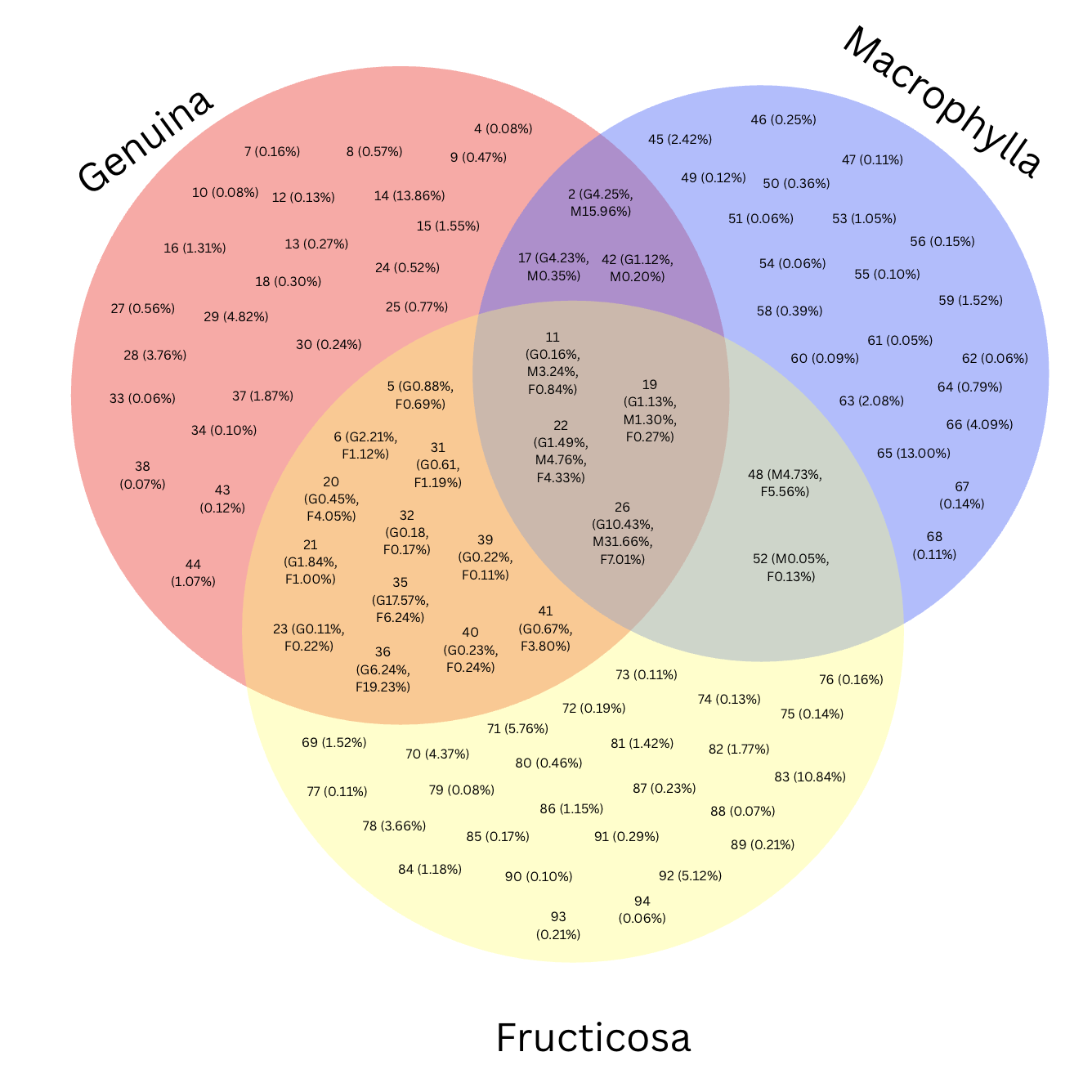 |
|---|
The figure above is a Venn diagram illustrating the distribution of 94 VOCs in three C. odorata species using the data from Table 1 to increase readabilityThe greatest number of unique VOCs was seen in Fruticosa; however, the largest number of total VOCs was seen in Genuina, which has been shown previously to have a high degree of chemotypic variation. The three variants shared a conserved core of compounds (11, 19, 22, 26) present across all three circles, suggesting a common biosynthetic baseline. Additionally, Geraniol (#65) is uniquely present in macrophylla, indicating this is the most biochemically distinct feature among the three variants. Pairwise overlaps were observed between Genuina–Fruticosa (compounds 5, 6, 20, 21, 23, 31, 32, 35, 36, 39, 40), Genuina–Macrophylla (compounds 2, 17, 42), and Macrophylla–Fruticosa (compounds 48, 52).
Of those 94 identified compounds unique across all species, the proportion of species-exclusive VOCs can be calculated by dividing the number of compounds unique to each species by the total of 94 non-repeating VOCs identified, then multiplying by 100 to express the result as a percentage. Using this approach, 25 unique VOCs were found in Genuina, 22 were identified in Macrophylla, and 26 VOCs were found in Fruticosa. The values derived for each of the 3 chemotypes in the study show that each has its own individual identity. These indicate greater chemical divergence between Macrophylla and Fruticosa/Genuina and Fruticosa/Macrophylla than between the last 2 species. Nevertheless, it also has to be noted how Macrophylla retains significant distinction, as it is the only species which produces geraniol. This further supports the ability to successfully discriminate between varieties based on the collection of VOC profiles by GC-MS/MS analysis, because meaningful differences are exhibited between samples of C. odorata species that morphologically resemble each other but were distinguished by our analytical approach.
The figure above is a heatmap showing the spread of VOCs in 3 Cananga odorata species by therapeutic applications. This figure shows how each of the 94 detected VOC was distributed into 5 biofunctional properties (Antimicrobial, Anti-Inflammatory, Anxiolytic, Spasmolytic, and Expectorant) was made using FlowerBase to increase the readability of our findings (Wang et al., 2025).
The multifunctional bioactivity of the most therapeutically significant VOCs reflects their distinct chemical structures and pharmacological mechanisms. Eucalyptol (compound 29), a bicyclic cyclic ether, exerts its broad activity by inhibiting NF-κB-mediated cytokine release (anti-inflammatory), disrupting bacterial membrane integrity (antimicrobial), relaxing bronchial smooth muscle (expectorant/spasmolytic), and modulating GABA-A receptor activity (anxiolytic) (Ceremuga et al., 2017; Arooj et al., 2023; Wang et al., 2026). Linalool (Compound #35) is an acyclic tertiary alcohol with a hydroxyl group facilitating membrane penetration and producing anti-anxiety effects (Anxiolytic) as well as spasmolytic effects by modulating GABA and glutamate receptors. It also disrupts bacterial cell walls (Baburin et al., 2008; Song et al., 2024). α-Pinene (compound 78), a bicyclic monoterpene hydrocarbon, suppresses MAPK and NF-κB inflammatory signalling pathways and inhibits acetylcholinesterase activity, accounting for its anti-inflammatory and anxiolytic properties (Miyazawa and Yamafuji, 2005; Kim et al., 2015). Anethole (Compound #63) is a phenylpropanoid ether characterised by a methoxy-substituted aromatic ring that causes reduction of prostaglandin synthesis (anti-inflammatory), contraction inhibition of smooth muscle (spasmolytic), and increases the rate at which mucus can be cleared from the respiratory tract (expectorant) (Domiciano et al., 2013; Lima et al., 2020). Geraniol (Compound #65) is an acyclic monoterpenol that is unique to Macrophylla and causes reductions in hippocampal oxidative stress and modifies monoaminergic neurotransmitter systems, thereby providing the biochemical basis for Macrophylla's anxiolytic and neuroprotective activities (Buch et al., 2023; Nisar et al., 2024) .
Discussions
The VOC profiles identified in this study suggest that each C. odorata species has distinct therapeutic strengths suited to different applications, and that these differences are grounded in divergent metabolic pathway activity and underlying genetic regulation.
Due to its high levels of eucalyptol and linalool, the Genuina variant may be best suited for respiratory and anti-inflammatory applications (Hoch et al., 2023; Peana et al., 2003). Not only that, genuina's chemical profile is dominated by oxygenated monoterpenes. This is likely caused by elevated cytochrome P450 enzyme activity acting after the MEP pathway, converting simple hydrocarbon monoterpenes into oxygenated compounds. Additionally, as these oxygenated monoterpenes generally have more biological activity than their non-oxygenated compounds, this oxygenation process may explain why Genuina is well suited for respiratory and anti-inflammatory activities compared to the other C. odorata species (Jin et al., 2015; Hąc-Wydro et al., 2017).
The unique geraniol content driven by CoTPS4 in Macrophylla distinguishes it biochemically from Genuina and Fruticosa, suggesting that an increase of this enzyme can shift monoterpene production toward geraniol, leading to unique neuroprotective and anti-anxiety effects for Macrophylla (Nisar et al., 2024; Buch et al., 2023; Jin et al., 2015).
While the Macrophylla variant is known for its geraniol content, Fruticosais characterised by its high diversity of sesquiterpenes and antimicrobial compounds, including humulene, β-ocimene, and pinene isomers, suggesting broader antimicrobial potential of the three (Jang et al., 2020; Laraib et al., 2025; Kovač et al., 2015). Fruticosa showed a high sesquiterpene relative area (35.40%), which suggests that the MVA pathway is highly active due to the influence of the CoTPS2 and CoTPS3 enzymes. Although this enzymatic specialisation likely developed through evolutionary adaptation to favour sesquiterpene biosynthesis, it may also have reduced the production of oxygenated monoterpenes. As a result, despite having a chemically diverse profile, Fruticosa does not contain significant expectorant compounds.
While the therapeutic versatility of the C. odorata species is primarily caused by multifunctional VOCs, it can also be viewed structurally. For instance, due to eucalyptol’s bicyclic ether structure, the plant can cross lipid membranes efficiently. This will allow Genuina to have better bioavailability across respiratory tissues, increasing its applicability in the bronchus (Hąc-Wydro et al., 2017; Mieres-Castro et al., 2021; Sheikh et al., 2025). On the other hand, Linalool possesses a flexible acyclic structure, which allows rapid CNS penetration, allowing Genuina to better function as a stress reliever and sleep promoter (Lee et al., 2018; Khedhri et al., 2025). As the only compound that displayed geraniol content, Macrophylla will benefit from the VOC’s acyclic monoterpenol backbone, which facilitates antioxidant activity in neural tissue to support neuroprotective mechanisms and distinguishes it from the other two species at the pharmacological level (Rajendran et al., 2024; Vo et al., 2025). Although Fruticosa acts as an excellent antimicrobial agent due to having hydrocarbon sesquiterpene structures that lack polar functional groups, this same benefit may explain why the same species has no expectorant compounds, as mucus-clearing activity requires oxygenated functional groups that are capable of interacting with mucosal surfaces.
More importantly, this difference in TPS gene regulation has direct effects on the pharmacological properties of each variant (Yang et al., 2023). Because Macrophylla mainly directs GPP toward geraniol production, Fruticosa channels FPP toward sesquiterpene synthesis, while Genuina produces more oxygenated monoterpene derivatives; differences in the expression of a single group of genes are enough to create three distinct chemotypes with different therapeutic strengths (da Silveira e Sá et al., 2013 ; Paço et al., 2022; Ammar, 2023; Canal et al., 2024 ). This finding suggests that TPS gene expression profiling could potentially be used as a reliable way to predict the pharmacological potential of different C. odorata variant
The phenomenon in which several VOCs were shared across multiple species can be attributed to a common biosynthetic origin, as the metabolic pathways in C. odorata species are largely conserved across multiple plant lineages, producing a baseline pool of shared compounds regardless of gene expression (Hąc-Wydro et al., 2017; Mieres-Castro et al., 2021; Sheikh et al., 2025). If looked further, overlapping of VOCs, specifically in Genuina and Fruticosa, was identified. This event suggests that Genuina is closer to Fruticosa compared to Macrophylla, whose methoxybenzene profiles may point to a distinct trajectory in evolution. On the other hand, a unique VOC composition was spotted in all three species of the plant. This divergence may be explained by the difference in gene expression for certain TPS genes, where transcription regulation of the TPS loci can redirect biosynthetic pathways toward different terpenoid products (Picazo-Aragonés et al., 2020).
All in all, the differences in TPS gene expression affect VOCs, causing different VOC content among the three C. odorata species, which also explains why each species has different theroretical therapeutic properties. This is evident in this study's findings, where Macrophylla's exclusive geraniol content causes it to potentially have better anxiolytic traits, whereas Genuina's high concentration of oxygenated monoterpene supports respiratory and anti-inflammatory applications (da Silveira e Sá et al., 2013). Furthermore, this study provides a preliminary phytochemical framework that may support future transcriptomic, metabolic, and pharmacological investigations into terpene biosynthesis in C. odorata.
Next steps
Future work should extend these findings by performing transcriptomic analysis that compares the level of expression of TPS genes in all species to determine whether the differences in CoTPS4, COTPS3, and COTPS2 expression are the driving force that stimulates the VOC divergence observed in this study. Not only that, directions such as a metabolic flux analysis through the MEP AND MVA pathways to quantify the biosynthetic contribution to each species’ chemotype should be taken. These future studies should also include multiple trees per species across different sites and seasons to account for environmental modulation of VOC expression and increase the overall accuracy of the results obtained. In-vitro and in-vivo testing should also be conducted to empirically affirm the pharmacological properties of these plants.In addition, future work should also explore the clinical and translational potential of these findings, as they can potentially aid in the development of plant-derived therapeutics for human health applications. Lastly, targeted pharmacological assays should be performed, particularly for Macrophylla’s anxiolytic activity and eucalyptol’s expectorant activity in Genuina to provide direct calibration of the potential conclusions drawn in this study. By doing all of these steps, researchers can develop a comprehensive understanding of the mechanisms, genetics, and level of differentiation of each C. odorata species
Author contributions
Daffi and Daffa were responsible for the conceptualisation, methodology, and execution of the study. Daffi, Daffa, and Ye Sung carried out the investigation, data curation, and formal analysis. Visualisation and data interpretation were prepared by Daffi and Melody. Daffi, Daffa, Ye Sung, Melody, and Thomas all contributed to writing and editing the original draft of the manuscript. Specifically, while Daffa, Ye Sung, and Thomas contributed to the data interpretation and performed statistical analysis on the data, Daffi and Melody focused on literature review synthesis and visualisation design. All authors reviewed and approved the final manuscript. Lastly, we would like to acknowledge the foundational research and published work of Bambang Hermawan, which informed and supported aspects of this study.
Acknowledgements
We gratefully acknowledge Sinarmas World Academy and Mr Bambang Hermawan for providing the laboratory facilities, equipment, and academic guidance that made this research possible.
References
Adams, R. P. (2007). Identification of essential oil components by gas chromatography/mass spectrometry (4th ed.). Allured Publishing Corporation.
Ali, N. B., Hussein, M. E., & Farag, M. A. (2023). Comprehensive metabolites characterization of Alpinia katsumadai seeds via a multiplex approach of UHPLC–MS/MS and GC–MS techniques. Journal of Food Science and Technology, 60(1), 123–135. https://doi.org/10.1038/s41598-025-29831-4
Arooj, B., Asghar, S., Saleem, M., Khalid, S. H., Asif, M., Chohan, T., Khan, I. U., Zubair, H. M., & Yaseen, H. S. (2023). Anti-inflammatory mechanisms of eucalyptol rich Eucalyptus globulus essential oil alone and in combination with flurbiprofen. Inflammopharmacology, 31(4), 1849–1862. https://doi.org/10.1007/s10787-023-01237-6
Baburin, I., Khom, S., Timin, E., Hohaus, A., Sieghart, W., & Hering, S. (2008). Estimating the efficiency of benzodiazepines on GABA(A) receptors comprising gamma1 or gamma2 subunits. British Journal of Pharmacology, 155(3), 424–433. https://doi.org/10.1038/bjp.2008.271
Benini, C., Mahy, G., Bizoux, J.-P., Wathelet, J.-P., du Jardin, P., Brostaux, Y., & Fauconnier, M.-L. (2012). Comparative chemical and molecular variability of Cananga odorata (Lam.) Hook.f. & Thomson forma genuina (ylang-ylang) in the Western Indian Ocean Islands: Implication for valorization. Chemistry & Biodiversity, 9(7), 1389–1402. https://doi.org/10.1002/cbdv.201100306
Bergman, M. E., Kortbeek, R. W. J., Gutensohn, M., & Dudareva, N. (2024). Plant terpenoid biosynthetic network and its multiple layers of regulation. Progress in Lipid Research, 95, 101287. https://doi.org/10.1016/j.plipres.2024.101287
Buch, P., Sharma, T., Airao, V., Vaishnav, D., Mani, S., Rachamalla, M., Gupta, A. K., Upadhye, V., Jha, S. K., Jha, N. K., & Parmar, S. (2023). Geraniol protects hippocampal CA1 neurons and improves functional outcomes in global model of stroke in rats. Chemical biology & drug design, 102(3), 523–535. https://doi.org/10.1111/cbdd.14260
Ceremuga, T. E., McClellan, C. B., Green, X. C., Heber, B. E., Jolly, M. L., Malone, T. B., Schaaf, J. L., & Isaacs, A. P. (2017). Investigation of the anxiolytic and antidepressant effects of eucalyptol (1,8-cineole), a compound from eucalyptus, in the adult male Sprague-Dawley rat. AANA Journal, 85(4), 277–284.
Chakira Abacar Soilihi. (2017). Detecting fraud of ylang-ylang essential oils. QualiREG – Quality for Development in Indian Ocean. https://www.qualireg.org/en/actions/enhancement-of-regional-products/plants/recognition-of-origin/detecting-fraud-of-ylang-ylang-essential-oils
de Cássia da Silveira e Sá, R., Andrade, L., & de Sousa, D. (2013). A Review on Anti-Inflammatory Activity of Monoterpenes. Molecules, 18(1), 1227–1254. https://doi.org/10.3390/molecules18011227
Domiciano, T. P., Dalalio, M. M., Silva, E. L., Ritter, A. M., Estevão-Silva, C. F., Ramos, F. S., Caparroz-Assef, S. M., Cuman, R. K., & Bersani-Amado, C. A. (2013). Inhibitory effect of anethole in nonimmune acute inflammation. Naunyn-Schmiedeberg's Archives of Pharmacology, 386(4), 331–338. https://doi.org/10.1007/s00210-012-0820-5
Hąc-Wydro, K., Flasiński, M., Broniatowski, M., & Sołtys, M. Langmuir, 33(27), 6916–6924. doi:10.1021/acs.langmuir.7b00774atural Food Additives and Ecological Pesticides—in Model Lipid Membranes. Langmuir, 33(27), 6916–6924. doi:10.1021/acs.langmuir.7b00774
Gomathi, D., Kalaiselvi, M., Ravikumar, G., Devaki, K., & Uma, C. (2015). GC-MS analysis of bioactive compounds from the whole plant ethanolic extract of Evolvulus alsinoides (L.) L. Journal of Food Science and Technology, 52(2), 1212–1217.
Guo, F., Chen, Q., Liang, Q., Zhang, M., Chen, W., Chen, H., Yun, Y., Zhong, Q., & Chen, W. (2021). Antimicrobial activity and proposed action mechanism of linalool against Pseudomonas fluorescens. Frontiers in Microbiology, 12, 562094. https://doi.org/10.3389/fmicb.2021.562094
Hermawan, B., Lachica, G., Andrianto, D., Fadholly, A., Kang, H. S., Basnet, P., & Choi, I.-Y. (2026). Chloroplast DNA barcoding of Cananga odorata using rbcL and trnL-F markers reveals intraspecific genetic structures. Genetic Resources and Crop Evolution, 73, Article 76. https://doi.org/10.1007/s10722-025-01865-0
Hoch, C. C., Petry, J., Griesbaum, L., Weiser, T., Werner, K., Ploch, M., Verschoor, A., Multhoff, G., Dezfouli, A. B., & Wollenberg, B. (2023). 1,8-cineole (eucalyptol): A versatile phytochemical with therapeutic applications across multiple diseases. Biomedicine & Pharmacotherapy, 167, 115467. https://doi.org/10.1016/j.biopha.2023.115467
Hollingsworth, P. M., Graham, S. W., & Little, D. P. (2011). Choosing and using a plant DNA barcode. PLOS ONE, 6(5), e19254. https://doi.org/10.1371/journal.pone.0019254
Hulyati, R., Syamsuardi, & Ardinis, A. (2014). Journal of Biology Universitas Andalas, 3, 14–19.
Jang, H. I., Rhee, K. J., & Eom, Y. B. (2020). Antibacterial and antibiofilm effects of α-humulene against Bacteroides fragilis. Canadian Journal of Microbiology, 66(6), 389–399. https://doi.org/10.1139/cjm-2020-0004
Jin, J., Kim, M. J., Dhandapani, S., Tjhang, J. G., Yin, J. L., Wong, L., Sarojam, R., Chua, N. H., & Jang, I. C. (2015). The floral transcriptome of ylang–ylang (Cananga odorata var. fruticosa) uncovers biosynthetic pathways for volatile organic compounds and a multifunctional and novel sesquiterpene synthase. Journal of Experimental Botany, 66(13), 3959–3975. https://doi.org/10.1093/jxb/erv196
Juergens, U. R., Dethlefsen, U., Steinkamp, G., Gillissen, A., Repges, R., & Vetter, H. (2003). Anti-inflammatory activity of 1.8-cineol (eucalyptol) in bronchial asthma: A double-blind placebo-controlled trial. Respiratory Medicine, 97(3), 250–256. https://doi.org/10.1053/rmed.2003.1432
Khedhri, S., Polito, F., Amri, I., et al. (2025). Antibacterial potential and in silico analysis of inflorescence-derived essential oils from three Eucalyptus species. Scientific Reports, 15, 41116. https://doi.org/10.1038/s41598-025-24957-x
Kim, D.-S., Lee, H.-J., Jeon, Y.-D., Han, Y.-H., Kee, J.-Y., Kim, H.-J., Shin, H.-J., Kang, J., Lee, B. S., Kim, S.-H., Kim, S.-J., Park, S.-H., Choi, B.-M., Park, S.-J., Um, J.-Y., & Hong, S.-H. (2015). Alpha-pinene exhibits anti-inflammatory activity through the suppression of MAPKs and the NF-κB pathway in mouse peritoneal macrophages. The American Journal of Chinese Medicine, 43(4), 731–742. https://doi.org/10.1142/S0192415X15500457
Kovač, J., Šimunović, K., Wu, Z., Klančnik, A., Bucar, F., Zhang, Q., & Možina, S. S. (2015). Antibiotic resistance modulation and modes of action of (-)-α-pinene in Campylobacter jejuni. PLOS ONE, 10(4), e0122871. https://doi.org/10.1371/journal.pone.0122871
Laraib, I., Qasim, S., Uttra, A. M., & Al-Joufi, F. A. (2025). Anti-inflammatory, antihyperalgesic, and gastric safety profiling of ocimene: Attenuation of nonsteroidal anti-inflammatory drug-induced gastric ulcers by modulating Toll-like receptor 4 and pyroptosis pathways. ACS Pharmacology & Translational Science, 8(3), 748–761. https://doi.org/10.1021/acsptsci.4c00639
Lee, B. K., Jung, A. N., & Jung, Y. S. (2018). Linalool ameliorates memory loss and behavioral impairment induced by REM-sleep deprivation through the serotonergic pathway. Biomolecules & Therapeutics, 26(4), 368–373. https://doi.org/10.4062/biomolther.2018.081
Lima, C. C., de Holanda-Angelin-Alves, C. M., Pereira-Gonçalves, Á., Kennedy-Feitosa, E., Evangelista-Costa, E., Bezerra, M. A. C., Coelho-de-Souza, A. N., & Leal-Cardoso, J. H. (2020). Antispasmodic effects of the essential oil of Croton zehnteneri, anethole, and estragole, on tracheal smooth muscle. Heliyon, 6(11), e05445. https://doi.org/10.1016/j.heliyon.2020.e05445
Lo, M.-M., Benfodda, Z., Molinié, R., & Meffre, P. (2024). Volatile organic compounds emitted by flowers: Ecological roles, production by plants, extraction, and identification. Plants, 13(3), Article 417. https://doi.org/10.3390/plants13030417
Paço, A., Brás, T., Santos, J. O., Sampaio, P., Gomes, A. C., & Duarte, M. F. (2022). Anti-inflammatory and immunoregulatory action of sesquiterpene lactones. Molecules, 27(3), 1142. https://doi.org/10.3390/molecules27031142
Manner, H. I., & Elevitch, C. R. (2006). Cananga odorata (ylang-ylang). In C. Elevitch (Ed.), Traditional trees of Pacific Islands: Their culture, environment, and use. Permanent Agriculture Resources.
Marinov, V., & Valcheva-Kuzmanova, S. (2015). Review on the pharmacological activities of anethole. Scripta Scientifica Pharmaceutica, 2(2), 14–19. https://doi.org/10.14748/ssp.v2i2.1141
Mieres-Castro, D., Ahmar, S., Shabbir, R., & Mora-Poblete, F. (2021). Antiviral activities of eucalyptus essential oils: Their effectiveness as therapeutic targets against human viruses. Pharmaceuticals, 14(12), 1210. https://doi.org/10.3390/ph14121210
Miro. (n.d.). Miro [Software]. https://miro.com/
Miyazawa, M., & Yamafuji, C. (2005). Inhibition of acetylcholinesterase activity by bicyclic monoterpenoids. Journal of agricultural and food chemistry, 53(5), 1765–1768. https://doi.org/10.1021/jf040019b
Nisar, R., Inamullah, A., Ghalib, A. U. F., Nisar, H., Sarkaki, A., Afzal, A., Tariq, M., Batool, Z., & Haider, S. (2024). Geraniol mitigates anxiety-like behaviors in rats by reducing oxidative stress, repairing impaired hippocampal neurotransmission, and normalizing brain cortical-EEG wave patterns after a single electric foot-shock exposure. Biomedicine & Pharmacotherapy, 178, Article 116771. https://doi.org/10.1016/j.biopha.2024.116771
Orwa, C., Mutua, A., Kindt, R., Jamnadass, R., & Simons, A. (2009). Agroforestree database: A tree reference and selection guide version 4.0. World Agroforestry Centre. http://apps.worldagroforestry.org/treedb2/speciesprofile.php?Spid=18150
Peana, A. T., Panin, F., D'Aquila, P. S., & Serra, G. (2003). Anti-inflammatory activity of linalool and linalyl acetate constituents of essential oils. Phytomedicine, 9(8), 721–726. https://doi.org/10.1078/094471102321621322
Piacentini, L., Guerrieri, C., Cavagnino, D., Riccardino, G., & Kutscher, D. (2022). Determination of BTEX and volatile organic compounds (VOCs) in drinking water by GC-MS/MS coupled to static headspace and solid-phase microextraction sampling (Application Note AN001199-EN). Thermo Fisher Scientific.
Picazo-Aragonés, J., Terrab, A., & Balao, F. (2020). Plant Volatile Organic Compounds Evolution: Transcriptional Regulation, Epigenetics and Polyploidy. International journal of molecular sciences, 21(23), 8956. https://doi.org/10.3390/ijms21238956
Plamen, S., Julian, L., & André-Michael, B. (2015). Effects of 1.8-cineole (eucalyptol) on the spontaneous contractile activity of smooth muscles fibre. Journal of Medicinal Plants Research, 9(14), 486–493. https://doi.org/10.5897/JMPR2014.5717
Rahmawati, N., Sholikah, I. Y. M., Mujahid, R., Widiyastuti, Y., Nugroho, A. E., & Rohman, A. (2024). Ethnomedical uses of Cananga odorata (Lam.) Hook. f. and Thomson in indigenous traditional medicine among Indonesia ethnic groups. Journal of Applied Pharmaceutical Science, 14(1), 1–6. https://doi.org/10.7324/JAPS.2024.183534
Rajendran, P., Al-Saeedi, F. J., Ammar, R. B., Abdallah, B. M., Ali, E. M., Al Abdulsalam, N. K., … Ahmed, E. A. (2024). Geraniol attenuates oxidative stress and neuroinflammation-mediated cognitive impairment in D galactose-induced mouse aging model. Aging, 16(6), 5000–5026. doi:10.18632/aging.205677
Ritter, A. M. V., Ames, F. Q., Otani, F., de Oliveira, R. M. W., Cuman, R. K. N., & Bersani-Amado, C. A. (2014). Effects of anethole in nociception experimental models. Evidence-Based Complementary and Alternative Medicine, 2014, Article 345829. https://doi.org/10.1155/2014/345829
Sadraei, H., Asghari, G., & Emami, S. (2013). Inhibitory effect of Rosa damascena Mill flower essential oil, geraniol and citronellol on rat ileum contraction. Research in PharmaceuticalSciences, 8(1), 17–23. https://doi.org/10.5681/rps.2013.003
Sheikh, R. A. E., Atwa, A. M., Elgindy, A. M., Mustafa, A. M., Senna, M. M., Alkabbani, M. A., & Ibrahim, K. M. (2025). Therapeutic applications of eucalyptus essential oils. Inflammopharmacology, 33(1), 163–182. https://doi.org/10.1007/s10787-024-01588-8
Stashenko, E., & Martínez, J. R. (2012). GC-MS analysis of volatile plant secondary metabolites. In Gas chromatography in plant science, wine technology, toxicology and some specific applications (pp. 262–264). IntechOpen.
Tang, D., Chen, M., Huang, X., Zhang, G., Zeng, L., Zhang, G., Wu, S., & Wang, Y. (2023). SRplot: A free online platform for data visualization and graphing. PLOS ONE, 18(11), e0294236. https://doi.org/10.1371/journal.pone.0294236
Thermo Fisher Scientific. (n.d.). Dionex Chromeleon chromatography data system (Version 7.2) [Computer software]. Thermo Fisher Scientific.
Vo, H. V., Satyal, P., Vo, T. T., Le, T. T., Nguyen, A. T., Vu, H. T., Nguyen, T. T., Nguyen, H. H., & Setzer, W. N. (2025). Chemical composition and biological activities of Chromolaena odorata (L.) R.M.King & H.Rob. essential oils from Central Vietnam. Molecules, 30(17), 3602. https://doi.org/10.3390/molecules30173602
Wang, C., Li, Z., Zhang, J., Zhang, J., Liang, Y., Zhang, H., … Chen, F. (2025). FlowerBase: An integrated multi-omics database for ornamental flowering plants. Plant Communications. Advance online publication. https://doi.org/10.1016/j.xplc.2025.101565
Wang, Y., Zhu, J., Zhang, X., Tong, F., & Xu, Q. (2026). Anti-inflammatory effects of 1,8-cineol via NF-κB/COX-2 pathway in BEAS-2B cells and alleviates bronchoconstriction and airway hyperreactivity in ovalbumin sensitized mice. Frontiers in Immunology, 17, 1714915. https://doi.org/10.3389/fimmu.2026.1714915
Zheng, Y., Yang, D., Yin, X., Yang, X., Chen, M., Li, X., Yang, T., Strijk, J. S., Hinsinger, D. D., Yang, Y., Kong, X., & Yang, Y. (2024). The chromosome-level genome assembly of Cananga odorata provides insights into its evolution and terpenoid biosynthesis. New Phytologist, 243(6), 2279–2294. https://doi.org/10.1111/nph.19977
Yang, Z., Zhan, T., Xie, C., Huang, S., & Zheng, X. (2023). Genome-wide analyzation and functional characterization on the TPS family provide insight into the biosynthesis of mono-terpenes in the camphor tree. Plant Physiology and Biochemistry, 196, 55–64. https://doi.org/10.1016/j.plaphy.2023.01.039