
Amalya Fischer, Eliana Goldenholz, Nessa Jaffe, Avishag Salzman, and Raya Sims, Maimonides School, Brookline, Massachusetts, United States of America
Reviewed on 9 May 2026; Accepted on 22 June 2026; Published on 26 October 2026
With help from the 2026 BioTreks Production Team.
Globally, between 10% and 30% of the population suffers from pollen-induced symptoms each year, and preexisting conditions such as asthma increase susceptibility and symptom severity. Due to its microscopic size and prevalence, pollen is difficult to avoid, particularly in the spring—the primary reproductive period for many plants. Mitigation is further complicated by pollen’s reproductive functions. Beyond acting as a vehicle for the transfer of male genetic information, pollen proteins, known as allergens, perform key, non-allergenic roles, including supporting male gamete development, facilitating pollen-stigma recognition, driving metabolic processes in pollen tube growth, and contributing to plant immune responses. Consequently, removing allergen genes risks damaging plant health and fertility. This study proposes a synthetic biology-based approach to selectively reduce pollen allergenicity while maintaining its reproductive functions. We targeted a birch tree allergen, Betula verrucosa allergen 1 (Bet v 1), which binds to Immunoglobulin E (IgE) antibodies in mucosal tissues and skin, triggering histamine release and allergic responses. This approach involves modifying the IgE-recognized epitope in Bet v 1, replacing glutamic acid, a key amino acid on the surface of the Bet v 1 protein, with lysine. To do so, Agrobacterium-mediated transformation may be implemented for the simultaneous introduction of two plasmids, inserting both a mutated Bet v 1 gene and a CRISPR-Cas9 mechanism, designed to silence the allergenic allele, into the birch cell's genome. Additionally, the inclusion of neomycin phosphotransferase II (nptII) in both plasmids, as well as the β-glucuronidase (GUS) reporter system in the plasmid containing the mutant Bet v 1 allele enables the confirmation of the uptake of both DNA segments by the birch cells. This approach enables the production of hypoallergenic birch trees with preserved reproductive and physiological functions. Moreover, this approach offers a model for broader remediation of other pollen-producing species.
Keywords: Agrobacterium tumefaciens, Bet v 1, Ti plasmid, CRISPR-Cas9, allergenicity
Authors are listed in alphabetical order. Maria Lazebnik mentored the group. Please direct all correspondence to mailto:maria.lazebnik@gmail.com.


Background
Each year, hundreds of millions suffer from pollen allergies worldwide (Allergy Statistics | AAAAI, n.d.). Furthermore, preexisting conditions such as asthma or chronic obstructive pulmonary disease can render individuals more susceptible to pollen and even increase the severity of pollen-induced symptoms (Neumann et al., 2019; Liu et al., 2024). Further exacerbating this issue is climate change and the warmer temperatures that accompany it, which enable a longer growing season, while increased levels of atmospheric carbon dioxide allow plants to grow larger and produce more pollen each year (Doral Health & Wellness, 2025). Both these factors contribute to longer, more intense pollen seasons.
Pollen is a microgametophyte of seed plants that produces male gametes used in sexual reproduction. When pollen enters the body, it triggers a type I, or immediate, hypersensitivity reaction resulting in painful allergic reactions. Proteins are contained within pollen grains, and, when released to the pollen surface, they are mistakenly recognized by the body as foreign invaders such as viruses or bacteria. In mucosal tissues, specialized antigen-presenting cells within the immune system known as dendritic cells capture such allergens and present them to naive T cells. Once presented with the antigen, these T lymphocytes differentiate into T helper 2 (Th2) cells, which are able to secrete cytokines involved in the allergic response, including interleukin (IL)-4, IL-5, IL-9, and IL-13. Simultaneously, B lymphocytes encounter the antigen and present it to Th2 cells, and CD40 on the B cells is able to bind to CD40L on Th2, stimulating the release of IL-4 and IL-13 and initiating the differentiation of B cells into plasma cells. These cells have the ability to produce large amounts of Immunoglobulin E (IgE), Y-shaped proteins that bind to antigens to identify and neutralize them. IgE, upon initial exposure to pollen grains, binds to receptors found on mast cells in the lungs, nose, and eyes. In subsequent exposures, pollen allergens bind to the IgE antibodies directly, causing the mast cells to degranulate and release chemicals including cytokines, proteases, and histamine (Abbas & Goldin, 2025) (Figure 1). Histamine increases permeability of blood vessels, leading to swelling, redness, and the fluid buildup characteristic in hives. Histamine also stimulates nerves in the lungs, nose, and eyes, causing itching and sneezing. Additionally, histamine increases mucus production, which—together with swelling in the throat—contributes to airway constriction. Within minutes, the outer membrane of the mast cells is further broken down, producing large amounts of leukotrienes and prostaglandins, while additional compounds, such as adenosine and bradykinin, are synthesized by way of extracellular pathways. These compounds intensify the allergic response, contributing to additional swelling, tissue soreness, and airway constriction (Wang et al., 2024).
| Figure 1: Immune cascade in type I hypersensitivity. | 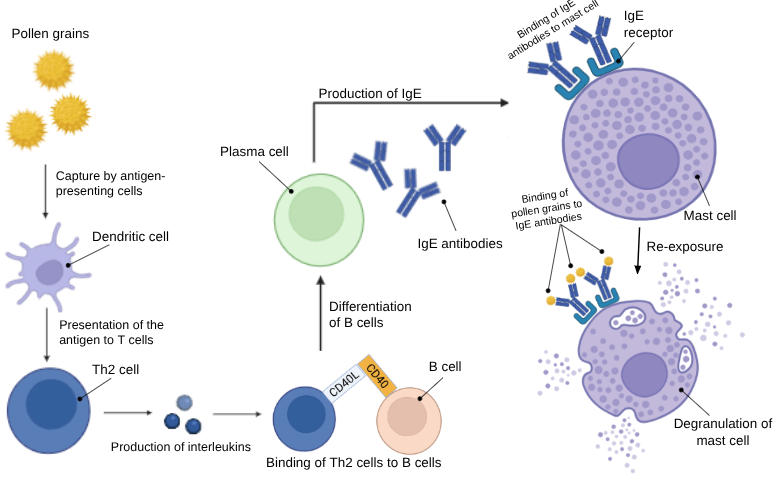 |
|---|
In spite of these health risks, pollen acts as the basis of plant reproduction. In flowering plants known as angiosperms, the flower makes up a plant’s reproductive system, containing both male and female structures, respectively known as the stamen and pistil. The stamen is made up of the pollen-producing structure called the anther, atop its supporting structure, the filament. The pistil is made up of three major parts: the stigma, to which pollen binds; the supporting structure known as the style, and the ovary at the base of the pistil, where the fertilization and formation of seeds occurs (Figure 2). Pollen grains contain male gametes, and after its release from the anther, the pollen interacts with the stigma of neighboring flowers or plants, allowing it to travel down to the ovaries to begin the process of fertilization (VanDerZanden, 2008).
| Figure 2: Anatomy of the flower. | 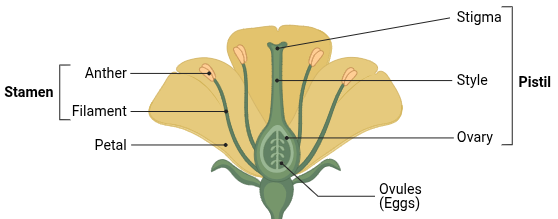 |
|---|
To successfully carry out such a process, proteins within pollen play several key, non-allergenic roles: in plant development, they support male gamete development; in fertilization, they enable pollen to recognize and bind to female tissue from plants of the same species, and they facilitate the development of the pollen tube, or the structure by which male sperm travel from the pollen grain to the ovaries, as well as enable the subsequent penetration of the stigma by the pollen tube; and to maintain plant health, they are involved in general metabolic processes within plant cells and contribute to immune responses (Songnuan, 2013; Guryanova et al, 2022). Consequently, simply damaging pollen grains or their proteins could negatively affect the propagation and health of plant species.
Our proposed method offers an approach to selectively alter the binding site of Betula verrucosa allergen 1 (Bet v 1), a major pollen allergen contained within birch pollen grains. Bet v 1 is a member of the pathogenesis-related proteins of class-10 (PR-10), which are members of the plant immune system and are induced in response to biotic stresses such as pathogens, as well as abiotic stresses such as drought and temperature fluctuations. Additionally, PR-10 proteins play a significant role in plant growth and development, as many have been found to contain an internal cavity that functions as a binding site for hydrophobic ligands such as steroids, cytokinin, fatty acids, and flavinoids. These ligands each contribute to stages of plant growth and development, in addition to defense strategies (Sinha et al., 2020). However, when detected by the human immune system, Bet v 1 induces allergic symptoms in over 90% of birch-allergic patients, therefore providing a strong target for relief from birch pollen-related symptoms (Hofer et al., 2017). Our approach utilizes a mutation in the IgE-recognized binding site of Bet v 1 to cause a significant reduction in the binding of Bet v 1 to IgE, thus preventing the release of histamines (Spangfort et al., 2003). Such a mutation will alter position 45 of the Bet v 1 protein, where a single substitution of lysine (Lys) for glutamic acid (Glu) may be introduced via a genetically altered Agrobacterium tumefaciens cell. Wild-type Agrobacterium causes serious disease in plants by detecting signals from wounded plant tissues and introducing segments of its own DNA into the plant, thereby triggering uncontrolled tumor growth. Agrobacterium-mediated transformation is therefore a widely used method for introducing foreign DNA into plant genomes, whereby tumor-inducing (Ti) genes within Agrobacterium are replaced with genes of interest, which are integrated into plant genomes for stable, inheritable modification (Thompson et al., 2020). By replacing pathogenic genes within Agrobacterium with selective CRISPR and DNA templates, we can efficiently introduce a modification in the Bet v 1 allergen of individual birch cells, a modification which will be inherited and integrated in daughter cells as the birch tree grows and matures.
Systems level
The primary objective of this study is to design a method for reducing the allergenicity of birch tree lines, through the modification of the IgE-recognized epitope in Bet v 1, a protein carried within birch pollen that has significant allergenic potential. Our system uses Agrobacterium as a DNA delivery vehicle to make a stable, noninvasive, and whole-plant change in birch plants while preserving pollen function. Agrobacterium naturally transfers genetic information into plants, a harmful process by which the bacteria detects wounded plant tissue and inserts a defined segment of its tumor inducing (Ti) plasmid known as T-DNA into the plant genome, triggering tumor growth. Additionally, Agrobacterium causes the plant to synthesize compounds known as opines, which the bacteria use as a nutrient source (Thompson et al., 2020). This study proposes a single mutation in the IgE-recognized binding site of Bet v 1.This mutation will alter the forty-fifth position of the finished protein, exchanging glutamic acid (Glu), a major amino acid in the p-loop—or glycine-rich loop—of Bet v 1, for lysine (Lys) The p-loop is an exposed structure existing in the center of the major IgE-recognized epitope of Bet v 1, and the negatively charged radical (R) group of Glu45 binds strongly to the slightly positive charge on the IgE antibody (Schmalz et al., 2021). While previous work brings evidence for the reduction of binding between Bet v 1 and IgE upon the substitution of Glu45 for serine (Ser), a neutrally charged amino acid, this work strives to more drastically reduce binding through the use of Lys (Spangfort et al., 2003). Lys has a strong positive charge on its R group, and therefore a substitution of Glu45 for Lys enables immediate electrostatic repulsion between the binding sites of Bet v 1 and IgE. Through the replacement of pathogenic T-DNA fragments contained within Agrobacterium’s Ti plasmids with such a mutation, birch cells may easily be genetically modified and grown into adult trees containing a copy of the mutated Bet v 1 gene. Moreover, due to the singular and highly localized nature of this mutation, this work strives to conserve the natural folding pattern and physiological functions of the protein.
Even with the introduction of a modified allele coding for a nonreactive Bet v 1 protein, affected cells still containing the native Bet v 1 allele will continue to induce symptoms. Therefore, an introduction of an additional plasmid into Agrobacterium will allow for the uptake of a CRISPR-Cas9 system by the cell, which will target and knock out the native Bet v 1 allele, allowing for the exclusive activity of the inserted hypoallergenic gene. Through the propagation and growth of modified cells in the laboratory, adult birch trees which no longer induce allergic symptoms may be grown and introduced into natural environments. (Figure 3).
| Figure 3: Transformation of birch cells via Agrobacterium to enable the acquisition of both a mutated Bet v 1 allele as well as a CRISPR-Cas9 mechanism in order to develop hypoallergenic trees. | 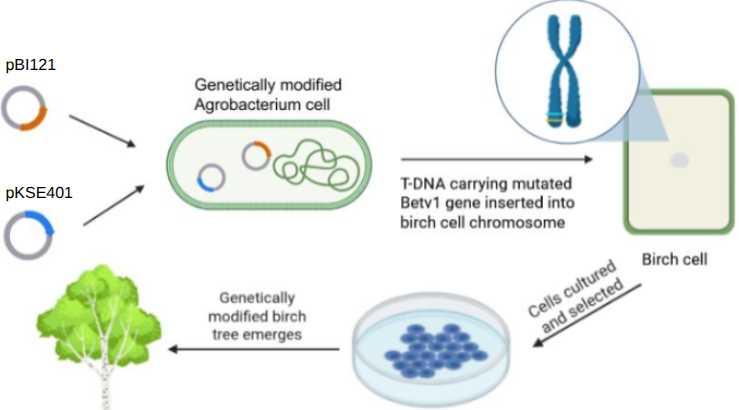 |
|---|
To introduce such constructs, this study utilizes EHA105, a hypervirulent strain of Agrobacterium optimized for high efficiency in plant cell transformation. Birch trees are deciduous, woody species and are naturally far more resistant to bacterial transformation and infection than soft-tissue plants. Therefore, when dealing with birch tissues, EHA105 will exhibit increased efficiency in transformation as compared to more standard, milder strains such as LBA4404 (Maharjan et al., 2025).
Device level
Our device is an integrated genetic program delivered into birch cells using Agrobacterium and two coordinated T-binary vectors. One vector, pBI121, carries the mutated Bet v 1 gene to be incorporated into the plant genome and uses the Cauliflower Mosaic Virus (CaMV) 35S promoter for high-level expression. This promoter, derived from the plant pathogen CaMV, is a well-studied and widely used regulatory element, primarily utilized in genetically modified crops (Amack & Antunes, 2020). Under standard biological conditions, CaMV 35S is constitutively active, continuously promoting the transcription of inserted transgenes by RNA polymerase. This vector also contains neomycin phosphotransferase II (nptII), a bacterial enzyme capable of detoxifying aminoglycoside antibiotics such as kanamycin and G418, as a kanamycin-resistance selectable marker to indicate successful incorporation (Yenofsky et al., 1990). Therefore, the inclusion of nptII in the genetic circuit allows for an antibiotic selection procedure following transformation in order to ensure successful incorporation of the DNA segment. Furthermore, the inclusion of the β-glucuronidase (GUS) reporter system enables the tracking of each birch cell’s incorporation of the pBI121 plasmid independent of the second vector also containing nptII. In this vector, GUS is contained along with the mutated Bet v 1 allele under a single CaMV 35S promoter, and separated by a conserved Porcine teschovirus-1 2A (P2A) sequence (Figure 4A). P2A is a self-cleaving peptide used to efficiently coexpress two proteins contained within a single open reading frame. Including both genetic sequences under a single promoter leads to the expected coexpression of the mutated Bet v 1 allele as well as the GUS reporter protein in a near 1:1 stoichiometric ratio, enabling easy identification of the relative levels of the mutated Bet v 1 protein expressed in the cell.
The second vector, pKSE401, delivers a plant-engineered CRISPR-Cas9 module that expresses Cas9 and a target-specific guide RNA (gRNA) designed to cut the original allergenic Bet v 1 allele. In this vector system, gRNA synthesis is driven by an Arabidopsis thaliana U6-26 (AtU6-26) promoter. This regulatory sequence is often used in plant biotechnology to drive high levels of gRNA expression through the promotion of RNA polymerase III (RNAP III), an enzyme responsible for converting DNA into short, non-coding RNA sequences (Li et al., 2025). The pKSE401 construct also includes an nptII-based selectable marker cassette, allowing selection of cells that received the CRISPR construct (Figure 4B). Together, these components act as one device to add a less IgE-reactive Bet v 1 variant while enabling disruption of the native allergenic allele.
| Figure 4: (A) pBI121: Genetic circuit for the expression of mutated Bet v 1 in birch cells, as well as an antibiotic resistance and GUS reporter gene. (B) pKSE401: Genetic circuit for the expression of a CRISPR-Cas9 construct, including a gene for the expression of a gRNA, a cas9 protein, and antibiotic resistance. Both systems are contained within left border (LB) and right border (RB) sequences, with transcription start sites marked as the +1 nucleotide. (A)’s genetic circuit has been modified from Lal et al., 2024; the mutated Bet v 1 allele was introduced, along with the P2A sequence and GUS reporter system, under the CaMV 35S promoter. (B)’s genetic circuit has been modified from an existing vector proposed by Xing et al., 2014. | 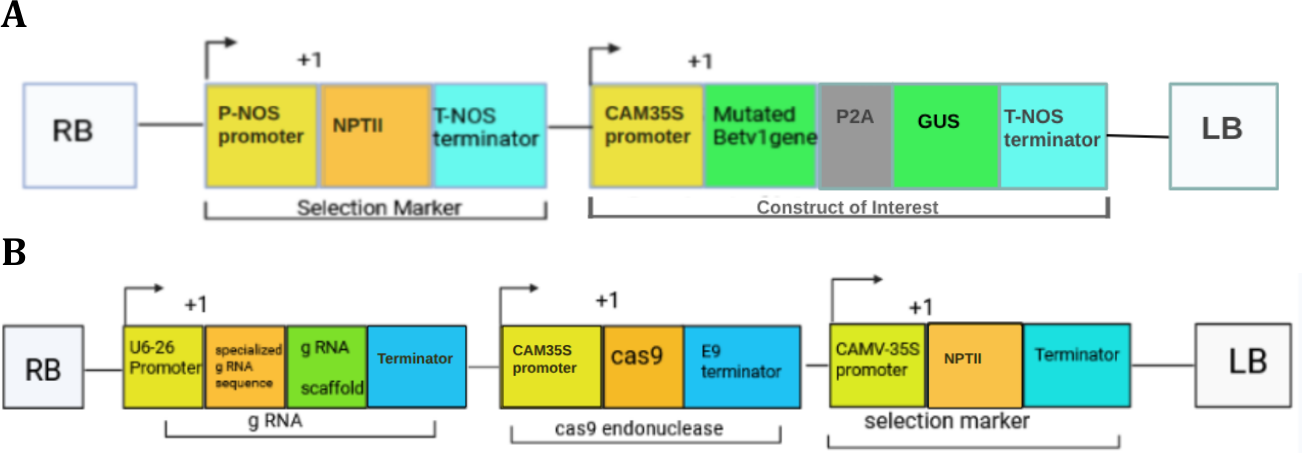 |
|---|
Both genetic fragments of interest are contained within a left border (LB) and right border (RB). The LB and RB are 23-25 base-pair repeats marking the beginning and end of the T-DNA segment, or the segment transferred into a specific plant cell’s genome (Culianez-Macia & Hepburn, 1988). Transfer of T-DNA is always initiated at the RB, when bacterial Vir proteins recognize the sequence and begin cleaving the DNA strand, and terminated at the LB.
Parts level
Our design uses standard plant genetic engineering parts organized within the T-DNA borders—RB and LB—which define the DNA segment transferred into the birch genome. In the pBI121 construct (Figure 4A), the selectable marker cassette is composed of the nopaline synthase promoter (P-NOS), the nptII gene conferring antibiotic resistance against kanamycin, and the T-NOS terminator, while the construct of interest contains the CaMV 35S promoter, the mutated Bet v 1 gene, and a T-NOS terminator. The mutated Bet v 1 gene includes a mutation in the forty-sixth codon sequence, which naturally translates to glutamic acid (Glu). This codon sequence is defined by the nitrogenous bases guanine (G) followed by two adenines (A) in the coding strand of DNA (Hoffmann-Sommergruber et al., 1997). This study proposes a single-base mutation substituting the native GAA sequence with AAA, a codon sequence resulting in the addition of lysine (Lys) to the translated amino acid chain in place of Glu. Thus, when the mutated Bet v 1 gene is transcribed and translated, it will result in a modified protein containing Lys in the critical p-loop of the IgE-recognized epitope. As stated previously, this mutation will result in electrostatic repulsion between the now positively charged binding sites of IgE and Bet v 1, reducing binding.
In the pKSE401 construct (Figure 4B), the guide RNA unit uses the U6-26 promoter to drive the expression of a target-specific gRNA sequence and the gRNA scaffold, followed by a terminator. The CRISPR nuclease cassette uses the CaMV 35S promoter to express Cas9, followed by the E9 terminator. Finally, pKSE401 includes a plant selection cassette consisting of the CaMV 35S promoter, nptII, and a terminator. The CRISPR-Cas9 mechanism has been engineered to selectively target the native Bet v 1 allele, coding for a protein with strong allergenicity in humans. Analysis of the genetic sequence of Bet v 1 has resulted in the location of several protospacer adjacent motif (PAM) sequences within 10 base pairs downstream of the proposed mutation. PAM sequences are 2-5 base-pair sequences of DNA located downstream of the target DNA and are needed for the binding of a Cas protein prior to cutting the DNA strands (Gleditzsch et al., 2019). Following binding of Cas to the PAM sequence, successful binding of the gRNA molecule, through complementary base-pairing, to the DNA sequence directly upstream of the PAM sequence is needed to initiate the cleavage of the DNA molecule. Due to the presence of several PAM sequences downstream of the intended mutation site, a gRNA molecule may be engineered to successfully bind to the native DNA sequence containing the GAA codon for Glu and knock out the allergenic allele, while failing to bind to the mutated DNA sequence containing the AAA codon for Lys. This way, the protection of the mutated allele during gene knockout may be ensured.
Safety
This research involves the modification of a major birch pollen allergen through the infection of undifferentiated birch cells with genetically engineered Agrobacterium. While established procedures have been set in place to enable the noninvasive modification of Bet v 1 and the preservation of physiological roles Bet v 1 plays in birch pollen, potential unexpected effects of this method have not yet been measured. Concerns have already been raised regarding the long-term negative environmental impact of genetically modified organisms. Indeed, such organisms may reduce biodiversity in environments into which they are introduced and unintended developmental effects in genetically modified birch trees may lead to further complications (Gartland et al., 2003).
A further concern lies in the possibility of horizontal gene transfer (HGT) of antibiotic resistance from modified birch trees to soil bacteria and other nontarget species. HGT is the acquisition of DNA by species from the surrounding environment rather than from a parental donor (Keese, 2008). As genetically modified plant species shed leaves, pollen, root cells, and other tissue cells into the surrounding soil, the decay of such components may result in the uptake of the plant’s DNA sequences by various competent soil-living bacteria. Due to the inclusion of nptII as an antibiotic selection marker in this study, there is a theoretical risk that surrounding soil bacteria could acquire antibiotic resistance through this pathway. Nevertheless, in light of current scientific evidence, the risk of adverse effects as a result of HGT is negligible. In order for transferred antibiotic resistance to persist in a bacterial population, several barriers must first be overcome: the trait must be uptaken by a soil-living bacterium, stably integrated into the bacterial genome, and inherited by offspring (van Elsas & Bailey, 2002). Furthermore, nptII must confer a distinct selective advantage in order to drive its spread throughout the bacterial population, a condition unlikely to be met due to the preexisting presence of kanamycin resistance in soil environments. Even so, long-term monitoring of genetically modified populations and consistent testing of surrounding soil and bacteria will ensure the continued health of ecosystems into which these birch populations are introduced.
Because trees spread their seeds over large areas and by multiple methods, monitoring genetically modified trees and their progeny presents a significant challenge. Consequently, determining long-term effects of such organisms prior to their widespread establishment will be nearly impossible. Therefore, extensive testing of modified trees must take place prior to introduction in natural environments. Initial introduction of genetically modified birch trees into controlled greenhouse environments may provide a beneficial strategy for evaluating ecological impacts of and potential risks involved in the trees’ release.
Risk evaluation requires the introduction of control lines in order to determine that phenotypic changes in genetically modified birch cells occurred exclusively due to the replacement of the native Bet v 1 gene with the mutated variant. For example, birch cells may undergo Agrobacterium-mediated transformation for the uptake of the native, non-mutated Bet v 1 gene contained within the same vector backbone, pBI121. Such a procedure will ensure that stress as a result of the transformation process did not induce the observed biological changes in modified cells. Additionally, a group transformed with non-targeting gRNA—gRNA that cannot bind to a segment of the host cell’s genome—may further determine whether specific results are caused by the introduction of a foreign mechanism into the birch cells and the resulting stress response, or by the modification of the target gene. Lastly, an edited line transformed with functional CRISPR-Cas9 machinery that can knock out the native gene, but lacking a replacement construct, will isolate and reveal the effects of the Bet v 1 knockout alone and determine the relative necessity of the introduction of a replacement construct.
A further consideration of this study is the presence of unmodified birch populations in the environment. Our system does not enable a method for modifying adult trees; rather, it allows the generation of hypoallergenic trees from engineered and undifferentiated birch cells. Thus, careful and gradual introduction of modified birch trees must be observed to avoid disrupting native populations.
Discussions
This work presents a novel design for modifying Bet v 1 allergens causing birch pollen-related symptoms. While the singular and highly localized nature of this design attempts to maintain the protein’s natural and key function within birch pollen and reproduction, further assays are required to determine unintended effects of this design on birch tree health. To modify Bet v 1 and reduce its allergenicity, this design utilizes Agrobacterium, a species of bacteria that has the ability to insert defined segments of its T-DNA into plant genomes (Thompson et al., 2020). A single mutation in the IgE-recognized epitope of Bet v 1 has been proven to significantly reduce the binding affinity between IgE and Bet v 1, and consequently inhibit histamine release during immune response (Spangfort et al., 2003). In a unique use of Agrobacterium-mediated transformation, we also propose an introduction of both a CRISPR-Cas9 mechanism designed to knock out the native allergenic allele, as well as an nptII gene conferring antibiotic resistance, allowing us to identify successfully transfected cells during subsequent antibiotic selection.
This study provides a framework that could be extended to other remediation strategies as well. The most direct application would involve the remediation of other pollen-producing species. Using a similar two-plasmid system, hundreds of different plant cells may be genetically altered, producing hundreds of hypoallergenic variants of species. However, such ambitions are complicated due to the lack of knowledge regarding such species. While the relatively small genome of birch trees enabled researchers to sequence and analyze the genomes of Betula pendula (silver birch), Betula platyphylla (Asian white birch), and other species of such genus, the genomes of hundreds of plant types remain unmapped, and their main allergens have not yet been identified (Chen et al., 2021). Furthermore, birch tree allergens are highly specific, driven mainly by the dominant protein Bet v 1, while other species have a broader mix of proteins playing both major and minor roles in the immune cascade and thus require multiple solutions for remediation (Hofer et al., 2017). A further extension of this study could relate to genetically engineering allergens contained within foods. However, as food allergies can be fatal, extensive testing would be required to ensure products may be safely consumed by individuals susceptible to the target allergens, as well as to ensure that the silencing of food allergens does not lead to harmful mutations or alterations within the plant (Grover et al., 2014). Occasionally, genetically modified foods can produce proteins which fold into a specific shape or have an amino acid sequence resembling that of an allergen’s epitope. Consequently, when consumed by sensitized individuals, such foods can trigger painful and potentially fatal immune responses (Fairlie-Clarke et al., 2009). This immune cross-reactivity presents a significant barrier to genetically modified crops and is combatted by laws requiring extensive testing and screening before such foods may become available to the public.
The primary application of this model relates to public health, focusing on reducing unnecessary and burdening seasonal allergies, specifically in relation to Bet v 1 in birch pollen. By modifying birch cell cultures and artificially inducing the differentiation of such cells and the growth of birch trees in the laboratory, this methodology proposes an exciting possibility of the introduction of hypoallergenic trees into populated areas. Especially applicable to places that are densely populated—such as urban environments—on a large scale, this introduction could contribute to a decrease in exposure to a major environmental allergen. As mentioned above, proper extension of this study may lead to genetic modification of flowering plants of all different species to allow safer enjoyment of the outdoors.
Despite its promise, this model is only conceptual and requires further development. No tests have yet determined the efficacy of this system in reducing birch pollen-related symptoms, and several factors must be addressed before practical implementation. While our design proposes a nondisruptive method of modifying birch pollen allergens, the long-term effects, both on the protein and on the plant itself, of a mutation in Bet v 1 are largely unknown and must be evaluated prior to the trees’ introduction to natural settings. Such effects may include a disruption in the folding pattern and shape of the Bet v 1 protein, dangerous cross-reactivity with other food and environmental allergens, and an impairment in plant growth, reproductive capacity, and ability to defend against biotic and abiotic stressors. Additional focus must also be placed on the safe transfection and growth of birch cells to maximize the fitness of genetically modified birch trees and ensure their survival outside of a laboratory setting. While largely uninvasive, Agrobacterium-mediated transformation may impose stress on cells, including oxidative stress, tissue necrosis, senescence, or even premature cell death, all resulting from plant defense pathways in response to infection by Agrobacterium (Dan et al., 2015). Further implementation of protective protocols, such as the introduction of antioxidative compounds, may benefit this study by significantly increasing the efficacy of Agrobacterium-mediated transformation. Additionally, the use of specific antibiotics to target Agrobacterium and inhibit its propagation following the transformation process will prevent cells from excessive stress due to Agrobacterium over growth (Ali et al., 2012). Finally, while this model proposes a method for growing hypoallergenic birch tree lines, it does not consider existing, full-grown trees, which will still produce pollen and induce allergic symptoms regardless of the introduction of hypoallergenic trees into the environment.
Next steps
Our immediate next step includes several tests to determine the effects of the Glu-Lys mutation and exploring alternative mutations in order to optimize the effects on Bet v 1 allergenicity. A single nucleotide substitution within the coding region for such a residue presents a relatively efficient way of significantly impacting the binding activity between Bet v 1 and IgE; however, future assays are necessary to determine the most efficient, safe, and effective mutation that will achieve the goals of this study while minimizing adverse impacts on the physiological role of Bet v 1. In vitro assays, such as circular dichroism (CD) spectroscopy and thermal shift assays, may determine whether the introduced mutation and gene knockout unintentionally caused a decrease in protein stability and folding. CD measures the difference between the absorption of left-handed (LCD) and right-handed (RCD) circularly polarized light as it passes through an asymmetric molecule such as a protein, charting the results on a CD graph (Rodger et al., 2005). Significant differences between the CD graph of the mutated Bet v 1 variant compared to the wild-type protein will demonstrate a failure in maintaining the natural shape and structural backbone of the protein. Similarly, a thermal shift assay will determine the precise temperature at which the mutated Bet v 1 protein denatures, a measure that may be compared to that of wild-type Bet v 1. A reduced denaturation temperature relative to that of wild-type Bet v 1 will demonstrate that the introduced mutation caused structural instability in the protein. These tests are necessary for preserving native protein shape and function, and will allow only variants maintaining proper structure to be selected for subsequent transformation experiments.
Following such optimization, long-term stability of transfected birch cells may be examined. Assessments will evaluate birch cell viability under varying environmental stressors, such as temperature shifts and exposure to foreign chemicals. These studies may expand both the functionality and the adaptability of this system, allowing for faster, more cost-effective methods of growing hypoallergenic trees.
Author contributions
NJ wrote the Background section; AF wrote the Systems, Safety, and Next steps sections; EG wrote the Device and Parts sections; and AS wrote the Discussions section. AF edited the manuscript. RS created the figures based on AF’s design. While AF and EG led the group and designed the system, all members attended meetings and contributed to each stage of the project.
Acknowledgements
We would like to thank Scott Gaines for mentoring us for the past three years. We would also like to thank our advisor, Maria Lazebnik, for helping us discuss and refine our project ideas.
References
Abbas, M., & Goldin, J. (2025, August 3). Type I hypersensitivity reaction. StatPearls – NCBI Bookshelf. https://www.ncbi.nlm.nih.gov/books/NBK560561/
Ali, S., Mannan, A., Oirdi, M. E., Waheed, A., & Mirza, B. (2012). Agrobacterium-mediated transformation of rough lemon (Citrus jambhiri Lush) with yeast HAL2 gene. BMC Research Notes, 5(1), 285. https://doi.org/10.1186/1756-0500-5-285
Allergy Statistics | AAAAI. (n.d.). https://www.aaaai.org/about/news/for-media/allergy-statistics
Amack, S., & Antunes, M. (2020, December). CAMV35S Promoter – a plant biology and biotechnology workhorse in the era of synthetic biology. Current Plant Biology. https://doi.org/10.1016/j.cpb.2020.100179
Chen, S., Wang, Y., Yu, L., Zheng, T., Wang, S., Yue, Z., et al. (2021). Genome sequence and evolution of Betula platyphylla. Horticulture Research, 8, 37. https://doi.org/10.1038/s41438-021-00481-7
Culianez-Macia, F. A., & Hepburn, A. G. (1988). Right-border sequences enable the left border of an Agrobacterium tumefaciens nopaline Ti-plasmid to produce single-stranded DNA. Plant Molecular Biology, 11(4), 389–399. https://doi.org/10.1007/bf00039019
Dan, Y., Zhang, S., Zhong, H., Yi, H., & Sainz, M. B. (2015). Novel compounds that enhance Agrobacterium-mediated plant transformation by mitigating oxidative stress. Plant Cell Reports, 34, 291–309. https://doi.org/10.1007/s00299-014-1707-3
Doral Health & Wellness. (2025, December 12). Are your allergies getting worse every year? How climate change is supercharging pollen season. Doral Health & Wellness. https://doralhw.org/are-your-allergies-getting-worse-every-year-how-climate-change-is-supercharging-pollen-season/
Fairlie-Clarke, K. J., Shuker, D. M., & Graham, A. L. (2009). Why do adaptive immune responses cross-react?. Evolutionary applications, 2(1), 122–131. https://doi.org/10.1111/j.1752-4571.2008.00052.x
Gartland, K. M. A., Crow, R. M., Fenning, T. M., & Gartland, J. S. (2003). Genetically modified trees: Production, properties, and potential. Arboriculture & Urban Forestry, 29(5), 259–266. https://doi.org/10.48044/jauf.2003.030
Gleditzsch, D., Pausch, P., Müller-Esparza, H., Özcan, A., Guo, X., Bange, G., & Randau, L. (2019). PAM identification by CRISPR-Cas effector complexes: diversified mechanisms and structures. RNA biology, 16(4), 504–517. https://doi.org/10.1080/15476286.2018.1504546
Grover, A., Ashhar, N., & Patni, P. (2014). Why genetically modified food need reconsideration before consumption?. Journal of family medicine and primary care, 3(3), 188–190. https://pmc.ncbi.nlm.nih.gov/articles/PMC4209668/
Guryanova, S. V., Finkina, E. I., Melnikova, D. N., Bogdanov, I. V., Bohle, B., & Ovchinnikova, T. V. (2022). How do pollen allergens sensitize? Frontiers in Molecular Biosciences, 9, 900533. https://doi.org/10.3389/fmolb.2022.900533
Hofer, H., Asam, C., Hauser, M., Nagl, B., Laimer, J., Himly, M., Briza, P., Ebner, C., Lang, R., Hawranek, T., Bohle, B., Lackner, P., Ferreira, F., & Wallner, M. (2017). Tackling Bet v 1 and associated food allergies with a single hybrid protein. Journal of Allergy and Clinical Immunology, 140(2), 525–533.e10. https://doi.org/10.1016/j.jaci.2016.09.055
Hoffmann-Sommergruber, K., Vanek-Krebitz, M., Radauer, C., Wen, J., Ferreira, F., Scheiner, O., & Breiteneder, H. (1997). Genomic characterization of members of the Bet v 1 family: genes coding for allergens and pathogenesis-related proteins share intron positions. Gene, 197(1-2), 91–100. https://doi.org/10.1016/s0378-1119(97)00246-1
Keese P. (2008). Risks from GMOs Due to Horizontal Gene Transfer. Environ. Biosaf. Res. 7 (3), 123–149. https://doi.org/10.1051/ebr:2008014
Lal, S., Kumar, V., Gupta, U., Sushma, Shirke, P. A., & Sanyal, I. (2024). Overexpression of the chickpea Metallothionein 1 (MT1) gene enhances drought tolerance in mustard (Brassica juncea L.). Plant Cell Tissue and Organ Culture (PCTOC), 157(1). https://doi.org/10.1007/s11240-024-02737-1
Li, F., Xue, M., Guo, D., Zhu, L., Li, Y., & Xie, L. (2025). A Truncated Endogenous U6 Promoter Enables High-Efficiency CRISPR Editing in Flax (Linum usitatissimum L.). Plants, 14(7), 1142. https://doi.org/10.3390/plants14071142
Liu, A., Sheng, W., & Tang, X. (2024). Atmospheric pollen concentrations and chronic obstructive pulmonary disease (COPD) patients visits in Beijing: Time series analysis using a generalized additive model. Scientific Reports, 14, 3462. https://doi.org/10.1038/s41598-024-54055-3
Maharjan, B. K., Islam, M. T., Muzaffar, A., Tschaplinski, T. J., Tuskan, G. A., Chen, J., & Yang, X. (2025). Woody Plant Transformation: current status, challenges, and future perspectives. Plants, 14(22), 3420. https://doi.org/10.3390/plants14223420
Neumann, J. E., Anenberg, S. C., Weinberger, K. R., Amend, M., Gulati, S., Crimmins, A., Roman, H., Fann, N., & Kinney, P. L. (2019). Estimates of present and future asthma emergency department visits associated with exposure to oak, birch, and grass pollen in the United States. GeoHealth, 3(1), 11–27. https://doi.org/10.1029/2018GH000153
Rodger, A., Marrington, R., Roper, D., & Windsor, S. (2005). Circular dichroism spectroscopy for the study of protein-ligand interactions. Methods in molecular biology (Clifton, N.J.), 305, 343–364. https://doi.org/10.1385/1-59259-912-5:343
Schmalz, S., Mayr, V., Shosherova, A., Gepp, B., Ackerbauer, D., Sturm, G., Bohle, B., Breiteneder, H., & Radauer, C. (2021). Isotype-specific binding patterns of serum antibodies to multiple conformational epitopes of Bet v 1. Journal of Allergy and Clinical Immunology, 149(5), 1786-1794.e12. https://doi.org/10.1016/j.jaci.2021.10.026
Sinha, R. K., Verma, S. S., & Rastogi, A. (2020). Role of Pathogen-Related Protein 10 (PR 10) under Abiotic and Biotic Stresses in Plants. Phyton, 89(2), 167–182. https://doi.org/10.32604/phyton.2020.09359
Songnuan, W. (2013). Wind-pollination and the roles of pollen allergenic proteins. Asian Pacific Journal of Allergy and Immunology, 31(4), 261–270 https://pubmed.ncbi.nlm.nih.gov/24383968/
Spangfort, M. D., Mirza, O., Ipsen, H., van Neerven, R. J. J., Gajhede, M., & Larsen, J. N. (2003). Dominating IgE-binding epitope of Bet v 1, the major allergen of birch pollen, characterized by X-ray crystallography and site-directed mutagenesis. The Journal of Immunology, 171(6), 3084–3090. https://doi.org/10.4049/jimmunol.171.6.3084
Thompson, M. G., Moore, W. M., Hummel, N. F. C., Pearson, A. N., Barnum, C. R., Scheller, H. V., & Shih, P. M. (2020). Agrobacterium tumefaciens: A bacterium primed for synthetic biology. BioDesign Research, 2020, 8189219. https://doi.org/10.34133/2020/8189219
VanDerZanden, A. M. (2008). Reproductive Plant Parts. Ag – Community Horticulture/Landscape. https://extension.oregonstate.edu/gardening/techniques/reproductive-plant-parts
van Elsas, J. D., & Bailey, M. J. (2002). The ecology of transfer of mobile genetic elements. FEMS microbiology ecology, 42(2), 187–197. https://doi.org/10.1111/j.1574-6941.2002.tb01008.x
Wang, R., Lan, C., Benlagha, K., Olsen, N., Miller, H., Kubo, M., Heegaard, S., Lee, P., Yang, L., Forsman, H., Li, X., Zhai, Z., & Liu, C. (2024). The interaction of innate immune and adaptive immune system. MedComm, 5(10). https://doi.org/10.1002/mco2.714
Xing, H., Dong, L., Wang, Z., Zhang, H., Han, C., Liu, B., Wang, X., & Chen, Q. (2014). A CRISPR/Cas9 toolkit for multiplex genome editing in plants. BMC Plant Biology, 14(1), 327. https://doi.org/10.1186/s12870-014-0327-y
Yenofsky, R. L., Fine, M., & Pellow, J. W. (1990). A mutant neomycin phosphotransferase II gene reduces the resistance of transformants to antibiotic selection pressure. Proceedings of the National Academy of Sciences, 87(9), 3435–3439. https://doi.org/10.1073/pnas.87.9.3435